| Dimensions | 120 mm |
|---|---|
| Focal Length (mm) | |
| Max Aperture (f) | |
| Aperture Blades | |
| Elements | |
| Rear Mount | |
| Front Thread |
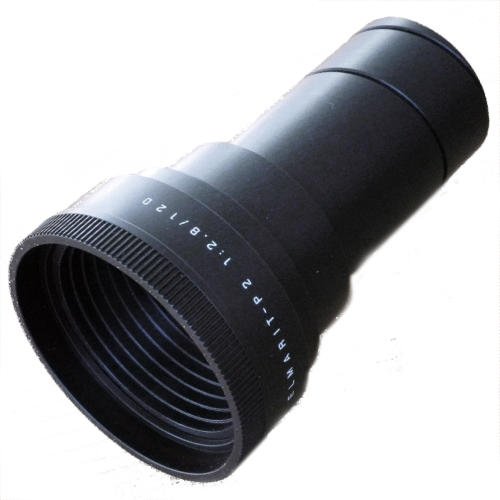




Leica Elmarit-P2 120/2.8
Black polycarbonate-barrel slide projector lens. Multicoated. Probably same optical formula as Elmarit-P: reflections and bokeh suggest triplet, but certainly three-group.
Reviews
Related to . . .

Related products
-

Benoist Berthiot 75/2.8
Compare -
Appro 100-225/4
Compare -
Benoist Berthiot 90/2.8
Compare -
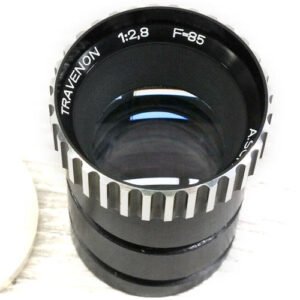
A. Schacht Travenon 85/2.8
Compare -

Airequipt Luminac 100/3.5
Compare -
Apollo 85-150/3.5
Compare -
Bell & Howell Trionar 100/3.5
Compare -
Pentacon AV 200/4
Compare -
Benoist Berthiot 90/2.5
Compare -
Argus Projection 100/3.5
Compare -
Agfa Agomar 90/2.8
Compare -
Agfa Agomar 85-150/4
Compare -
Pentacon AV 150/2.8
Compare -
Agfa Color-Agolar 60/2.8
Compare -
Braun Color-Autogon 85/2.8
Compare -
Benoist Berthiot 110/2.4
Compare -
Agfa Color-Agolar 250/4.5
Compare -
Arsenal Triar-3 85/2.8
Compare -
Aldis Anastigmat 152/4
Compare -
Apollo 100-150/3.5
Compare -
Apollo 90/2.8
Compare -
Arsenal Triar-1 150/3.5
Compare -
Aldis Tele-Projection 250/3.5
Compare -
Aldis Projection 100/3.2
Compare -
Aldis Anastigmat 85/2.5 [V1]
Compare
16:9 –
The legacy of the Leica 120mm projector lens stretches back to the original Hektor. It is likely that this Elmarit-P2 version is unchanged from the P-mount version. It was certainly redesigned for the metal-barrel Elmarit-Pro. A distinct trio of reflections confirms this is a three-group lens – perhaps no more exotic than a stock air-spaced triplet – a conjecture supported by its notably bubbly bokeh, quite unlike the Colorplans or its 150mm sibling, which are (respectively) clearly, and slightly, sharper. The vagueness around its construction signals not only Leica’s close-fisted stance on releasing production information about their projector lenses, but the equally locked-down construction of these plastic ‘monocoque’ optics that have no visible threads, tool notches, or otherwise apparent means of disassembly. It feels like you’d really have to break one to repair one. On the plus side, sealing the cells like this ensures that you rarely come across an Elmarit-P2 with internal dust or fungus.
Rendition is smooth, with rather more glow, or spherical aberration, than you might expect from Leica glass of the 1990’s. It’s understandable why Leica were keen to completely redesign this lens for the release of the Ektapro-compatible RT and RT-m series.