| Weight | 71 g |
|---|---|
| Dimensions | 90 mm |
| Focal Length (mm) | |
| Max Aperture (f) | |
| Min Aperture (f) | |
| Aperture Blades | |
| Elements | |
| Sharp (Near) | |
| Sharp (Far) | |
| Rear Mount | |
| Flange-Focal Distance (mm @ ∞) | |
| RF/L Extension (mm) |

Reviews
Related to . . .

Related products
-
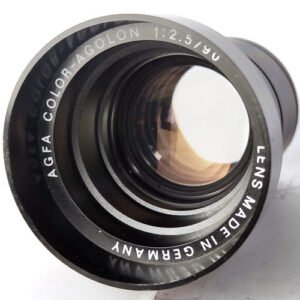
Agfa Color-Agolon 90/2.5
Compare -
Agfa Agomar 70-120/2.8
Compare -
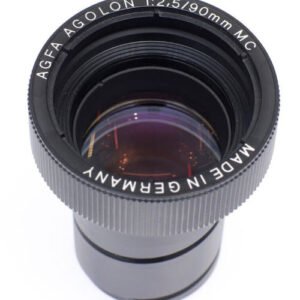
Agfa Agolon 90/2.5
Compare -
Bell & Howell Trionar 100/3.5
Compare -

Agfa Agomar 100/2.5 [V2]
Compare -
Apollo 85-150/3.5
Compare -
Pentacon AV 150/2.8
Compare -
Agfa Agomar 85-150/4
Compare -
Bauer Neovaron 80/2.8
Compare -
AG Optical Trionar 152/3.5
Compare -
Aldis Anastigmat 152/4
Compare -
Benoist Berthiot 125/2.8
Compare -
Argus Projection Anastigmat 100/3.3
Compare -
Agfa Color-Agolar 85/2.8
Compare -
Pentacon AV 200/4
Compare -
Apollo 100-150/3.5
Compare -
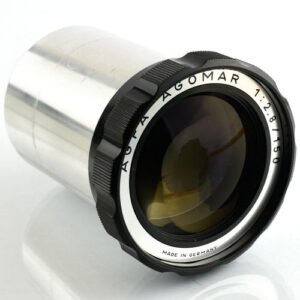
Agfa Agomar 150/2.8 [V2]
Compare -
Benoist Berthiot 60/1.6
Compare -

Airequipt Luminac 100/3.5
Compare -

Argus Projection 100/2.8
Compare -
Aldis Anastigmat 85/2.5 [V1]
Compare -
Benoist Berthiot 75/2.8
Compare -
Ansco 127/3.5
Compare -
Benoist Berthiot 110/2.4
Compare -
Argus Projection 100/3.5
Compare
16:9 –
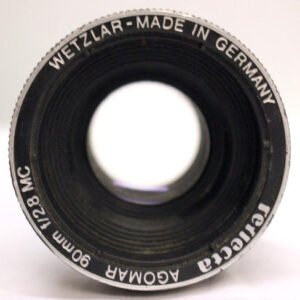
The Agfa Agomar, AKA Reflecta/Wetzlar Agomar 90mm f2.8, is a commonly-available entry-level projector lens that suffers from extreme flare susceptibility and hot-spotting despite its multicoating.
Typically, projector lenses have a sweet spot of high resolution in the centre frame, deteriorating rapidly in the outer image circle. However at distance, the Agomar 90/2.8 only rises to a peak of 6.8, with Zone 3 sinking to 5.9. Near-field shooting flattens Zone 1 resolution to the same low level (6.0) as Zone 3 (5.8). It is consistently soft all over, rendering images with vintage glow and smeared focus transitions, with a thin-walled soap-bubble bokeh typical of a triplet in a well damped barrel. On a 35mm sensor there’s minimal swirling, with cat-eyes developing predictably across an image circle that appears to be at least 55mm in diameter, allowing space for movements or coverage of a medium format sensor – where swirly bokeh would strongly feature. Colours are somewhat muted. As you might expect, the fixed circular ‘aperture’ doesn’t render specular highlights as sunstars.
Few projector lenses of this specification are noteworthy performers, and this one is no exception. In the present market, there’s no difference in price between f2.8 lenses and far more recommendable f2.4 or f2.5 versions.