| Dimensions | 150 mm |
|---|---|
| Focal Length (mm) | |
| Max Aperture (f) | |
| Aperture Blades | |
| Elements | |
| Rear Mount |
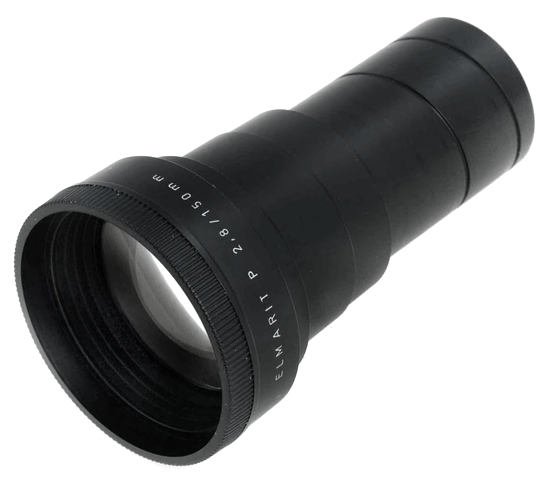




Leica Elmarit-P 150/2.8
Leica slide projector lens (black polycarbonate barrel). [Cat. 37 017].
Reviews
Related to . . .
Related products
-
Agfa Agomar 85/2.8 [V4]
Compare -

Pentacon AV 150/2.8
Compare -
Pentacon AV 200/4
Compare -
Bell & Howell Trionar 100/3.5
Compare -
Agfa Color-Agolar 85/2.8
Compare -
Agfa Color-Agolar 60/2.8
Compare -
Benoist Berthiot 90/2.8
Compare -
Benoist Berthiot 60/1.6
Compare -
Benoist Berthiot 110/2.4
Compare -
Aldis Anastigmat 152/4
Compare -
Agfa Agolar 85/2.5
Compare -
Bell & Howell Trionar 127/4
Compare -
Apollo 90/2.8
Compare -

Agfa Agomar 85/2.5 [V1]
Compare -
Agfa Agomar 90/2.8
Compare -
Agfa Agomar 90/2.4
Compare -
Aldis Tele-Projection 250/3.5
Compare -
Appro 100-225/4
Compare -
Apollo 100-150/3.5
Compare -
Benoist Berthiot 90/2.5
Compare -
Arsenal Triar-1 150/3.5
Compare -

Argus Projection 100/2.8
Compare -
Benoist Berthiot 75/2.8
Compare -
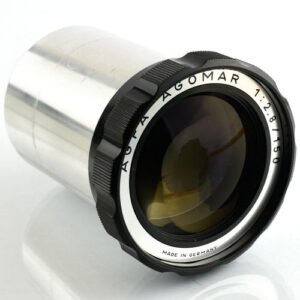
Agfa Agomar 150/2.8 [V2]
Compare -
Arsenal Triar-3 85/2.8
Compare
16:9 –
Though uncomfirmed, it is believed that the Elmarit-P is optically identical to the Elmarit-P2. Leica catalogues of the period are voluble on the benefits of the recent redesign of the Elmarit 120/2.8. Their silence on the origins of the 150/2.8 implies the lens is unchanged in recent history.
The inherent properties of any 150mm f2.8 lens ensure effective subject isolation and background blur, and if it’s blur you’re looking for, the Elmarit-P delivers textbook Leica-smooth bokeh. The relatively short focal-flange distance of this lens makes it more useable than projector optics of similar focal length. The large image circle amply covers 645 (or 36×24 with movements) and on ‘full-frame’ there’s zero mecahnical vignetting or ‘swirl’. For the same reason, sharpness is quite well maintained into Zone C (‘full frame corners’). F2.8 performance is quite good, spoiled only by subtle spherical aberration that would likely vanish if an aperture permitted the lens to be stopped down somewhat. The glow is just within reach of post-production tools, so it’s possible to apply various de-hazing and contrasting enhancements like DXO’s ClearView if the aberration is offensive. Nonetheless, resolution is very good. The Elmarit-P behaves similarly at f2.8 to pro-grade 70-200mm lenses of the early noughties shot wide open – in fact, it’s perhaps a little sharper in the outer image circle than my old Nikon 70-200/2.8 VR II.
Colour is typically a strong suit of Leica glass and the Elmarit-P 150/2.8 doesn’t disappoint, though chromatic aberration is present in the form of LOCA – most noticeable when contributing extra glow to the bokeh fringing. Contrast is moderately strong for a projector lens thanks to 1990’s multicoating, but pleasingly less stark than contemporary taking lenses.
Most samples I’ve seen are clean internally, which is just as well, because the polycarbonate barrel is effectively a one-piece (sealed) construction. If there’s a way to get it apart without breaking it, I’ve not found it.