| Dimensions | 60 mm |
|---|---|
| Focal Length (mm) | |
| Max Aperture (f) | |
| Aperture Blades | |
| Elements | |
| Rear Mount | |
| Front Thread | |
| Production |

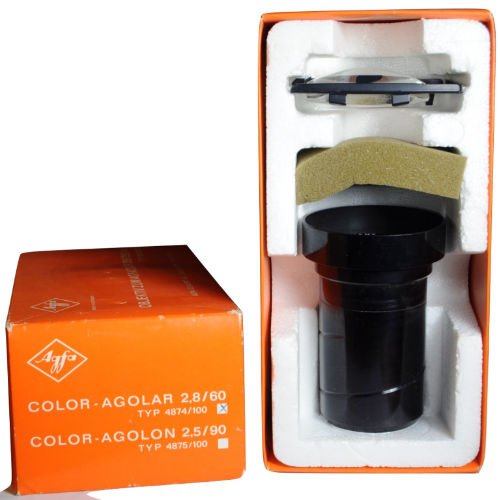


Agfa Color-Agolar 60/2.8
Six-element lens for Agfacolor 250 Series. Black plastic barrel. [Cat 4874/100].
Reviews
Related to . . .
Related products
-

Aldis Uno 200/4.5
Compare -
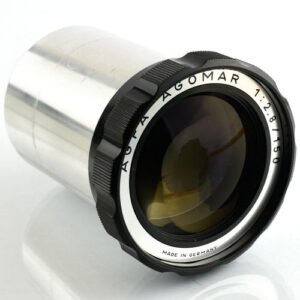
Agfa Agomar 150/2.8 [V2]
Compare -
Bell & Howell Trionar 127/4
Compare -
Aldis Anastigmat 152/4
Compare -
Ansco 127/3.5
Compare -
Apollo 100-150/3.5
Compare -
Benoist Berthiot 90/2.8
Compare -
Bauer Neovaron 80/2.8
Compare -
Benoist Berthiot 75/2.8
Compare -
Bell & Howell Trionar 100/3.5
Compare -
Aldis Projection 100/3.2
Compare -
Benoist Berthiot 90/2.5
Compare -

Argus Projection 100/2.8
Compare -
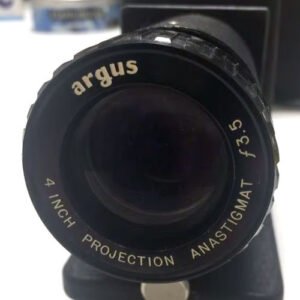
Argus Projection 100/3.5
Compare -
Agfa Color-Agolar 85/2.8
Compare -
Benoist Berthiot 140/2.4
Compare -
Arsenal Triar-1 150/3.5
Compare -
Pentacon AV 200/4
Compare -
Aldis Tele-Projection 250/3.5
Compare -
Agfa Agomar 85-150/4
Compare -
Arsenal Triar-3 85/2.8
Compare -
Agfa Agomar 90/2.4
Compare -
Agfa Agolar 85/2.5
Compare -
Benoist Berthiot 110/2.4
Compare -
Benoist Berthiot 125/2.8
Compare
16:9 –
There are many Agolars but only one Color-Agolar – the shorter 60mm sibling of the Color-Agolon 90/2.5. The Color-Agolar shares the smooth-rendering style of its big brother, and is perhaps a little sharper. Designed for short-throw projection of 35mm and medium format transparencies, it has an unusually long register for a 60mm optic – and a usefully capacious image circle, allowing generous movements on 36x24mm sensors or comfortable coverage of GFX and 645z medium format sensors.
The Color-Agolar’s look is Cooke-like: adequate resolution when in focus, sliding gracefully into harmoniously blended bokeh that never distracts: mechanical vignetting is minimal on 36x24mm by virtue of its compact length and large image circle. Saturation is on the richer side of average but the tonality is soft, with pleasingly low contrast, easily tweaked in post if bolder rendition is preferred. The results may remind some of the Isco/Schneider Cinelux family, but bokeh isn’t quite as creamy-smooth – partly due to the lost stop. However, across-the-frame performance is much more consistent here: the ‘pop’ of Cinelux lenses derives partly from their many aberrations in the outer image circle: this is a much better behaved (and therefore less ‘characterful’) tool.
A desirable but rather uncommon projector lens worth seeking out.