| Dimensions | 140 mm |
|---|---|
| Focal Length (mm) | |
| Image Circle (mm) | |
| Max Aperture (f) | |
| Aperture Blades | |
| Elements | |
| Rear Mount | |
| Front Thread | |
| Serial Numbers | |
| Production |

![Emil Busch 140mm [V2] (GFX uncropped)](https://deltalenses.com/wp-content/uploads/2025/09/emil-busch_neokino-140-render4.webp "emil-busch_neokino-140-render4")
![Emil Busch 140mm [V2] (GFX uncropped)](https://deltalenses.com/wp-content/uploads/2025/09/emil-busch_neokino-140-render3.webp "emil-busch_neokino-140-render3")
![Emil Busch 140mm [V2] (GFX uncropped)](https://deltalenses.com/wp-content/uploads/2025/09/emil-busch_neokino-140-render2.webp "emil-busch_neokino-140-render2")
![Emil Busch 140mm [V2] (GFX uncropped)](https://deltalenses.com/wp-content/uploads/2025/09/emil-busch_neokino-140-render1.webp "emil-busch_neokino-140-render1")
![Emil Busch 140mm [V2] Field Curvature (full-frame GFX)](https://deltalenses.com/wp-content/uploads/2025/09/emil-busch_neokino-140-field-curv.webp "emil-busch_neokino-140-field-curv")
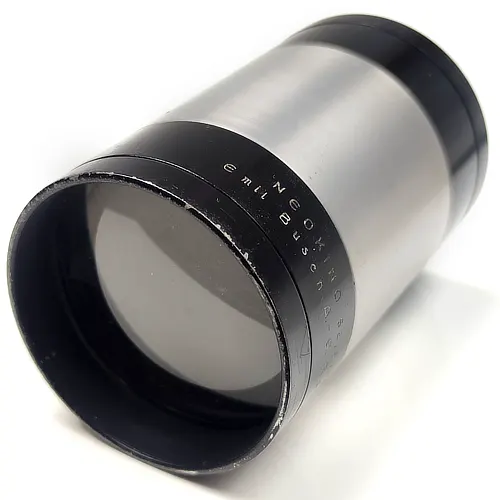
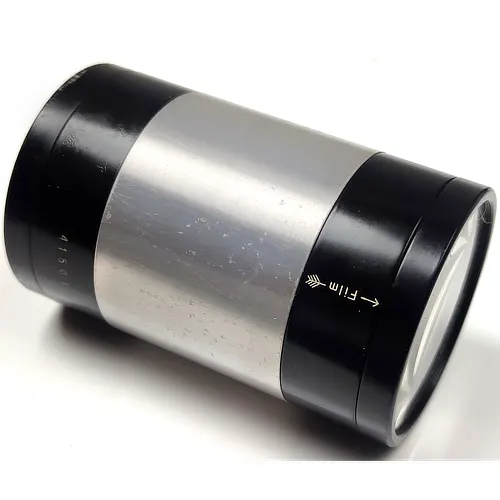
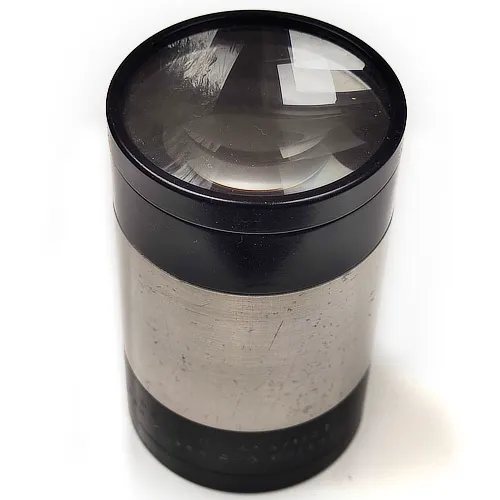
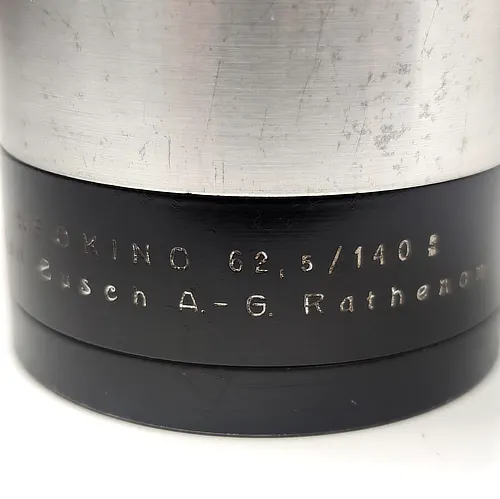
Emil Busch Neokino 140/2.3 [V2]
Petzval cine projector lens marked ‘Emil Busch A-G Rathenow’. [V2] has aluminium (rather than silvered brass [V1]) barrel with black element-holding end-rings. Unmarked aperture estimated.
Reviews
Related to . . .
Related products
-

Bausch & Lomb Baltar 35/2.3
Compare -
Bausch & Lomb Super Baltar 35/2
Compare -
Bausch & Lomb Super Cinephor 108/1.8
Compare -
Bausch & Lomb Super Cinephor 127/2
Compare -
Bausch & Lomb Super Baltar 25/2
Compare -
Bausch & Lomb Baltar 25/2.3
Compare -
Astro-Berlin Pan-Tachar 50/1.8
Compare -
Bausch & Lomb Super Baltar 30/2
Compare -
Astro-Berlin Pan-Tachar 75/2.3
Compare -
A. Schacht Travenon 17/1.4
Compare -
A. Darlot (Paris) 160/3.5
Compare -
Benoist Berthiot Cinestar 75/1.9
Compare -
Angenieux Type 75 90-95/3.5
Compare -
Bausch & Lomb Super Baltar 75/2
Compare -
Bausch & Lomb Cinephor 75/2
Compare -

Bell & Howell Procomat 127/3.5
Compare -
Bausch & Lomb Baltar 18/2.3
Compare -
Angenieux Type 75 164-172/3.5
Compare -
Bausch & Lomb Cinephor 140/1.8
Compare -
Bausch & Lomb Super Cinephor 75/2
Compare -
Bausch & Lomb Baltar 50/2.3
Compare -
Bausch & Lomb Baltar 100/2.3
Compare -
Astro-Berlin Pan-Tachar 125/2.3
Compare -
Bausch & Lomb Super Cinephor 178/1.8
Compare -
Bausch & Lomb Super Cinephor 152/1.8
Compare
16:9 –
Emil Busch Neokino series 35mm projection lenses were launched in 1927 but upgraded in 1935 [V2] to aluminium (rather than silvered brass) barrels and featuring improved illumination. No official aperture designation was given, but rough calculation points to c.f2.3 for this 140mm lens in a 62.5mm barrel. Coverage on GFX is impeccable, with barely any discernable vignetting. The image circle is likely c.130mm in diameter.
The Petzval aplanat scheme (a front cemented doublet and two air-spaced elements at the rear) gives typical rendering. Longer Neokino appear to have less swirl in Zone D bokeh; shorter Neokinos have more. On a 35mm format, little swirl is visible. Similarly, field curvature for these lenses is relatively benign – a textbook dome – but stronger than a modern taking lens: after all, these were made pre-WW2, and designed for projection not capture. All part of its distinctive rendition.
Resolution is low, and only approaches serviceable levels in Zone A and part of Zone B. Chromatic aberration in these central areas is well controlled, though it rears up strongly in Zones C and D. All lenses of this type are one-trick ponies: aberrations in the outer image circle create strong subject separation, providing the in-focus subject falls in Zone A – otherwise the illusion collapses. Although colours are muted and the unocated lens is hugely flare-prone, rendering is pleasingly painterly.
Most samples will have some fungus, haze or scratches but the lens is easy to dismantle and clean: the brass end barrels simply unscrew.