History
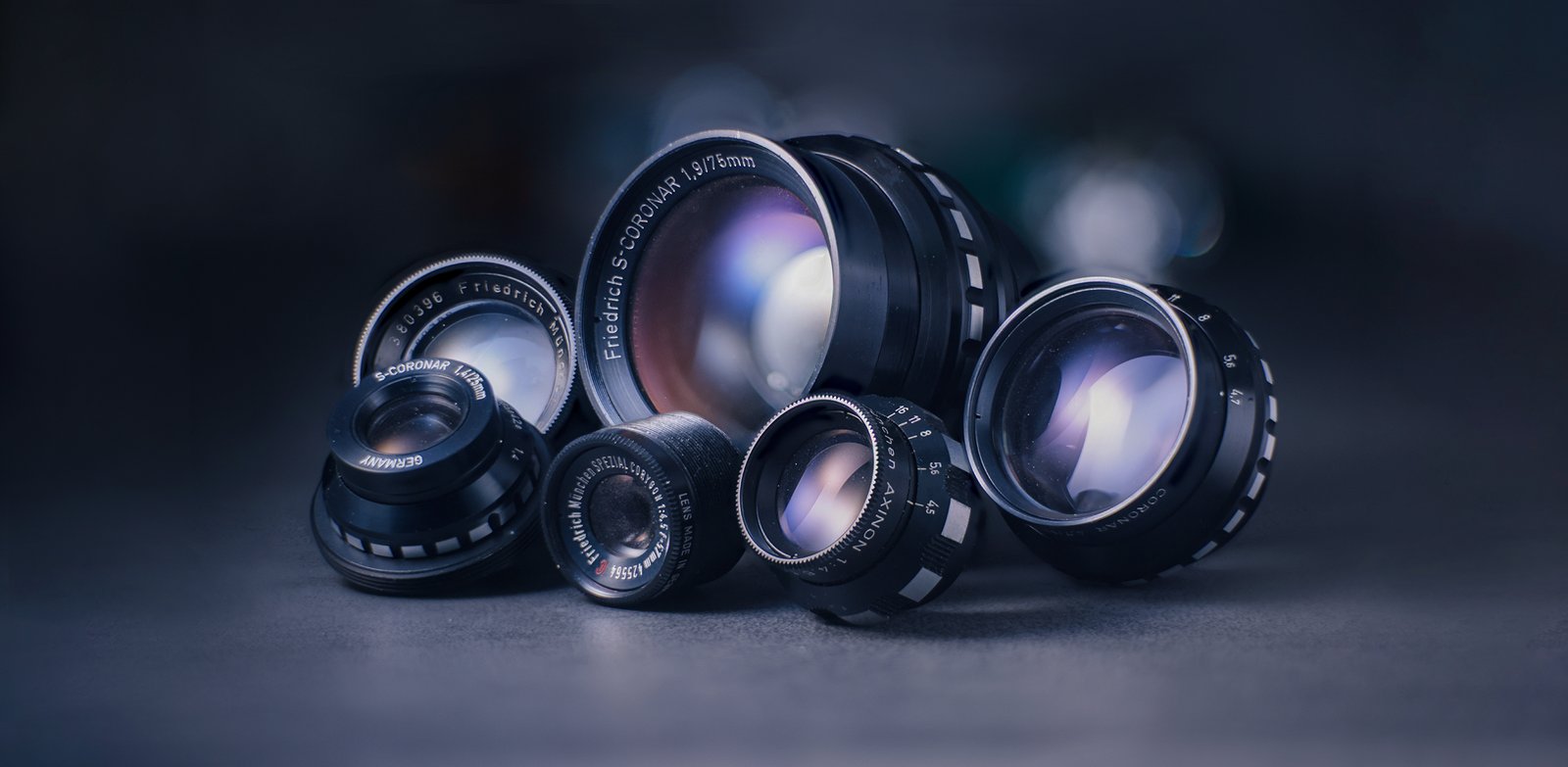
C. Friedrich was a small german manufacturer, based in Munich, which was mainly known for making lenses for plate- and folding cameras in its beginnings. Later on the company seems to have specialized in providing lenses for enlarging and industrial applications, but it never gained any significant name recognition outside of its narrow field.
Christof Friedrich established the company in 1919 as “Fabrik für Objektiv-Fertigung” (Factory for lens-manufacturing). It’s possible – even though not documented anywhere – that he had worked at Liesegang Düsseldorf before. The two companies certainly had a working relationship however as there are lenses with both names engraved and a number of Liesegangs enlargers were equipped with Friedrich lenses.
Collectors and eBay sellers outside central Europe may erroneously refer to the company as ‘Friedrich Munchen’ – misled by the ‘C. Friedrich München’ legend commonly printed on lens fascias. The ‘C.’ easily comes adrift or can be misjudged as a model designator, and the convention of mid-century German manufacturers to attach their home manufacturing district as a suffix to the family name of the maker is sometimes overlooked. See also Will Wetzlar – neither the cousin of Leitz Wetzlar nor the brother of Docter Wetzlar!
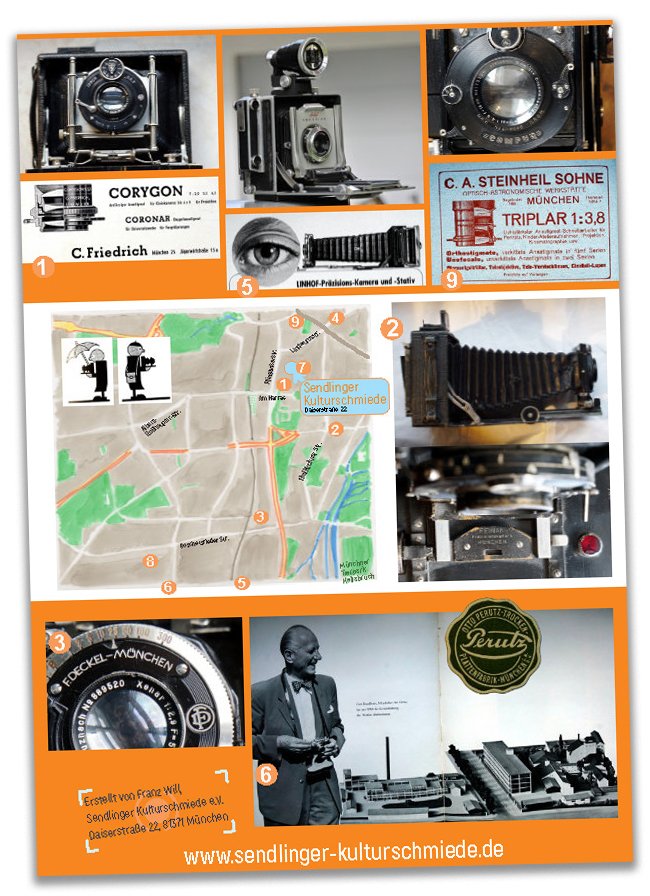
After having moved several times to different locations inside the Bavarian capital, C. Friedrich finally set up shop at Jägerwirtstraße in the district of Sendling in 1929. A culture initiative and photography club from there are among the only ones who have kept some information about that era alive:

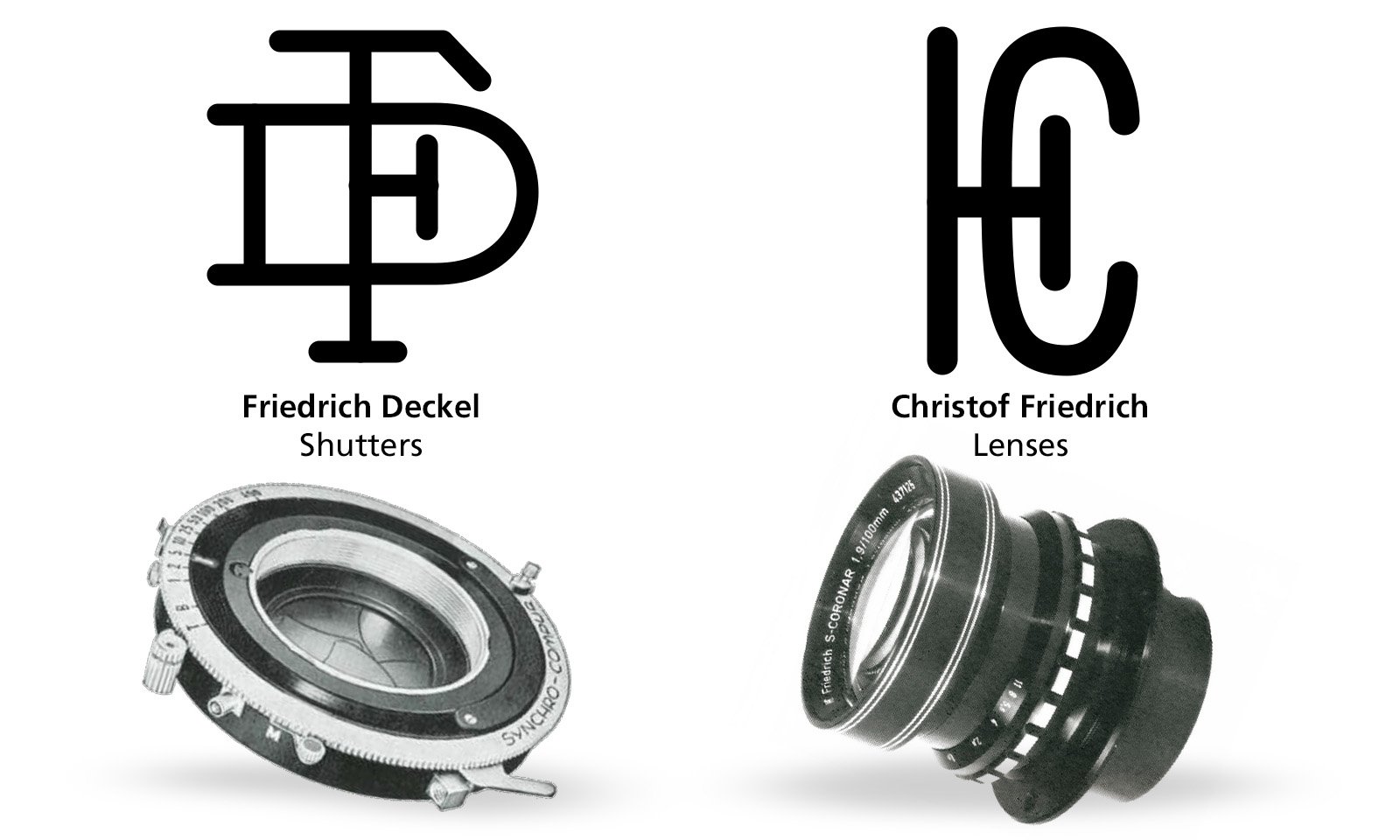
Because of the close proximity and similarity in name to Friedrich Deckel, an important manufacturer of Compur shutters, there has been some confusion online about a possible connection between the two companies. However they are distinctly separate and Friedrich the surname in one, and the first name in the other.
It also doesn’t help that the logos of both companies look somewhat similar as well and that many C. Friedrich lenses were indeed sold in Friedrich Deckel shutters.
There’s little information to be found about C. Friedrich from that early period and apart from the lenses with their own name on them we only know about some contract work for Steinheil, another important name from Munich.
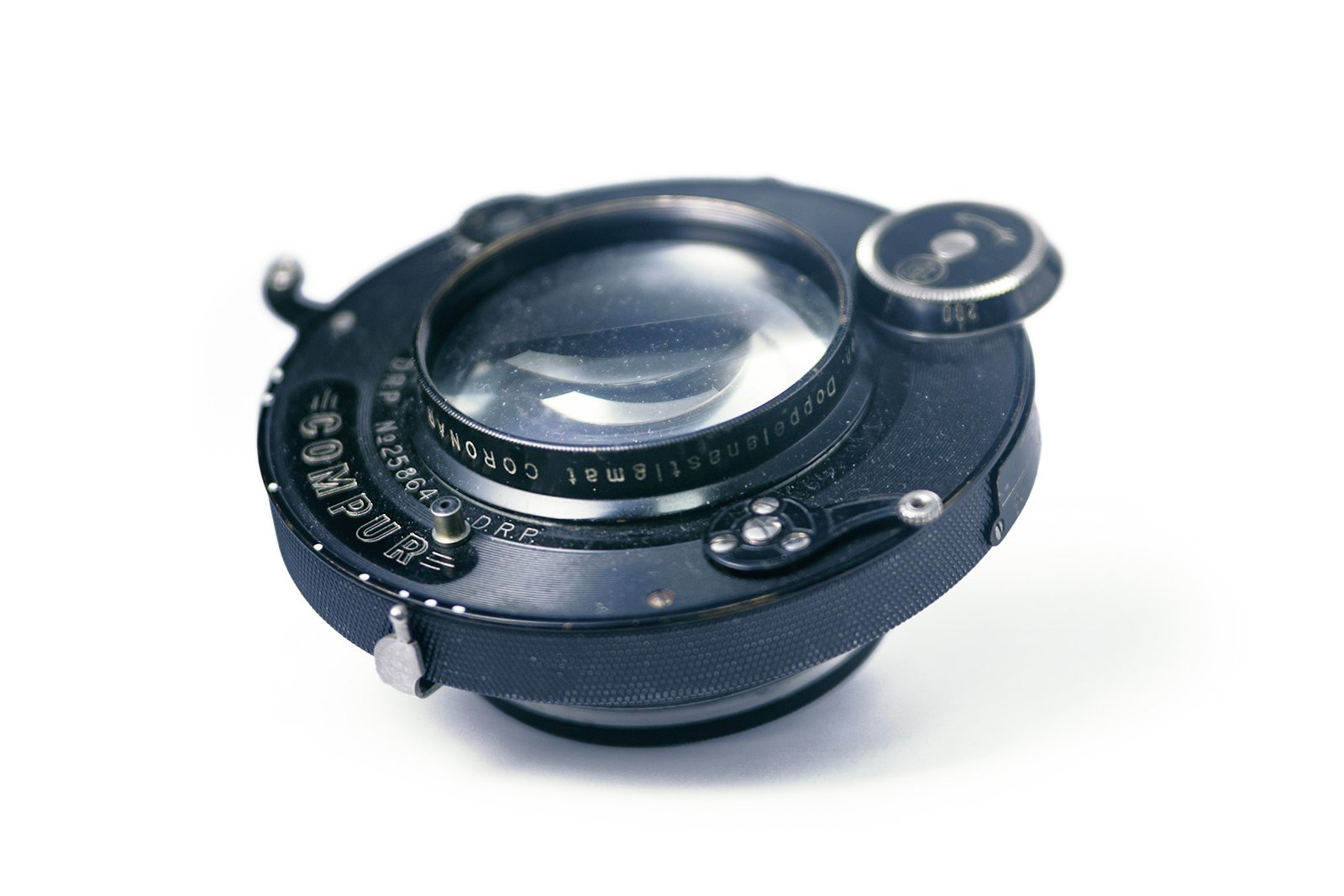
An interesting large format lens, which seems to date back to that era is the Doppelanastigmat Coronar 150/3.5, which an experienced photographer likened to the Xenar Typ-D because of its smooth rendering, making it an effective tool for portraits. From my observations it seems to be a 4 elements in 4 groups (Dialyte) construction though. This is also backed up by the information provided in the book “Kompendium der praktischen Photographie”.

Hartmut Thiele – an expert on many german optics manufacturers – notes in his highly recommended book “Die Deutsche Photoindustrie – Wer war wer”:
The production of enlarging lenses was started in 1936 and represented the biggest line of products after the war. In addition to that Friedrich also manufactured Collimators in the 50s and from 1963 onwards the specialized enlarging lens Vario-Coronar 4.5/135 mm. (translated from German)
Interestingly enough the known lenses they made then (for Liesegang for example) were pretty basic ones still, so cost might have been a factor there as well.
According to Hartmut Thiele the company was sold at the start of the 60s and it’s where things get really interesting. Because the person who bought it was Theodor Brendel, an optics engineer responsible for a number of interesting Agfa and Enna lens patents and an established and experienced figure in the Munich optical scene. He moved part of the company to the small village Gößweinstein in 1965.
At some point between 1962 and 1968 C. Friedrich started supplying specialized enlarging- and projection lenses to Rolyn Optics Company, which was a major supplier of optics for industry in the United States.
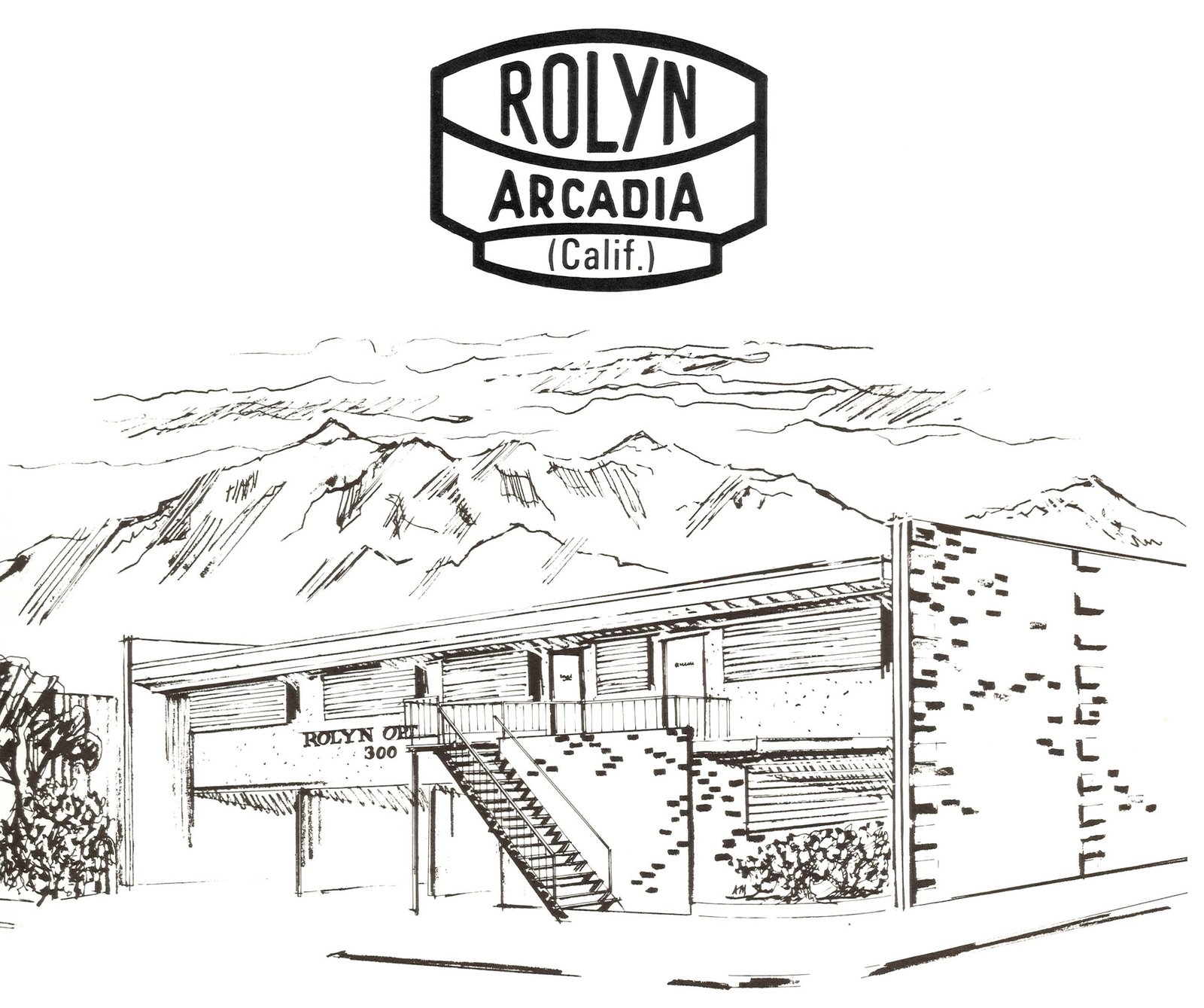
Nikolaus Brendel, the son of Theodor Brendel was very kind and answered a couple of my questions on the company and its barely documented continued work after 1965:
According to him the reason for choosing the Christof Friedrich company name (later Friedrich Optik) was that it was already established and known and initially the Munich workshop was kept open in addition with the newly established one in Gößweinstein. In 1968 the company had a staff of 20 people and in year of 1974 Nikolaus Brendel took over the leadership role in the company from his father Theodor due to some health issues.
Nikolaus Brendel also sent me a photograph from the time, which shows the staff from Munich and Gößweinstein in front of the company building:

right under the “Friedrich Optik” lettering. (Copyright: Nikolaus Brendel)
In 1975 the workshop in Munich was closed but the Gößweinstein branch continued to supply a variety of optical and mechanical tools. Production consisted (among others) of lenses from the Corygon-, Axinon-, Anastigmat, Coronar- and S-Coronar series, which were produced in Iris- or tube-mounts according to the needs of their customers. Production units were fairly small, ranging from 5 to 200 pieces.
Production of the mechanical parts as well as coating and Eloxal (blackening of aluminium parts) were installed within the workshop. The company also produced customized single lens elements ranging from 6 to 65 mm, in part for customers from medical technology companies.
The main customers were of course Rolyn Optical from the US as well as the well known cine-camera and equipment maker ARRI (Arnold & Richter) in Munich for whom C. Friedrich supplied parts for the Arriflex camera. Even though the majority of the lenses found their way to todays used market via the stock of Rolyn Optics, there was no exclusive deal in place with that company.
After being around for more than 80 years, the company finally ceased to exist in 2001.
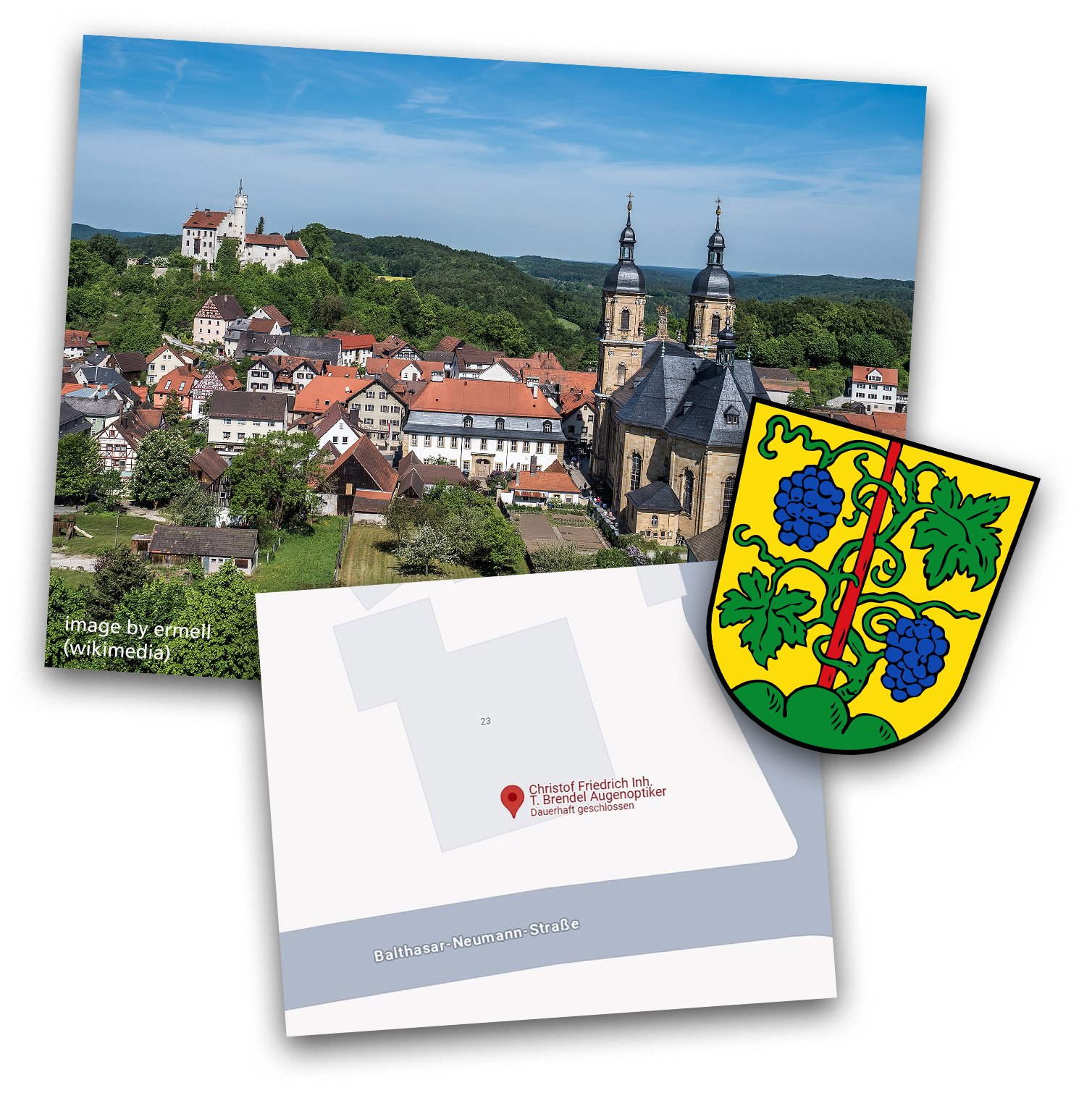
Rolyn Optical in Arcadia had a great number of Friedrich lenses in stock till after the millenium so even though they likely weren’t among the topsellers, they seem to still have been somewhat relevant even 30+ years after they were introduced.
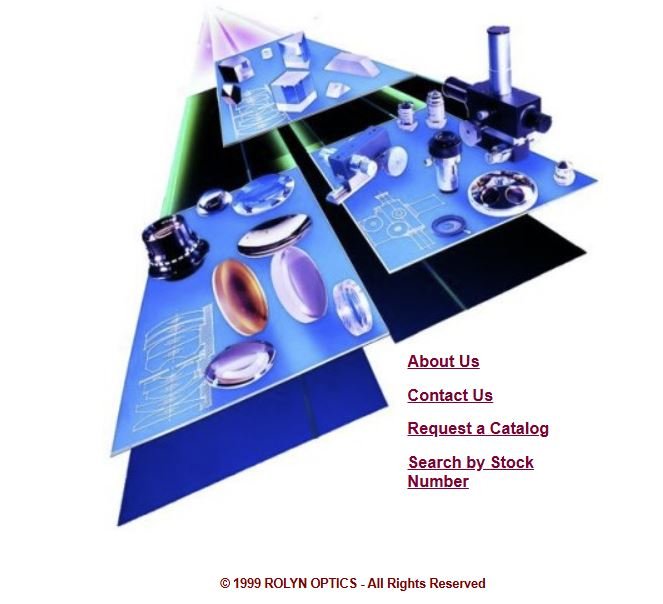
For example, Rolyn still featured a Friedrich S-Coronar 75 mm f/1.9 on the landing page of their website in 1999:
There were three offical German brand entries for different lens names granted to Friedrich, marking their most important lens names:
Corygon (1966) – usually 3/3 Triplets
Axinon (1939) – usually 4/3 Tessars
Coronar (1966) – usually 4 elements in 2 Groups Anastigmats (Dialyte)
and at a later stage:
S-Coronar – usually six-element Double-Gauss designs
The lens vademecum also mentions the name Akmar (for a 6/2 Dagor type lens), Biochron (for an unspecified faster f/2 lens) and Coronav. It’s not unlikely though that the last one was rather a printing or reading error, given the unusual sound of the name, as well as the similarity in sound and look to Coronar. As far as I know there’s just a single mention of it as well.
The book “Kompendium der praktischen Photographie” mentions another lens by C. Friedrich only called Weitwinkel-A. (likely for Anastigmat), described as a Protar-type with 4 elements in 2 groups there. Thanks to calvin@lensfever I’ve also been made aware of another lens series called Corylan.
My personal journey into the world of C. Friedrich lenses started with my curiosity about the fastest enlarging lens ever made. I knew about the Computar-DL 55/1.9 and while looking into that, found the reference to Friedrich S-Coronar lenses on the Big List of Enlarging Lenses by John Jovic on photocornucopia. Curious about some of the fast lenses mentioned there I began looking into them only to realize how incredibly rare they seem to be. A significant amount of time passed before I finally found the first S-Coronar lens but during all that time my fascination with a small, almost completely unknown manufacturer from Munich (a city which is close to where I live), never ceased to fascinate me. So from time to time, I’d do some research and try to look into the matter. It has been a bumpy road to say the least and information was incredibly hard to find…
Through some tips by Dan Fromm – a kind and helpful photographer and researcher from the US – I finally managed to find a copy of the Rolyn catalog though, which contained a good amount of relevant information on the lenses.
John Jovic also helped me out a lot by providing some reference material/tests/articles on enlarging lenses, which I’m very thankful for because it helped me understand some of the historical context and clear up some possible misunderstandings.
With the additional information I was able to compile myself by trying and observing a number of Friedrich lenses I found over the years, I’m finally able to give an overview at least.
Serial Numbers
While, as far as I’m aware, there is no definitive serial number guide available for C. Friedrich lenses. Hartmut Thiele included lenses up until a certain point in his great book “Große Nummernsammlung Photoobjektive” which I would absolutely recommend, if you’re interested in a number of German manufacturers. The numbers end in 1952 however, so It’s safe to assume that many more were manufactured after that. A majority of the later C. Friedrich lenses seems to have been made without a serial number inscription and some seem to be out of order. Here’s a rough estimate:
| No. | Year (approx.) |
| 30,000 | 1922 |
| 50,000 | 1927 |
| 100,000 | 1930 |
| 200,000 | 1938 |
| 350,000 | 1948 |
| 400,000 | 1950 |
| 440,000+ | > 1952 |
Lenses
C. Friedrich lenses are not very common compared to bigger manufacturers, but they can be seen regularly on the used market. They’re usually not very sought after with a few exceptions. They seem to have been reliable and from my personal point of view certainly well-made and solid products but initially more focused around practical aspects and affordability and less on being fancy.
Why some of them are fetching fairly high prices (not quite up to the extremes like the Bausch & Lomb Baltar, Dallmeyer Super-Six or Taylor-Hobson/Cooke lenses however) has to do with the unique specs of some later lens series by the small manufacturer – by then probably already based in the small German village Gößweinstein – and the similarities with the aforementioned famous cine lens series, as well as the rarity due to small production numbers.
So a word of caution upfront: Don’t expect too much from these lenses and judge them on the basis of what they likely were designed as: work horses for specialized industrial applications. In some areas that might also mean: highly limited in terms of suitable magnification, not optimized as taking lenses etc.
Are they still fun to look at and even use today? I certainly think so.
One interesting aspect of these lenses is their look: Many Friedrich lenses appear to have a very intense blue color to the glass and I’ve been wondering if the company used some special coating tech, which might cause that (similar to the very colorful hues many USSR lenses show because of their coating). When disassembling some of the lenses though, it became clear that it’s not just the oftentimes blueish and purple coating causing this effect, but for the most part the blue-colored aperture blades. So far I’ve not found any explanation for why the company chose to apply that color, but it certainly gives their lenses a cool and somewhat unique look.
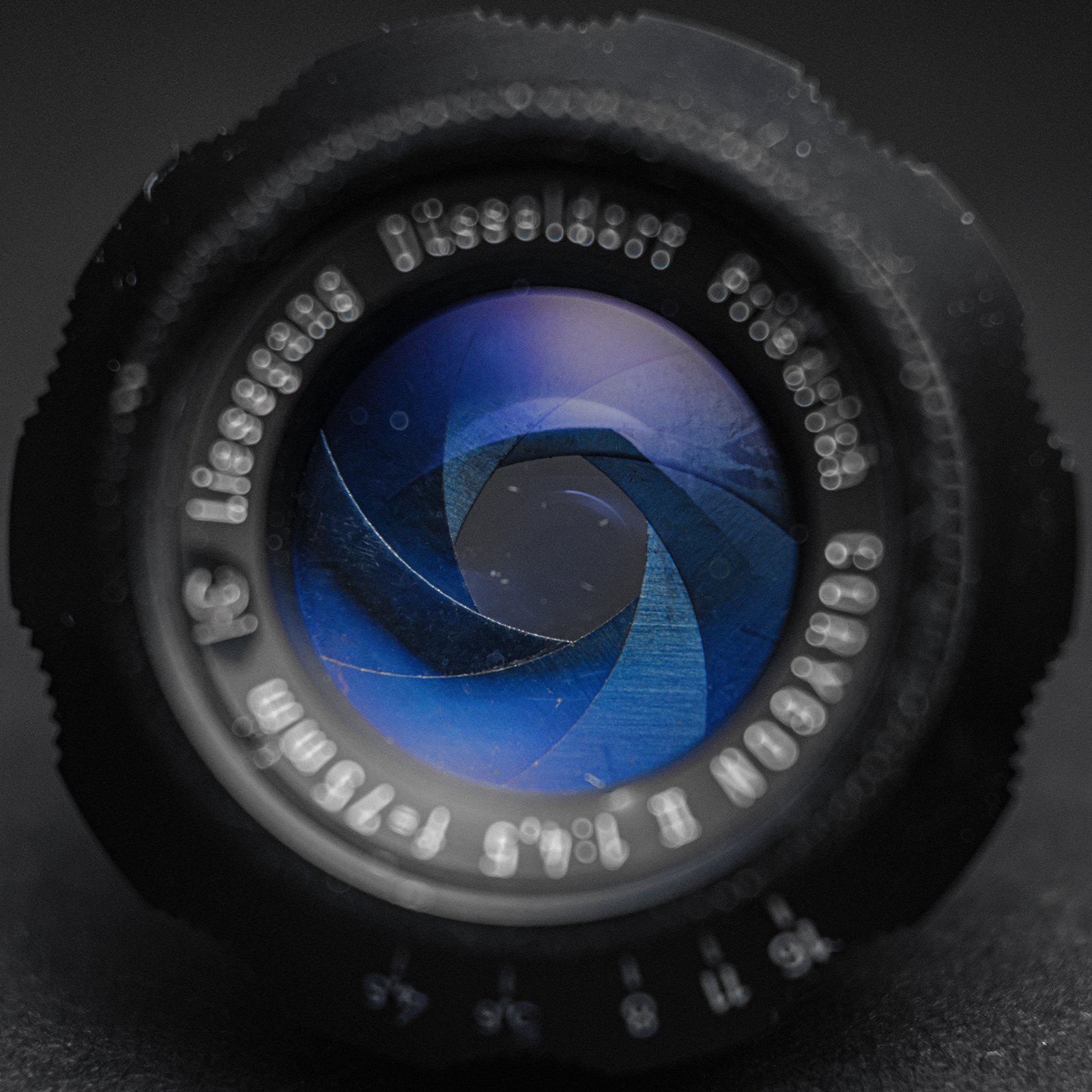
Corygon
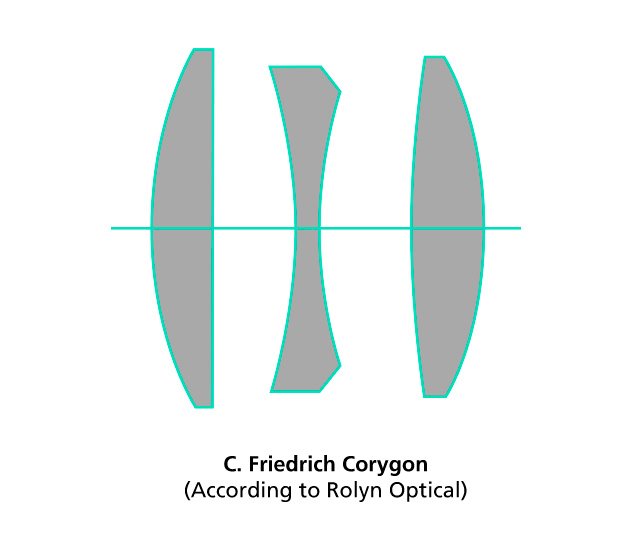
Corygon lenses are usually 3/3 Triplet designs and at least later versions are coated. According to the ad shown below, they were offered in several different speeds as taking lenses or for projection. They might be the most common lenses among the offerings of the small company, but the faster variants – particularly in longer focal lengths – are fairly rare.
Here’s an overview of the industrial lens versions US distributor Rolyn Optics had in stock:
30/2.8 Friedrich Corygon
35/2.8 Friedrich Corygon
40/2.8 Friedrich Corygon
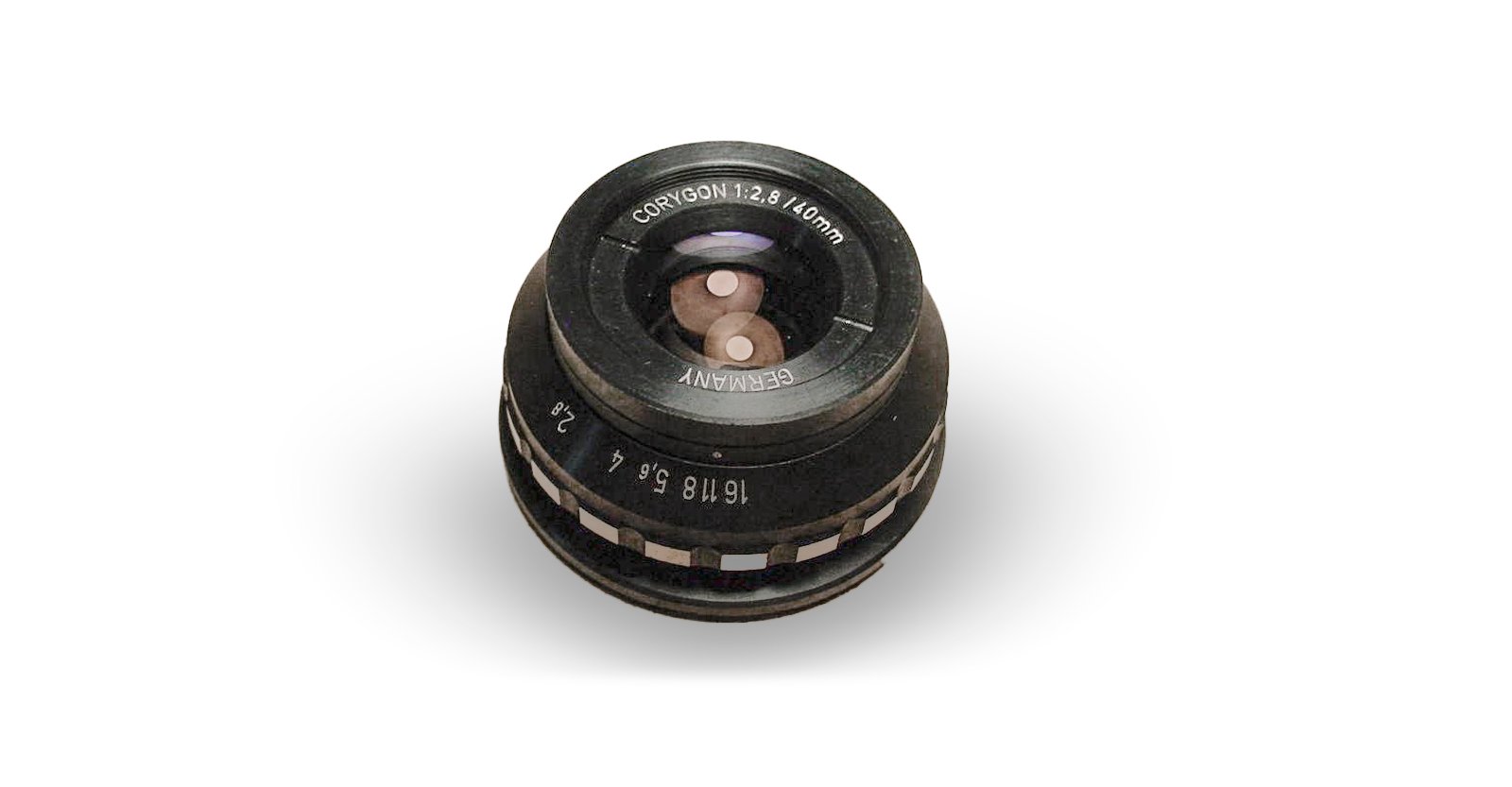
50/2.8 Friedrich Corygon

60/2.8 Friedrich Corygon
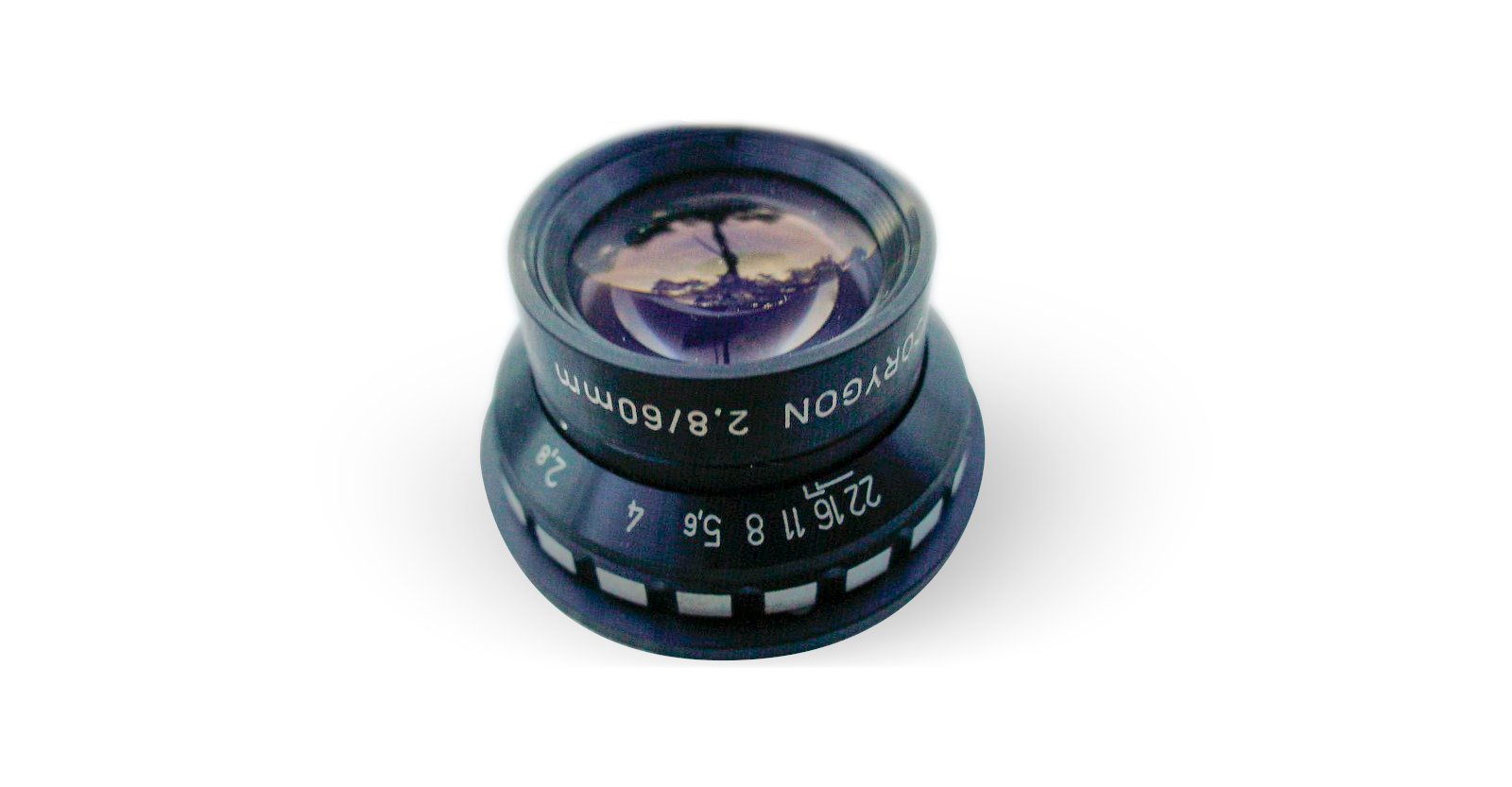
My sample of this lens is yet another fixed aperture one, which I suspect to be identical in terms of optics however.
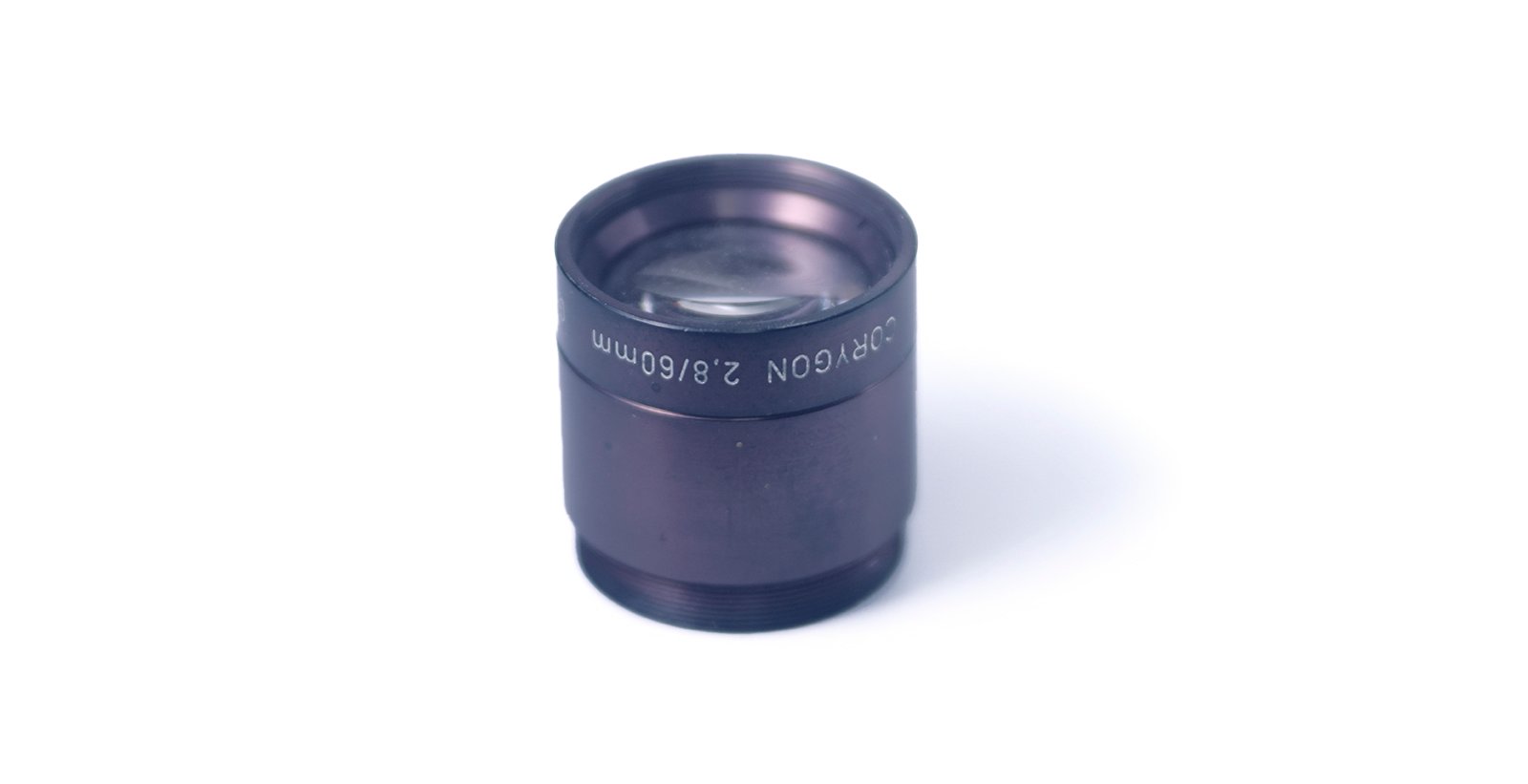
It’s not bad, but somewhat low in terms of contrast and in comparison to another surprisingly solid triplet lens by Som Berthiot also visibly less sharp. I’ve used two of the Corygon 60/2.8 lenses and they behave similarly, so I suspect the unimpressive performance might not be due to getting a bad sample. Overall I’d only call this one usable but not among the best triplet lenses out there.
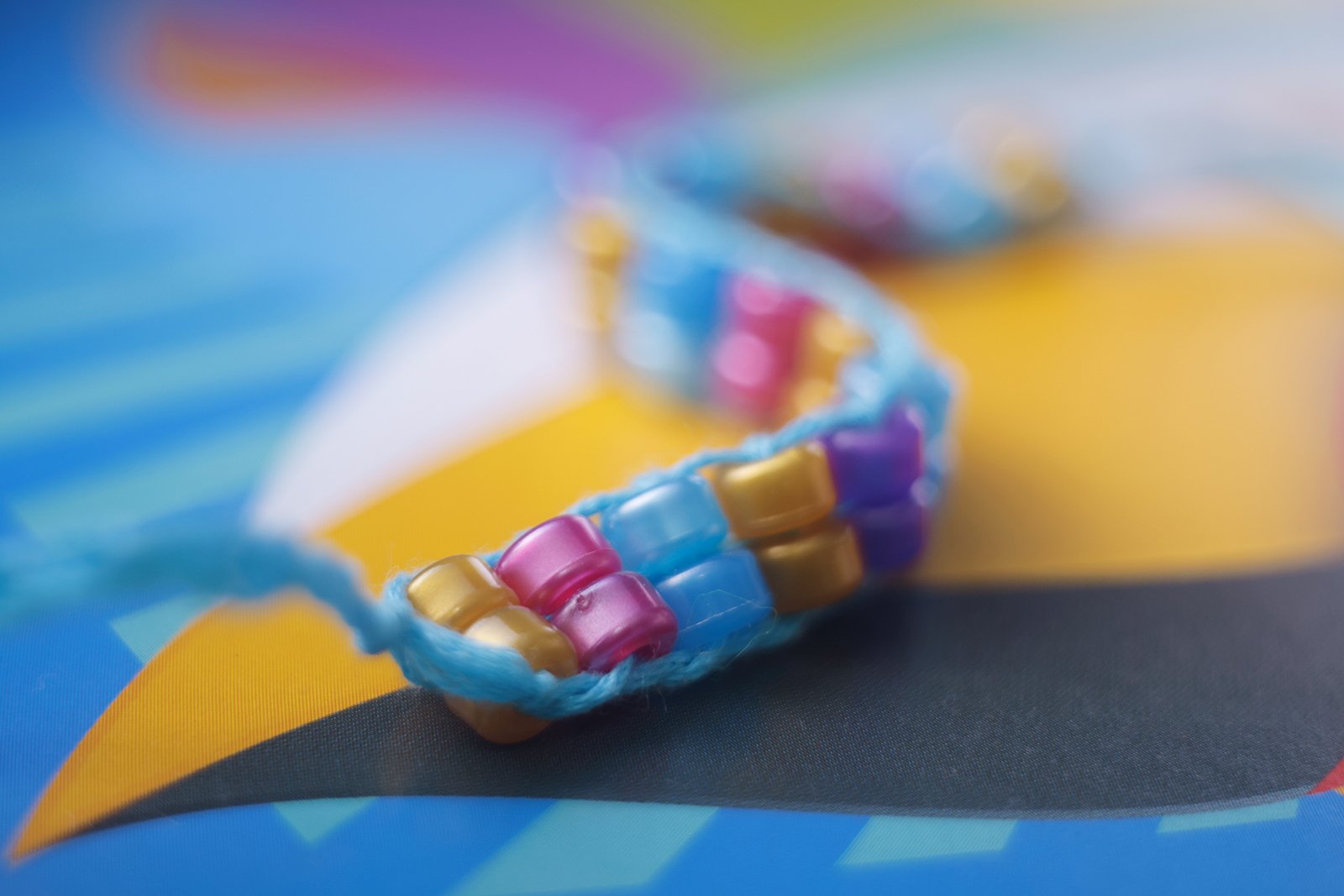
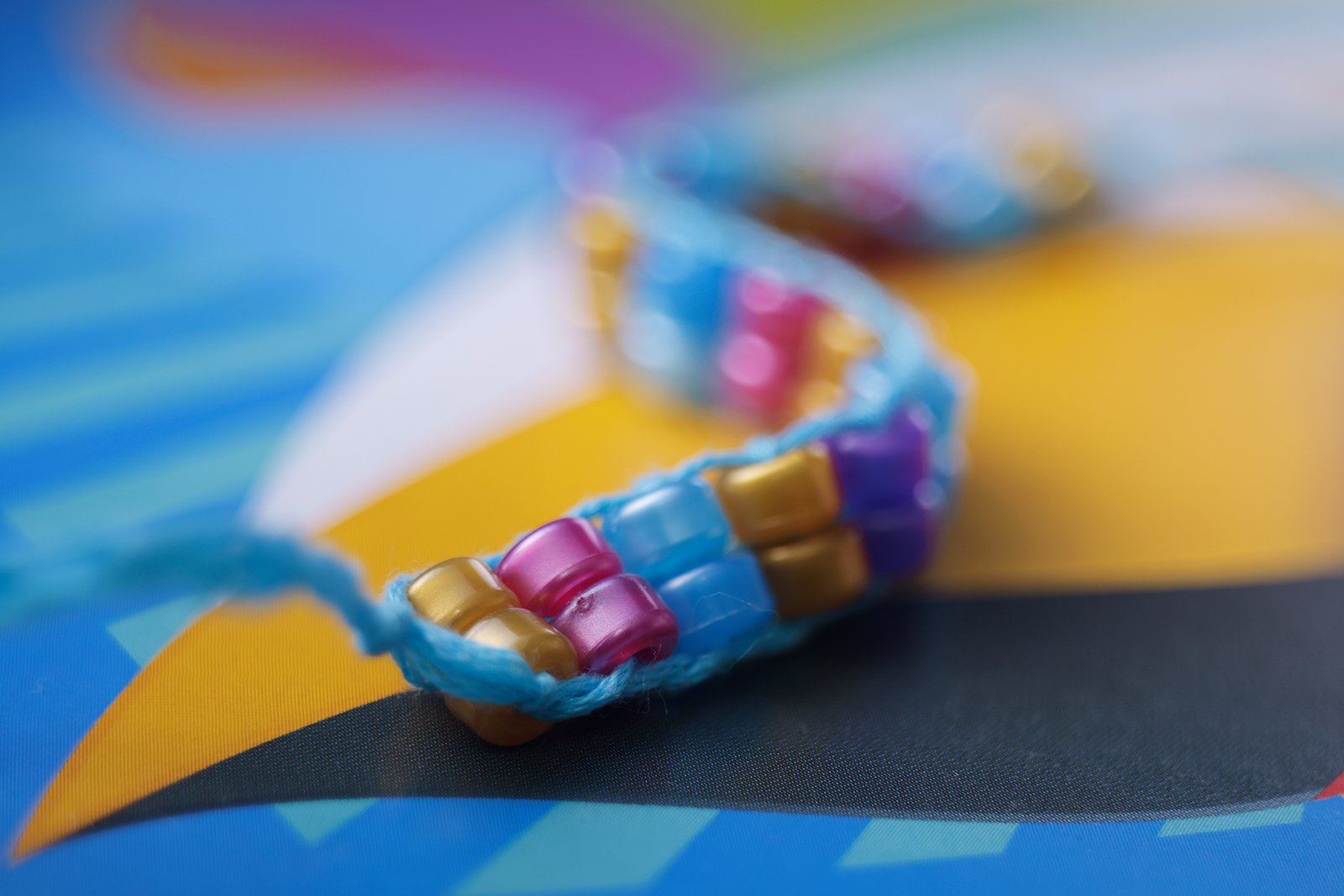
The Som Berthiot lens is likely the viewfinder lens for a Semflex TLR. It’s not necessarily meant to be used as a taking lens but does surprisingly well.
To be fair, I don’t know what magnification these f/2.8 Corygon lenses were optimized for – it’s possible they work better at limited task which resemble their intended application more closely.
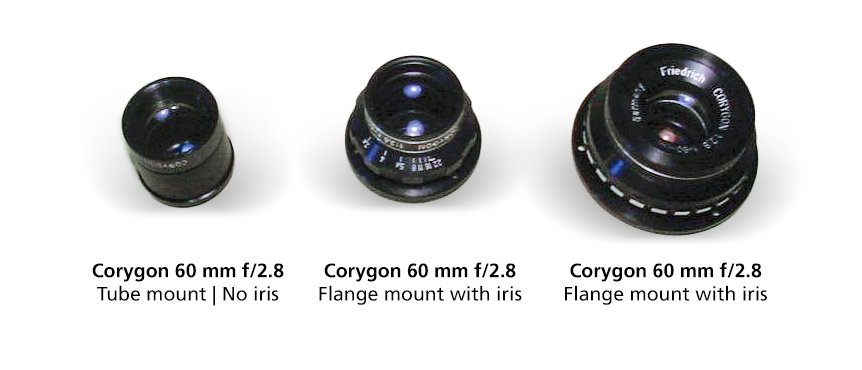
I was able to find out that Friedrich made this specific lens (and likely all of the other Corygon industrial lenses) in at least 4 different looking versions. While that is not unusual for bigger manufacturers of industrial lenses like Schneider Kreuznach, I’m quite surprised about this. Perhaps some might be simply redesigns but at least the 3 versions shown below seem to have been offered simultaneously, offering specific properties needed or beneficial for certain tasks.
In addition, price might also have been a factor or course. Compared to the ingenious enlarging/repro lens system by Schneider Kreuznach where a lot of lens cells are interchangeable between different bodies (and in many cases even standard Copal/Compur shutters) the lenses made by C. Friedrich don’t seem as versatile. There might be some shared parts/threads between several lenses but from my experience so far, it’s not common unfortunately.
80/2.8 Friedrich Corygon
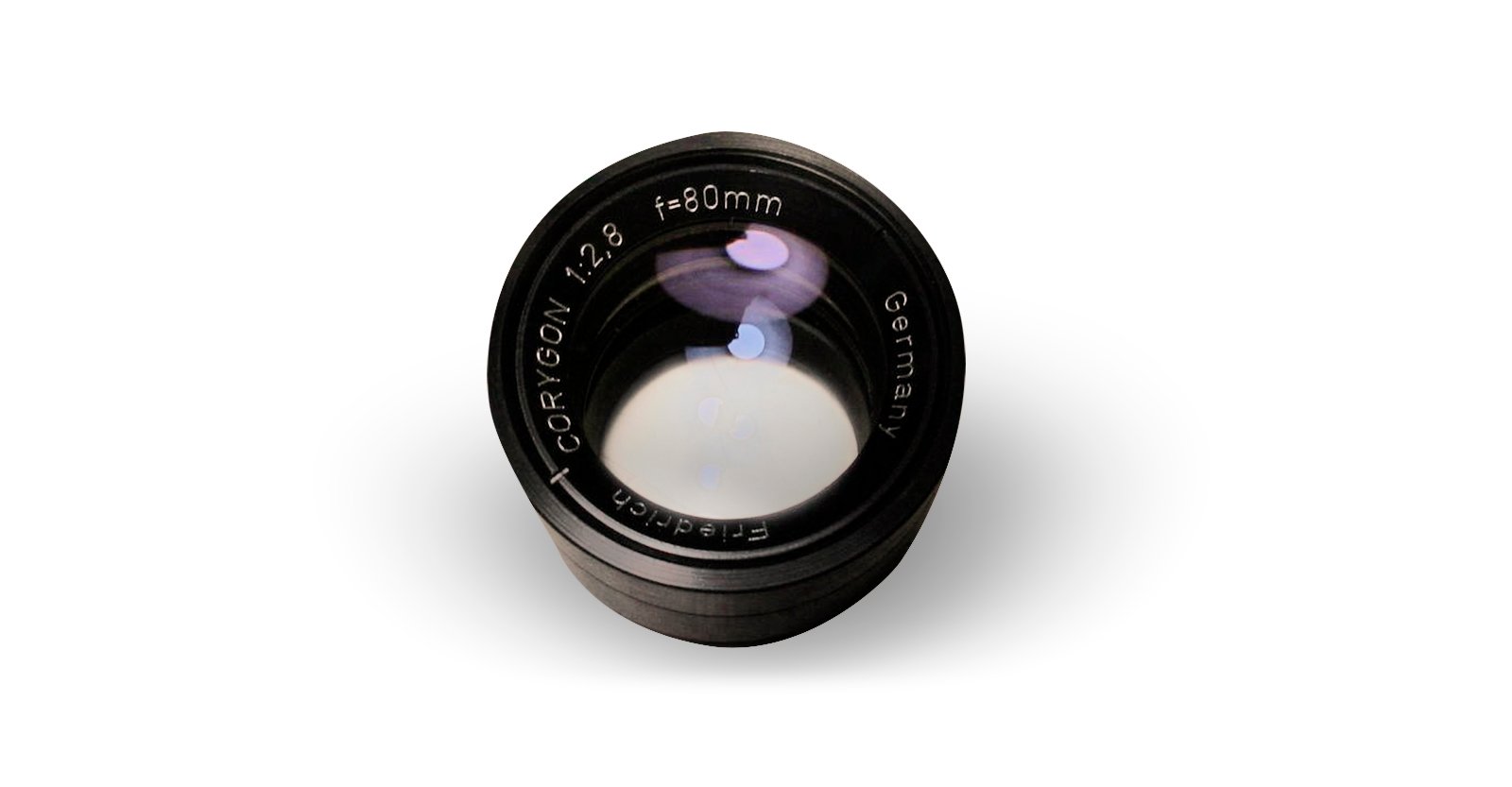
It’s hard to say if these are identical to the equivalent S-Corygon or not, because there just aren’t any descriptions or sample images of either lens online. Both are probably Triplets though and judging from my experience with the shorter focal length Corygon not among the best ones out there.
80/3.5 Friedrich Corygon
50/4.5 Friedrich Corygon
55/4.5 Friedrich Corygon
60/4.5 Friedrich Corygon
75/4.5 Friedrich Corygon
According to some ads this lens was used on Liesegang enlargers, including the Rax 6×6 and Uni-Rax 6×6. Thus, decent medium format coverage can be expected with these lenses in this and longer focal lengths.
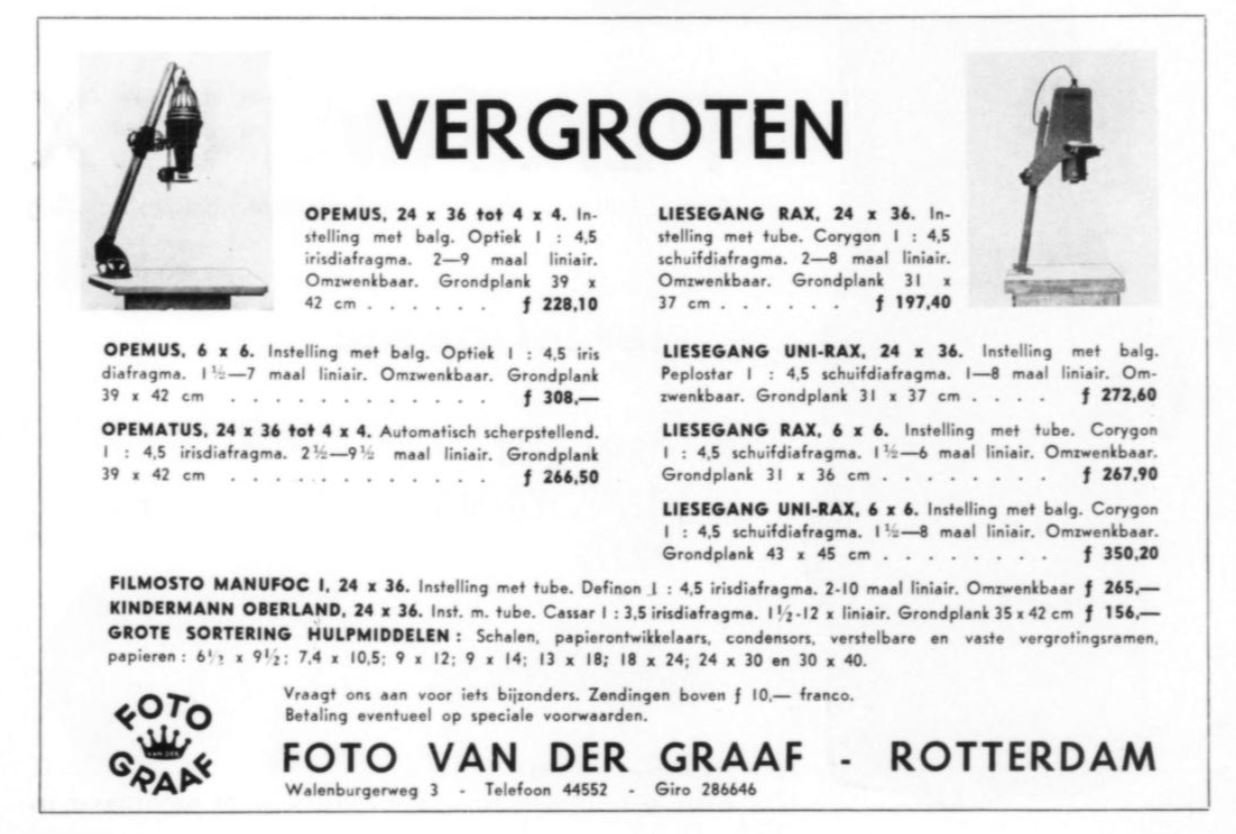
80/4.5 Friedrich Corygon
S-Corygon
While I wasn’t able to confirm that the single sample of this lens which I’ve once seen online did even feature an S- in its inscription, the S-Corygon series certainly seems to have existed and is mentioned in Hartmut Thiele’s book “Große Nummernsammlung Photoobjektive” with that particular name. It might be identical to the Corygon f/2.8 lineup mentioned in the Rolyn Optics catalog as far as the optics are concerned however.
80/2.8 Friedrich S-Corygon
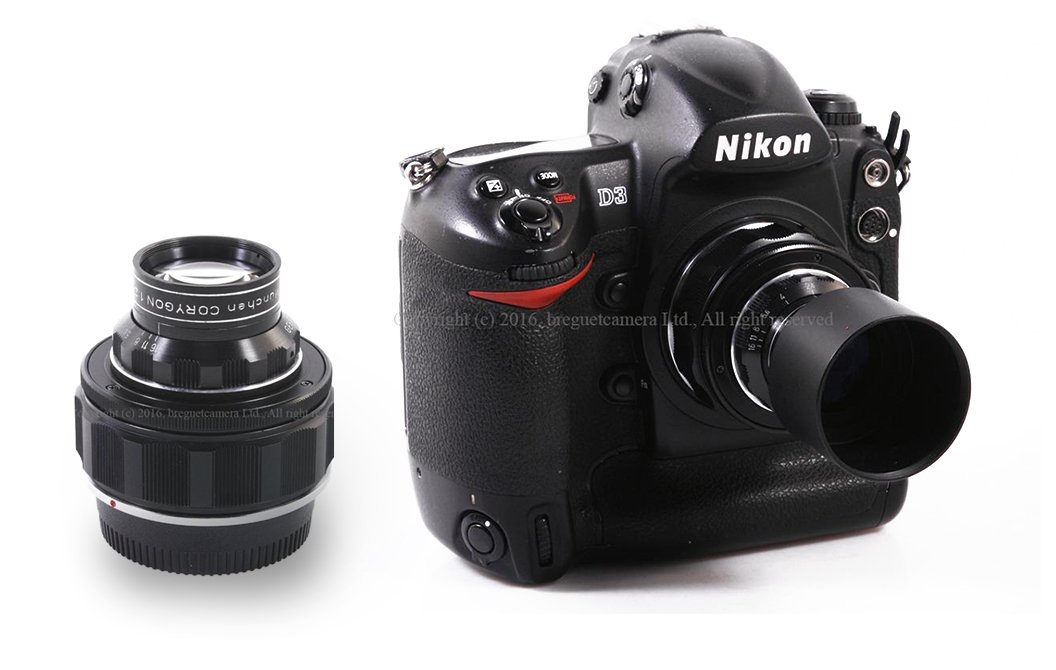
(Serial: 434588)
This lens was offered by Japan-based seller breguetcamera and it looks well adapted. They also included a sample shot with nice looking rendering, though it is hard to judge image quality from a single small image. Here’s a translation of how the seller describes this lens:
“All aspects are very balanced, rich colors, bokeh is soft, and the imaging is very beautiful! Covers more than 645 frames”
38/1.9 Friedrich Corygon
This lens is mentioned in Thiele’s book “Große Nummernsammlung Photoobjektive“. It is very unusual with its specs and so my suspicion is that this might be a cine lens for smaller formats. Because of the identical specs it’s possible that this lens was named Corylan (see further down) earlier or later.
While the following lenses were only mentioned as “CF Anastigmat” I have my suspicions that they belong to this series. There’s no hint at what they were intended for, but they were clearly produced in normal mount (variable aperture) and tube mount (fixed aperture) so they could have been used as cine-taking-lenses as well as for industrial applications.
10.5/2 Friedrich (Corygon) Anastigmat
22.5/2 Friedrich (Corygon) Anastigmat
25/2 Friedrich (Corygon) Anastigmat
38/2 Friedrich (Corygon) Anastigmat
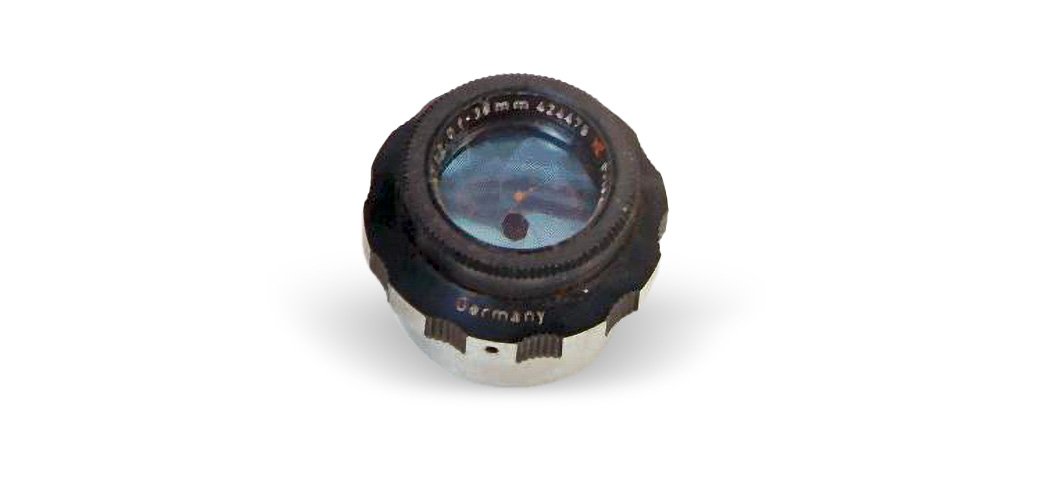
While I’ve not been able to find a single mention of the f/1.9 lens above, I’ve seen this lens offered online with almost identical specs. The listing doesn’t mention any application but from the looks and specs of it I suspect it might have been some sort of cheaper alternative to something like the Schneider Kreuznach Xenon 35 mm f/2, which was used both as an enlarging/inspection lens as well as a taking lens on movie cameras.
50/2 Friedrich (Corygon) Anastigmat
75/2 Friedrich (Corygon) Anastigmat
Corygon II (Liesegang)
A 3/3 Triplet design as well and coated. Maybe an optical redesign or improved in terms of materials used for glass and coating.
75/4.5 Liesegang Friedrich Corygon II
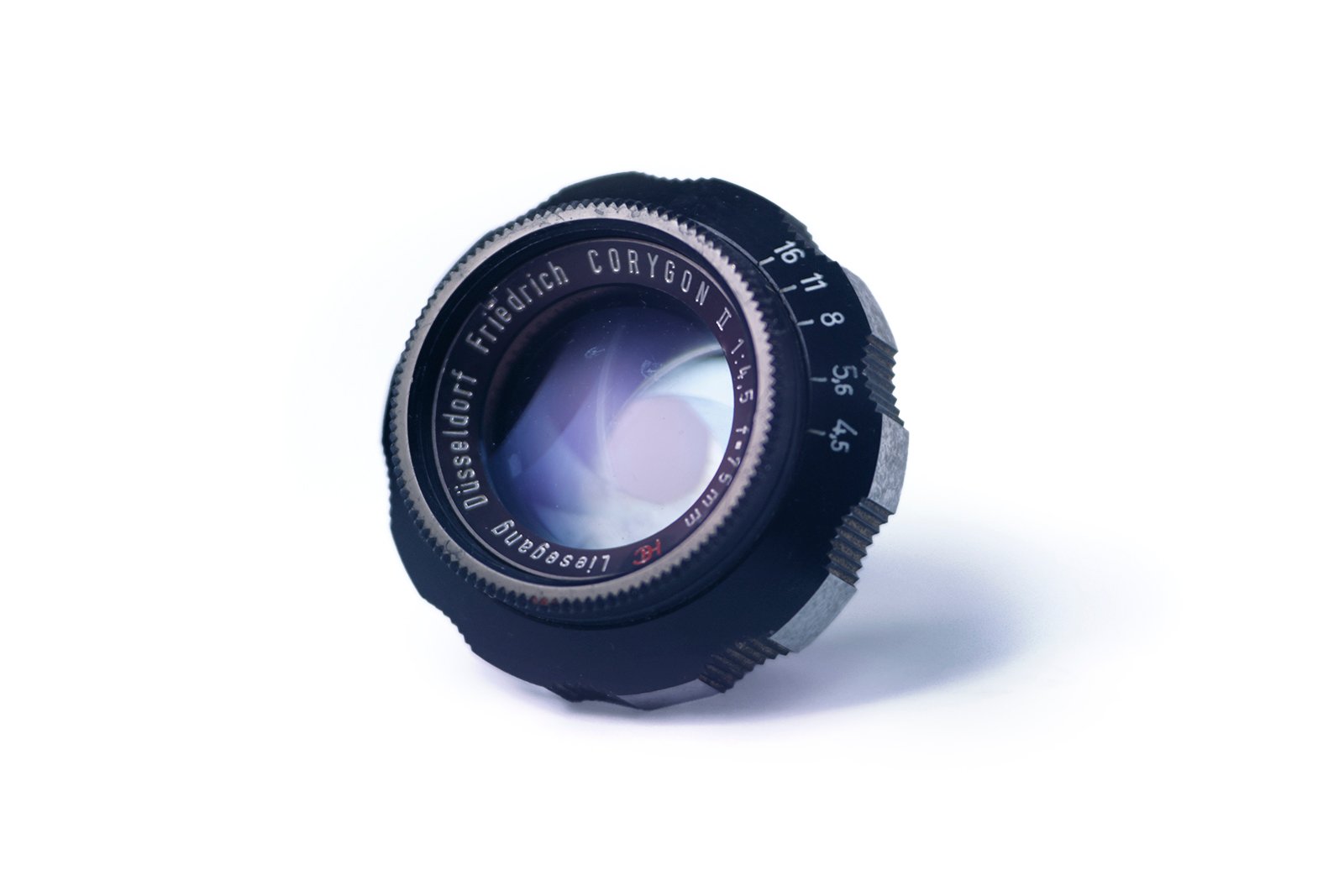
Why this lens is called Corygon II is anybody’s guess… it doesn’t seem to feature a more complex construction or include any special feature. It’s possible that it was just used to distinguish the lenses made for Liesegang but even that doesn’t make any sense, given that Corygon (non II) lenses were used simultaneously on Liesegang enlargers as well. It’s one of the very few lenses, which has both manufacturers featured on the inscription.
Spezial-Corygon
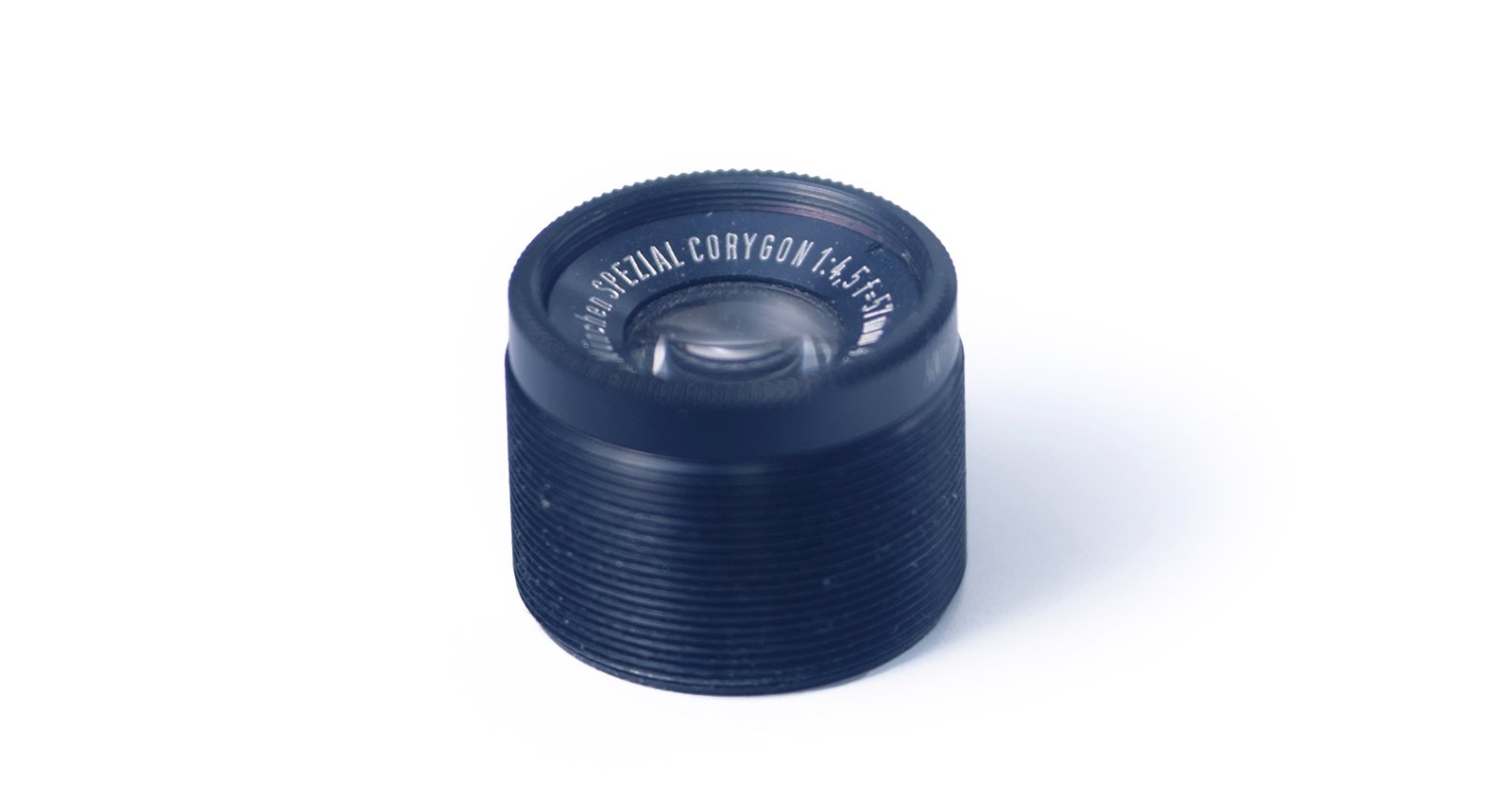
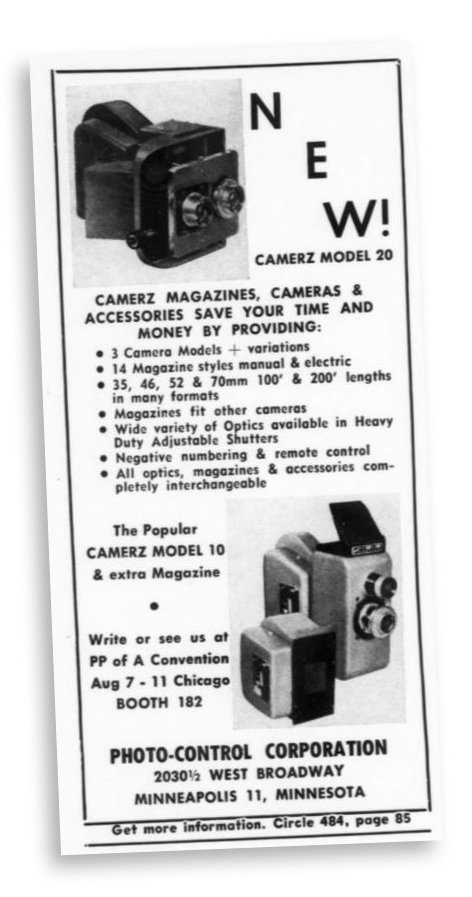
The Spezial-Corygon lenses might have been used in some type of repro- or photo-processing devices or related industrial applications (See Photo-Control Corporation/Camerz devices under “Axinon”). They do look very similar to the Printing-Ektar or Pako lenses among others.
User lepre posted some sample shots taken with several of these Spezial Corygon lenses on the mflenses forum. Results look quite promising, so if you can live with the limitations these lenses might be usable for a variety of photographic genres.
52/4.5 Friedrich Spezial-Corygon
57/4.5 Friedrich Spezial-Corygon

The following shots are cross-view stereo images – here’s a tutorial on how to view them.
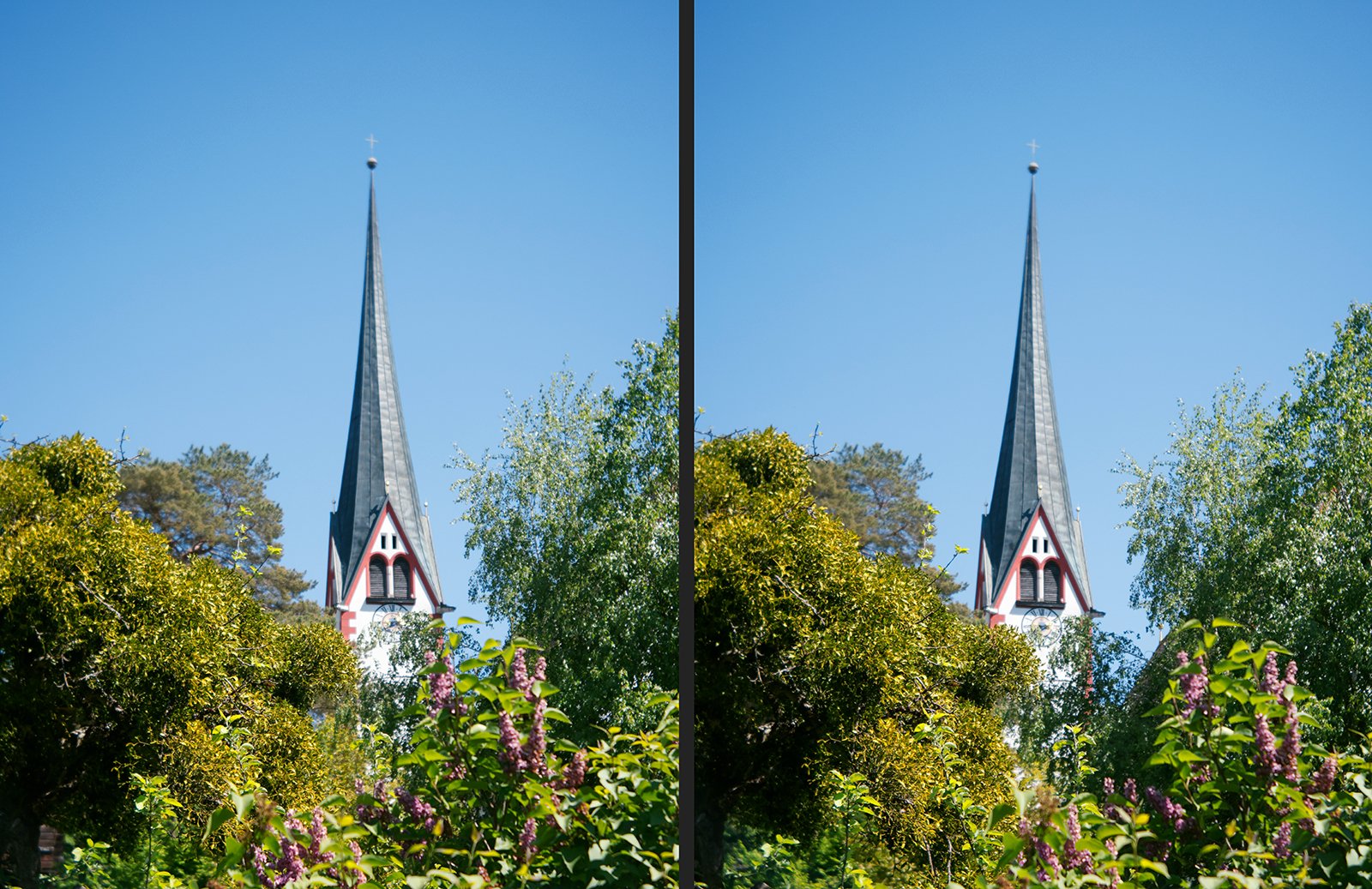

62/4.5 Friedrich Spezial-Corygon
66/4.5 Friedrich Spezial-Corygon
67/4.5 Friedrich Spezial-Corygon
68/4.5 Friedrich Spezial-Corygon
83/4.5 Friedrich Spezial-Corygon
88/4.5 Friedrich Spezial-Corygon
90/4.5 Friedrich Spezial-Corygon
Projektions-Corygon
It looks like usual projection lenses were never a big part of the C. Friedrich lens line-up, at least judging by how infrequently they appear on the used market. In terms of specs the single one I found certainly is not among the most impressive or of its kind.
100/3.5 Friedrich Projektions-Corygon

Initially I was somewhat torn on the performance of this lens. It delivered very low contrast shots and because it’s also not fast for a projection lens, it just didn’t seem very interesting as a taking lens. However its nice smooth rendering, which reminded me of another old lens from a similar era – the Leitz Voort 9.5 cm f/4, which I like a lot – I decided to give it another try, this time with an improved adaption including a lens hood.
And indeed – results can be improved quite dramatically by adding a lens hood (which should be fairly long due to the focal length + uncoated and flare prone optics. It’s also possible to add an aperture to the rear of that lens without any problems and it still covers full frame (and perhaps even more) at distance.
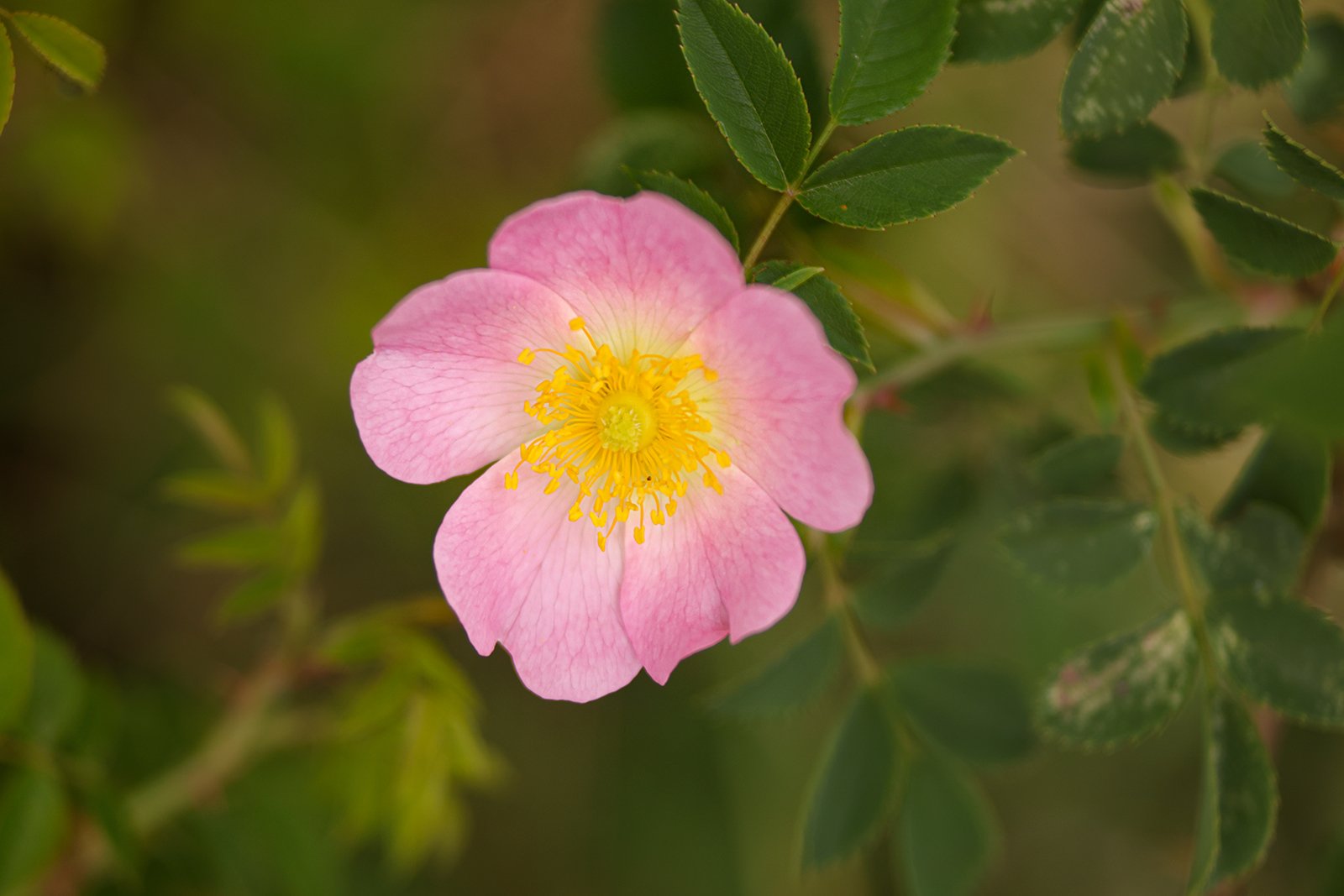


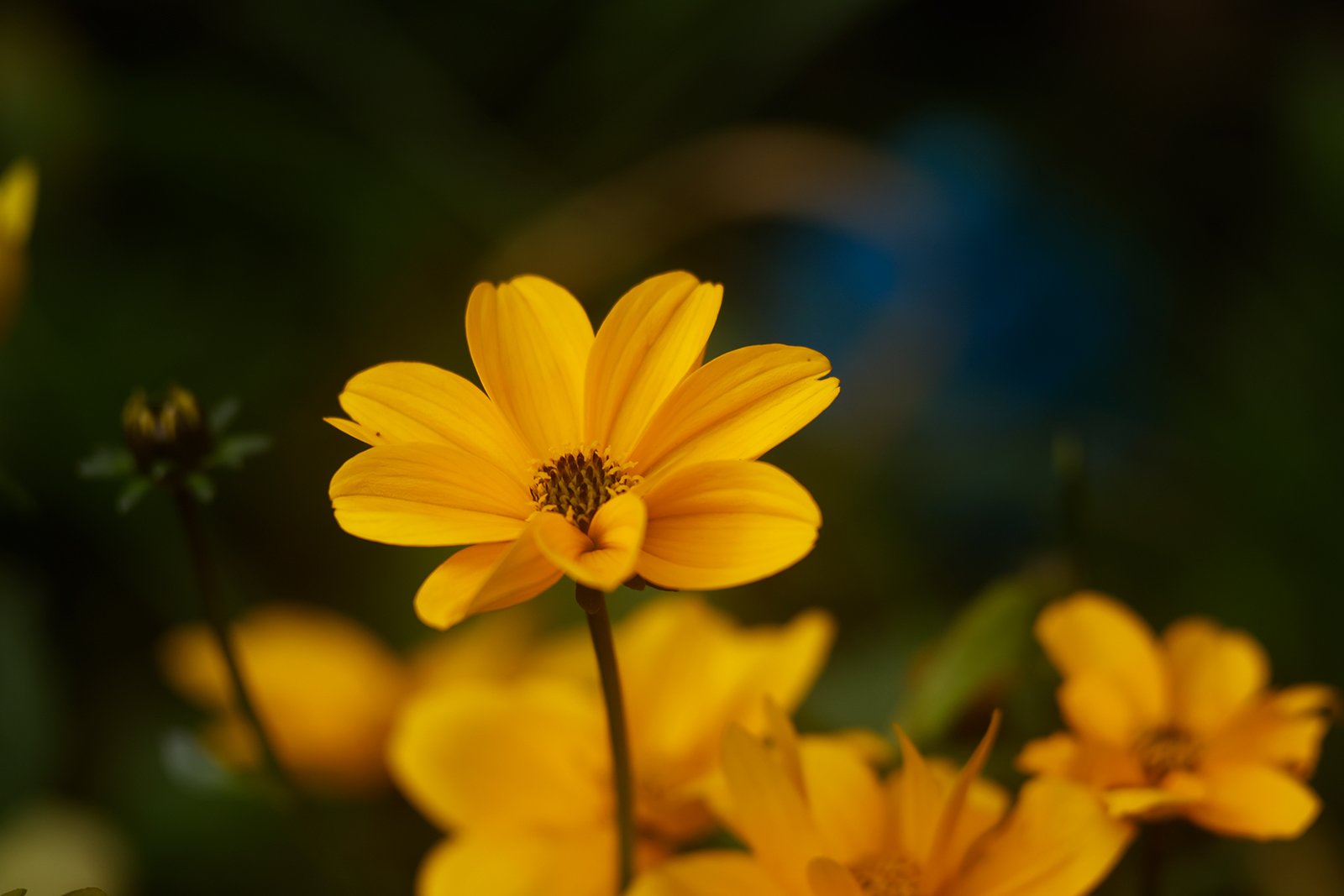

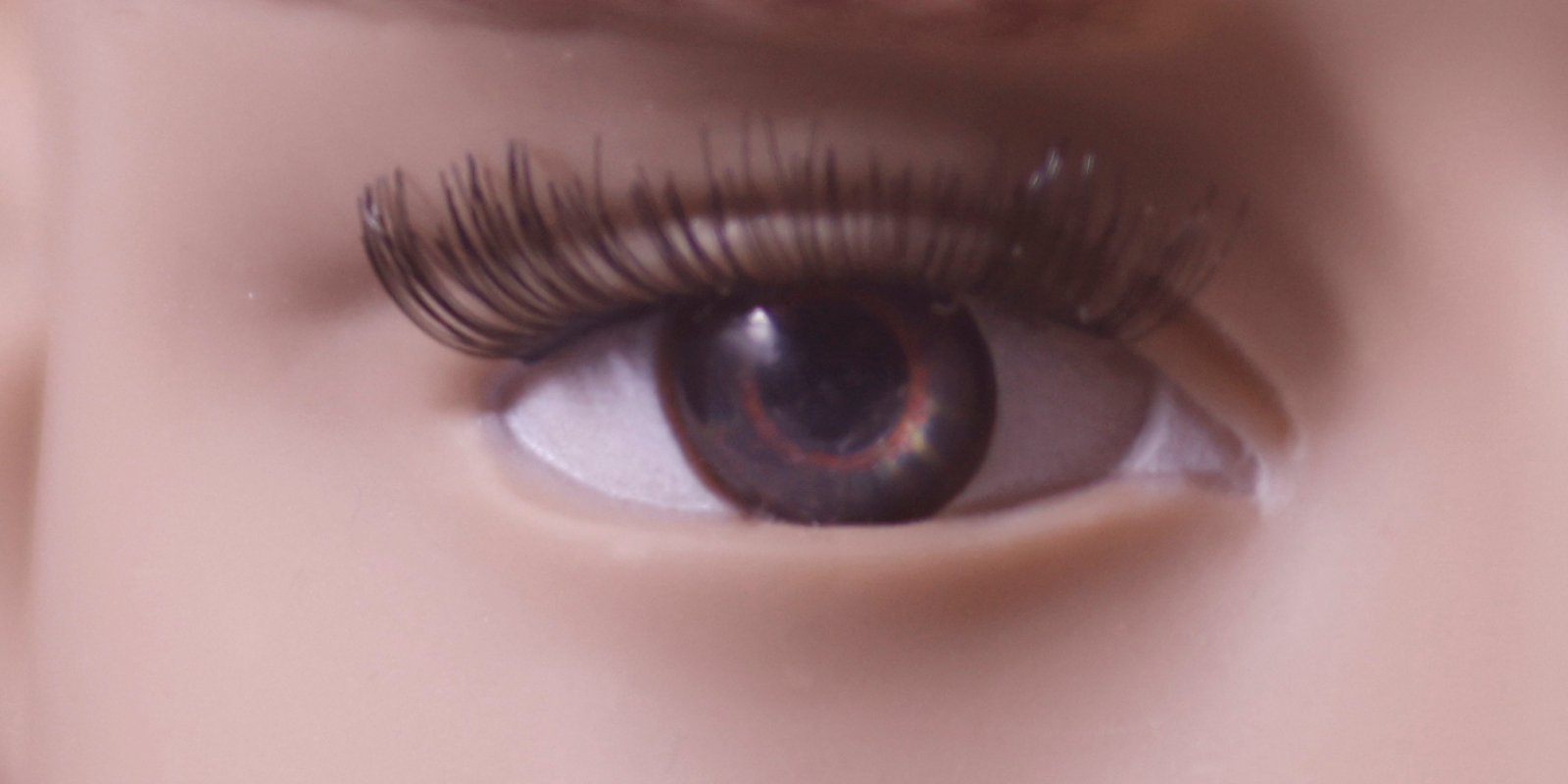
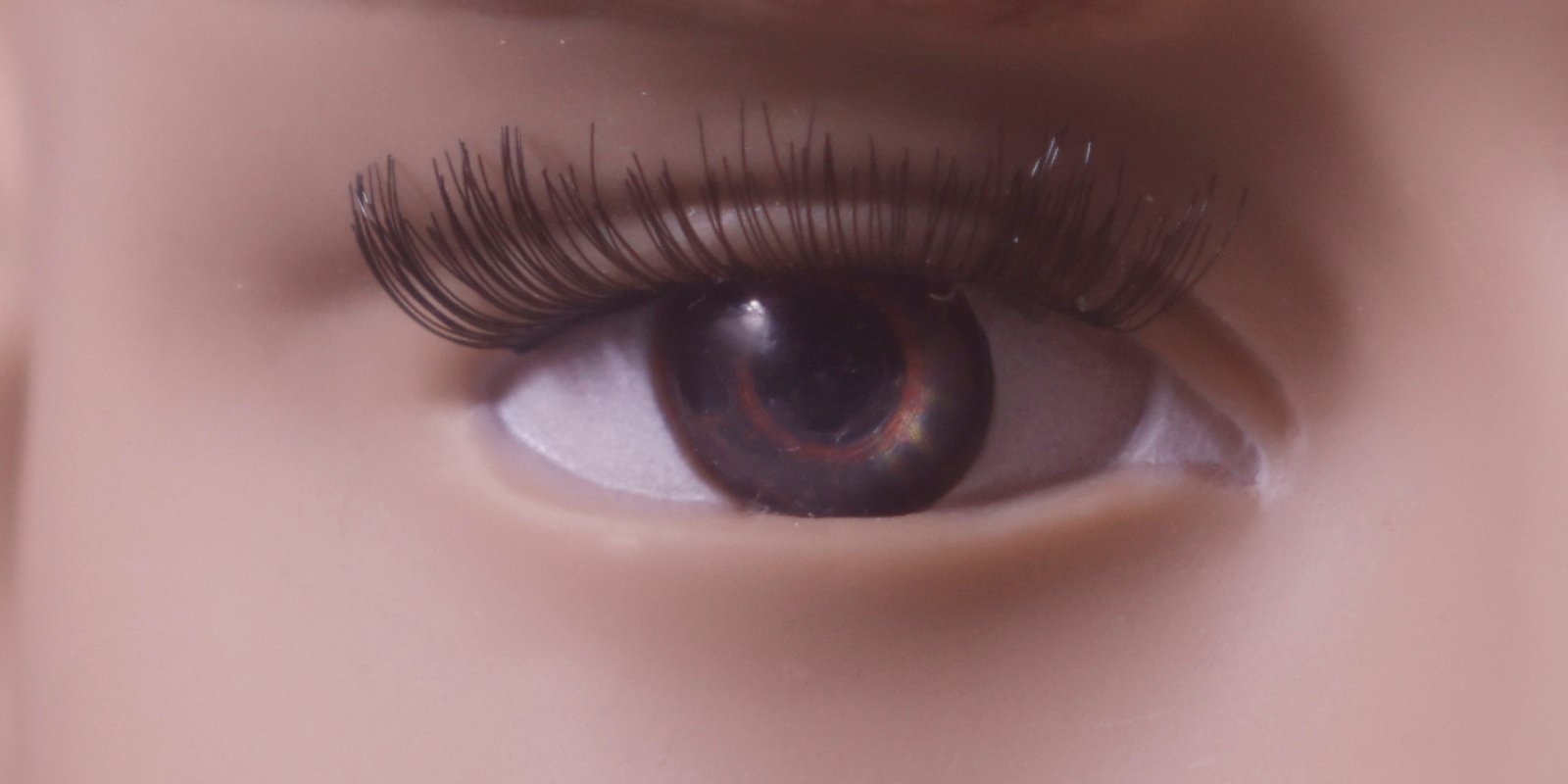
The lens is not very sharp wide open, but for portraits it is a nice option with its low contrast look. Here’s a comparison with the Leitz Voort 9.5 cm f/4, which is one of my favorite lenses from the same era:
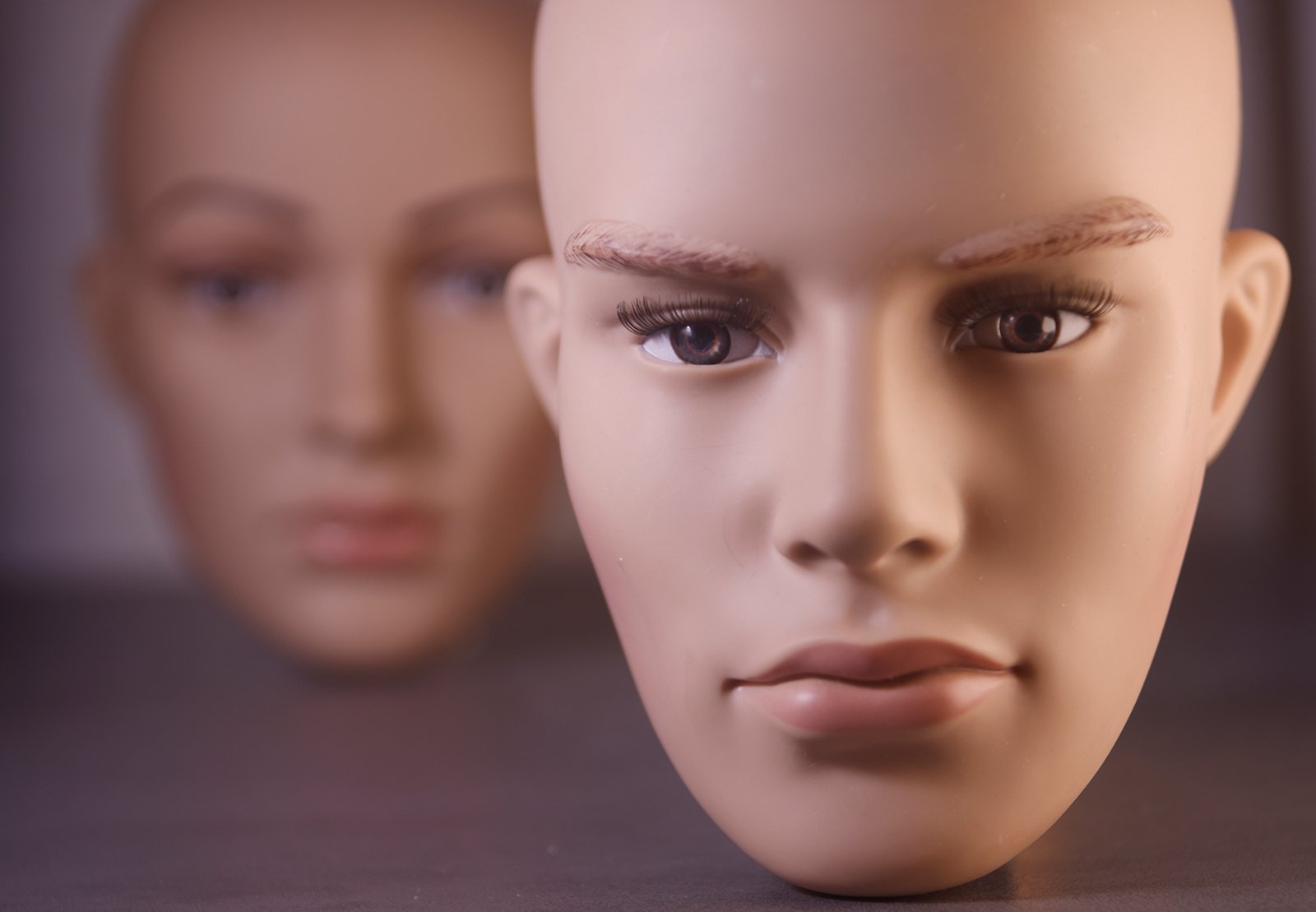
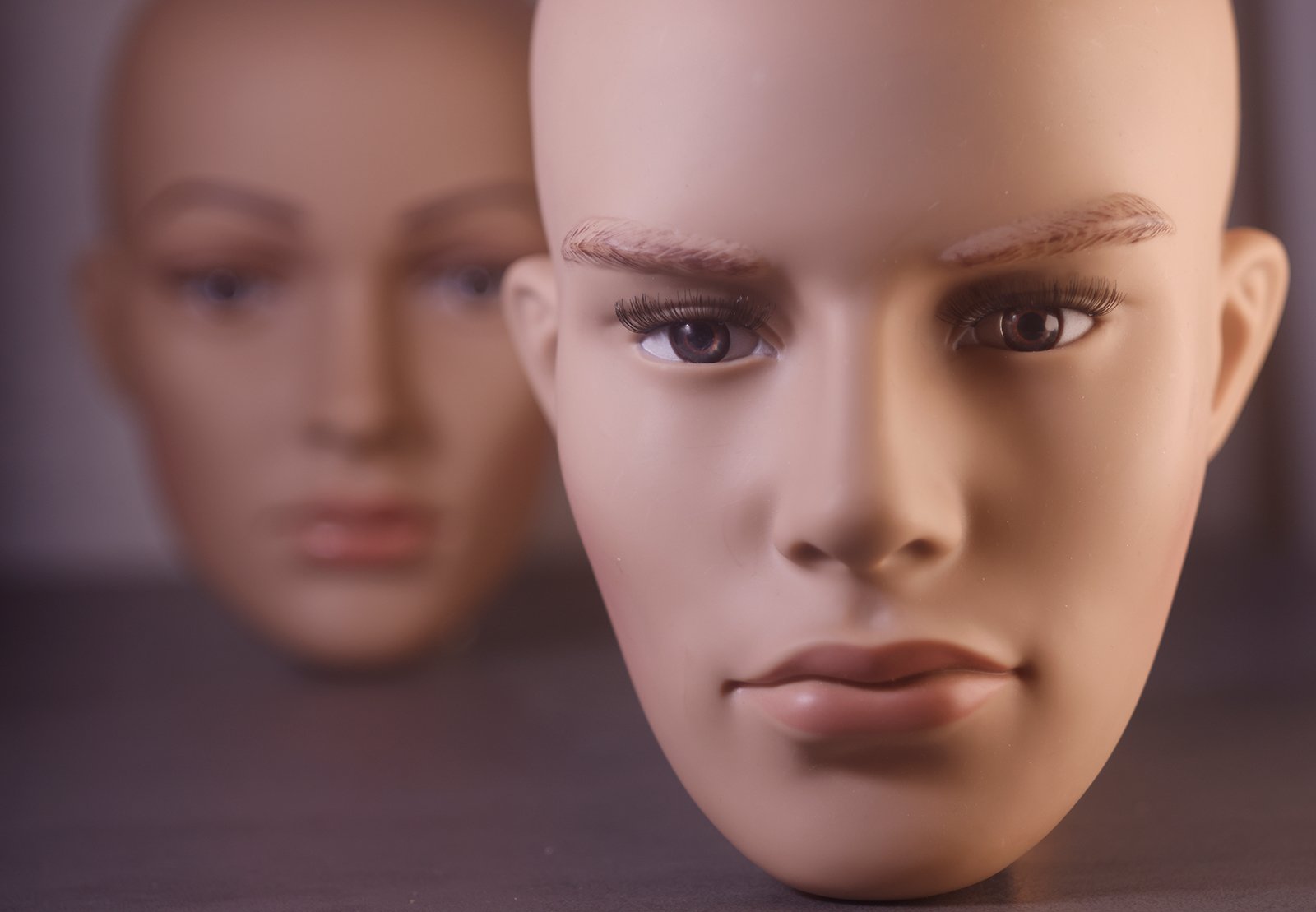
From some distance the image of the Projektions-Corygon can look punchier, however when you view it at full resolution it gets clear immediately that the Leitz lens is significantly sharper and more detailed and does only lack some contrast, which is easily applied in post. Even if you add an aperture to the Friedrich projection lens and stop it down to f/4, this discreptency doesn’t change. However in terms of out-of-focus rendering it does have an advantage wide open.
Corylan
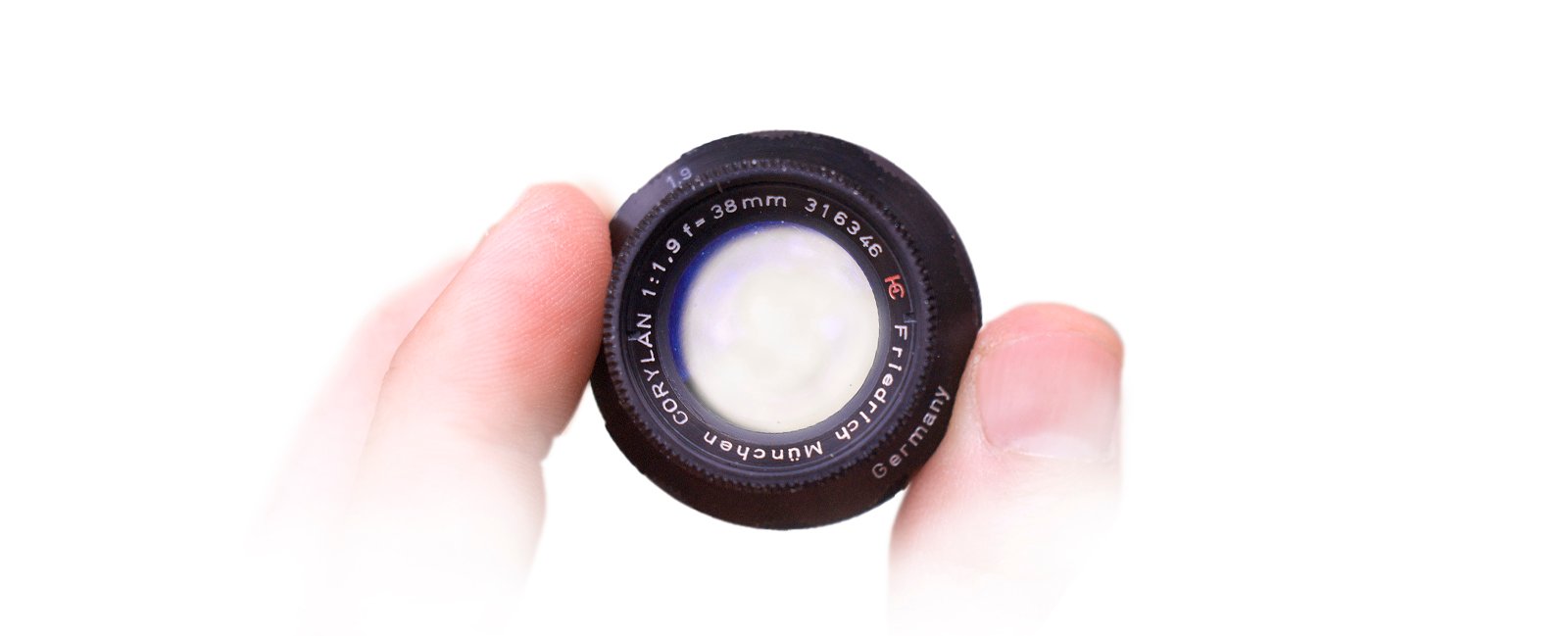
There’s not much besides the name and specs of these lenses, so what they were designed and used for is anybody’s guess. It’s possible that these lenses were identical to the similar Corygon/Anastigmat lenses mentioned above. Because of the specs, size and focal length, I would expect lenses similar to the Schneider Kreuznach Xenon series (28 & 35/2) though the name might suggest a simpler (perhaps Cooke-Triplet or derivative) construction.
28/2 Friedrich Corylan
38/1.9 Friedrich Corylan
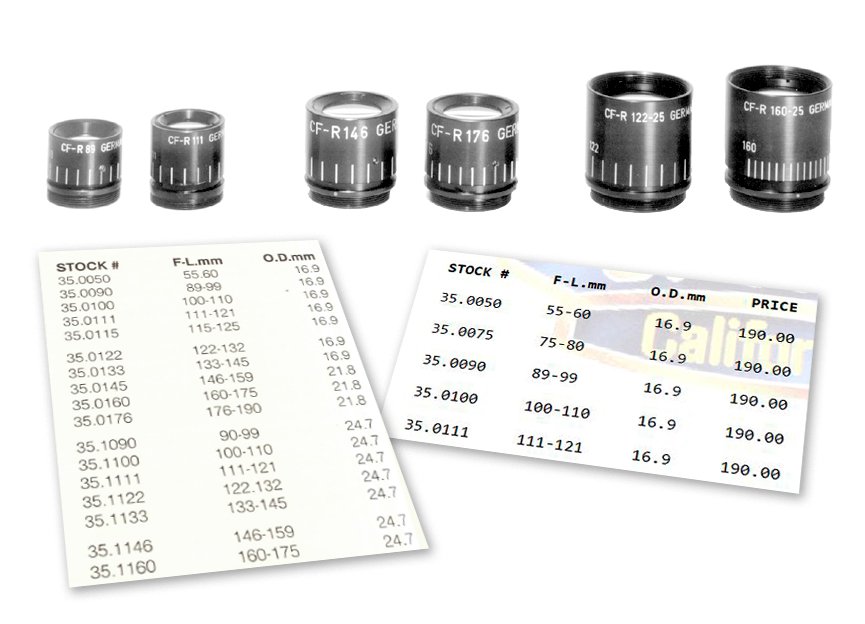
CF-R varifocal lenses (cluster lenses)

55-60 CF-R (Ø 16.9mm)
89-99 CF-R (Ø 16.9mm)
100-110 CF-R (Ø 16.9mm)
111-121 CF-R (Ø 16.9mm)
115-125 CF-R (Ø 16.9mm)
122-132 CF-R (Ø 16.9mm)
133-145 CF-R (Ø 16.9mm)
146-159 CF-R (Ø 21.8mm)
160-175 CF-R (Ø 21.8mm)
176-190 CF-R (Ø 21.8mm)
90-99 CF-R (Ø 24.7mm)
100-110 CF-R (Ø 24.7mm)
111-121 CF-R (Ø 24.7mm)
122-132 CF-R (Ø 24.7mm)
133-145 CF-R (Ø 24.7mm)
146-159 CF-R (Ø 24.7mm)
160-175 CF-R (Ø 24.7mm)
Axinon (Camerz)
Axinon was apparently the name Friedrich used for the 4/3 Tessar type design pretty much any manufacturer of the time had in its portfolio. Some were made with lanthanum glass and most of them coated. The Axinon name was used for large format and 35 mm taking lenses as well.
According to a Rolyn optics catalog, Thiele’s books and my own observations the following enlarging lens type Axinons were made:
35/2.8 Friedrich WA-Axinon

50/2.8 Friedrich Axinon
40/3.5 Friedrich Axinon
50/3.5 Friedrich Axinon
60/3.5 (?) Friedrich Axinon
45/4.5 Friedrich Axinon

55/4.5 Friedrich Axinon
72.2/4.5 Friedrich Axinon
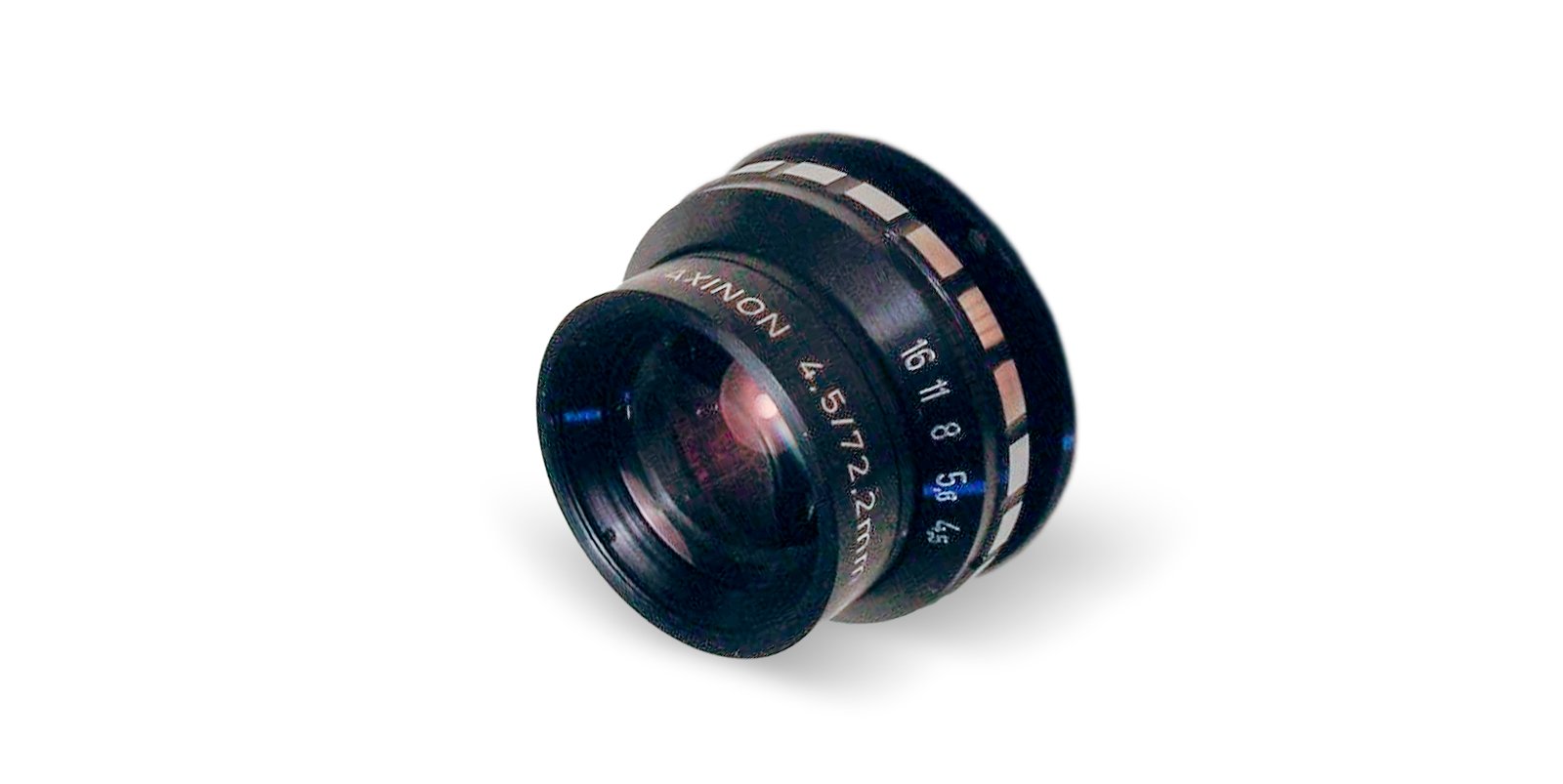
While a focal length of 72.2 mm might raise some eyebrows among people who’re used to regular taking lenses, I’m personally fairly used to lenses with mm decimals in focal lengths. They’re very common among printer lenses – enlarging lens type optics, which were used in optical printers aka minilabs as well as repro-devices. While this is the only lens with that special feature among the Axinon series that I’ve seen so far, it’s pretty safe to assume that Friedrich was making lenses like that as special orders regularly, either in their own name or for companies like Rolyn Optics.
User jamaeolus has shown his impressive Axinon collection on the mflenses forum and shared some beautiful sample shots taken with this interesting lens:
This lens has an RMS thread, which is also quite uncommon for its type, so it might have been optimized and used for some high-magnification work, where that mount is one of the main standards still.
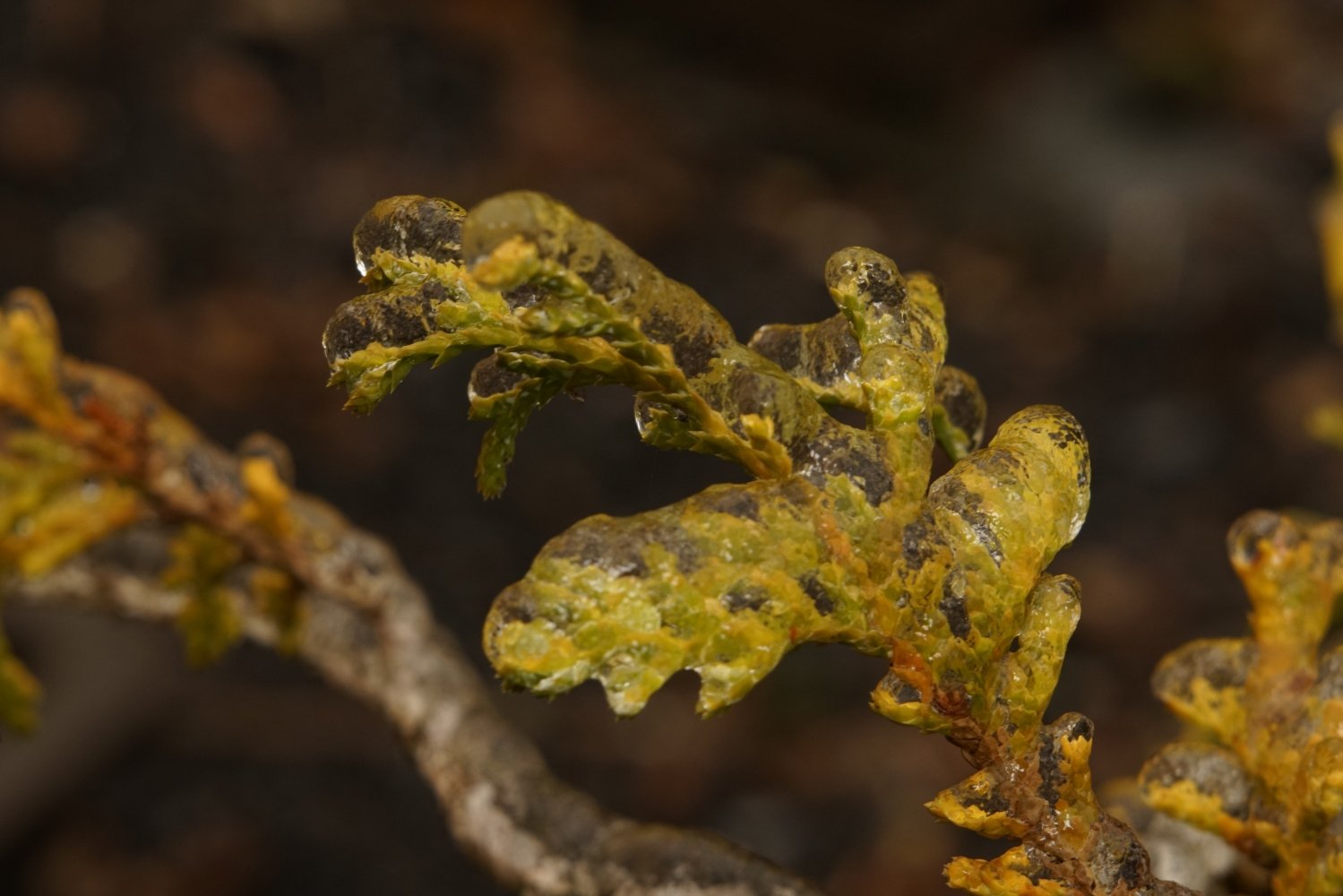

75/4.5 Friedrich Axinon
90/4.5 Friedrich Axinon

From my experience Tessar-based designs rarely disappoint and the Axinon lenses are no exception there. This sample has the inscription on the outside and it seems like Axinon lenses were also delivered in several lens bodies, as shown with the Corygon family earlier.

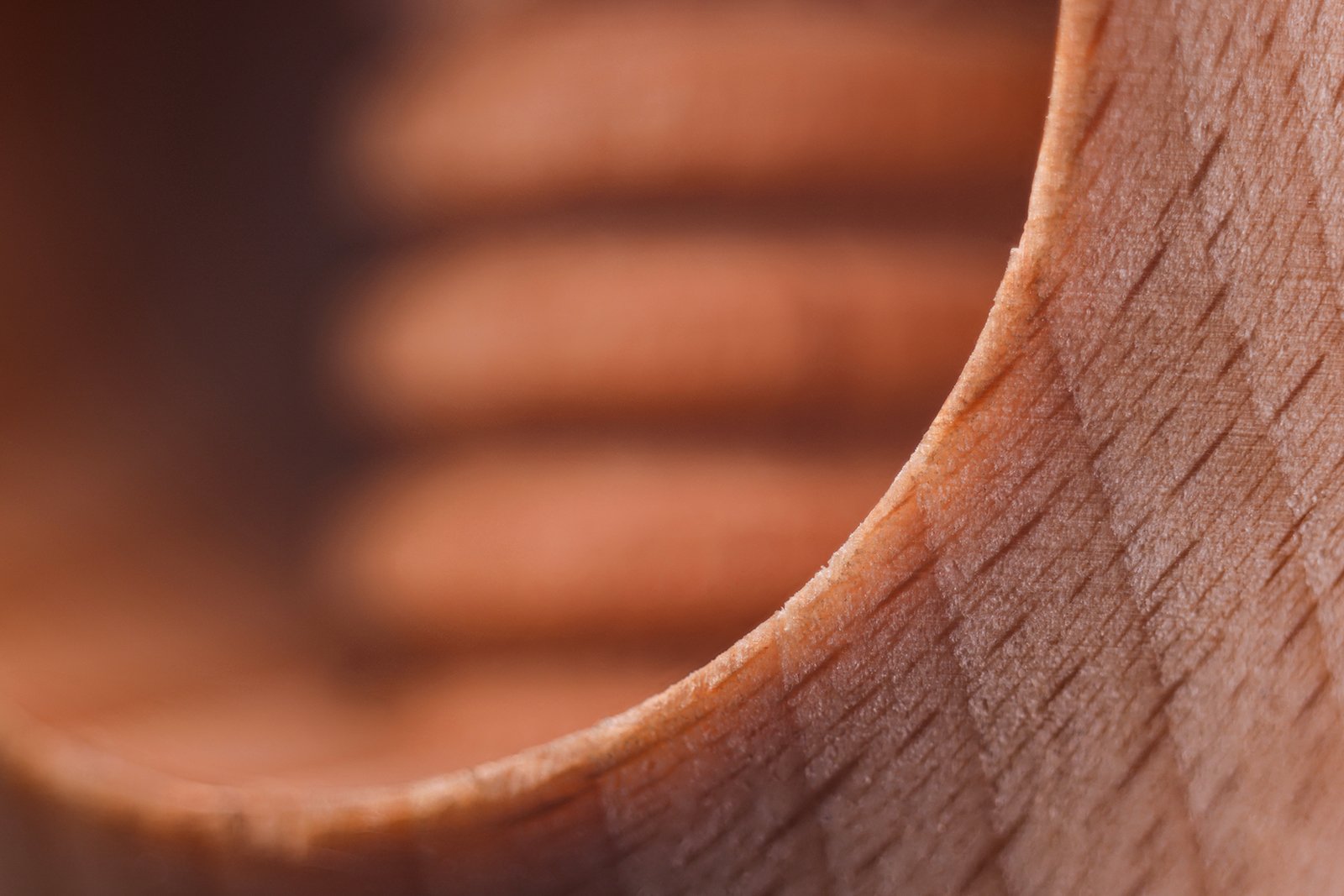
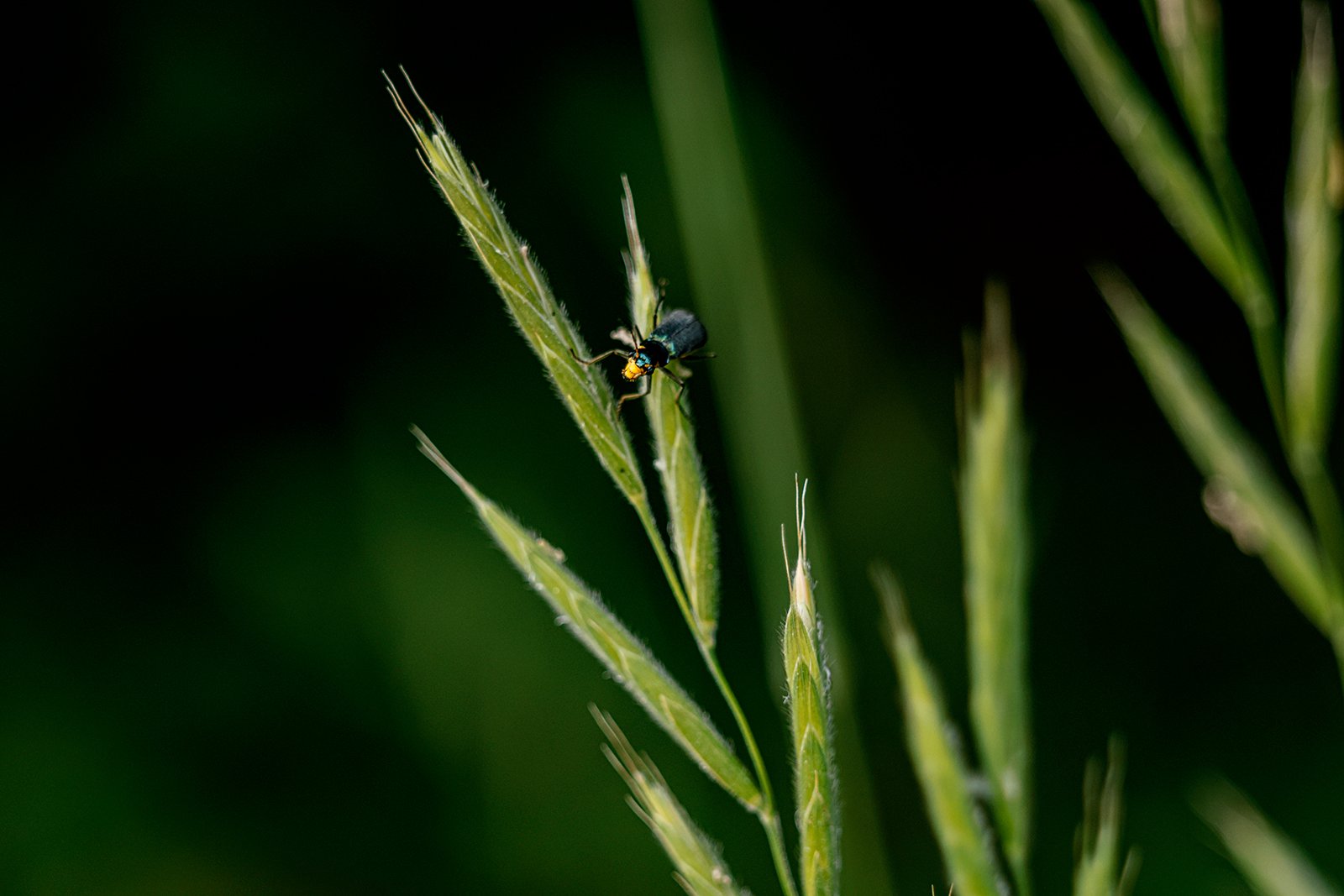

100/4.5 Friedrich Axinon
105/4.5 Friedrich Axinon
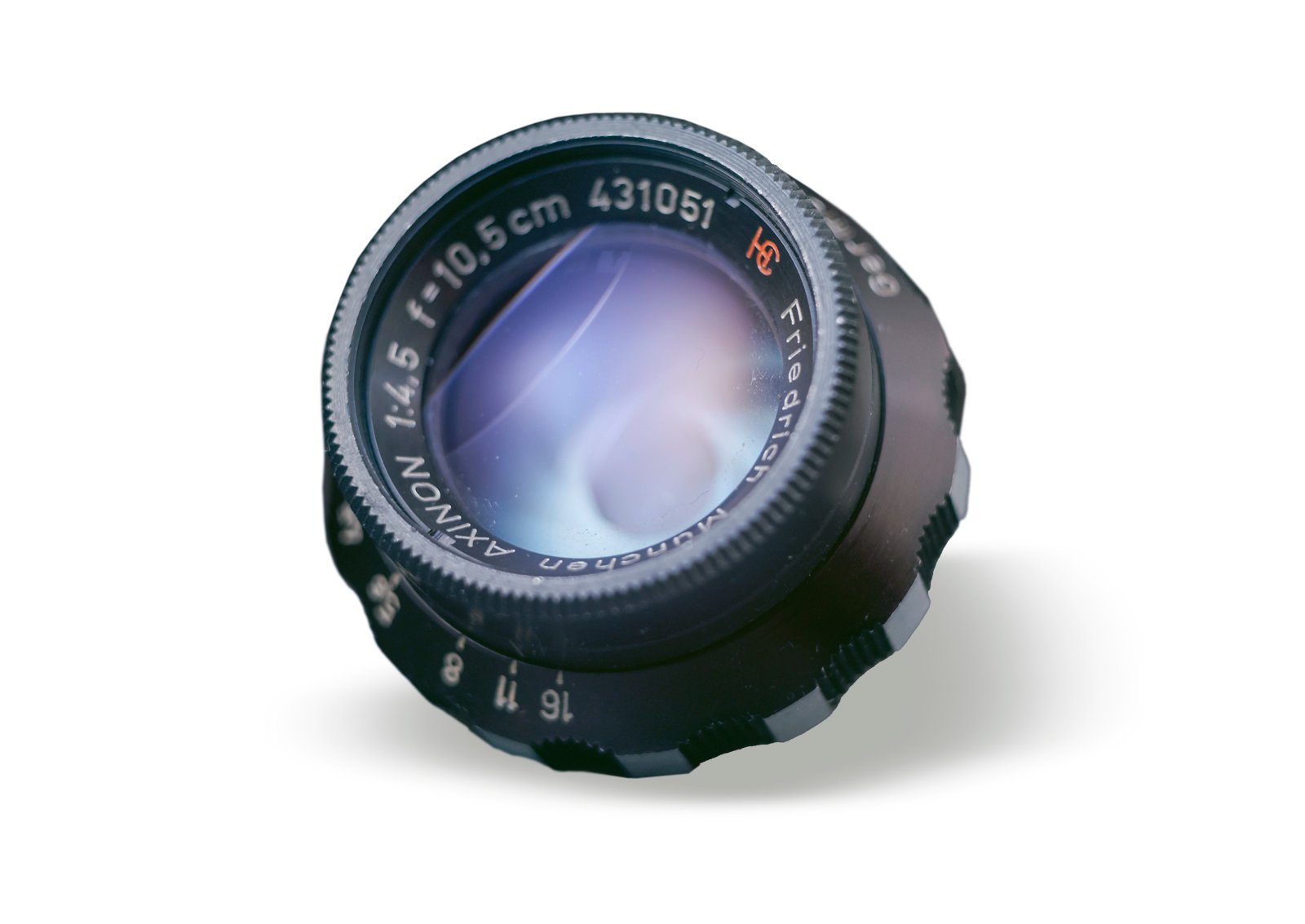
Once more a very solid lens with very nice – though some might also call it fairly plain – rendering. I’ve tried this one for real macro captures (around 1:1 and higher) and it did exceptionally well. Just a great all-round lens which is only limited by its moderate speed. The sample shown also has the beautiful but quite unusual blue aperture blades.
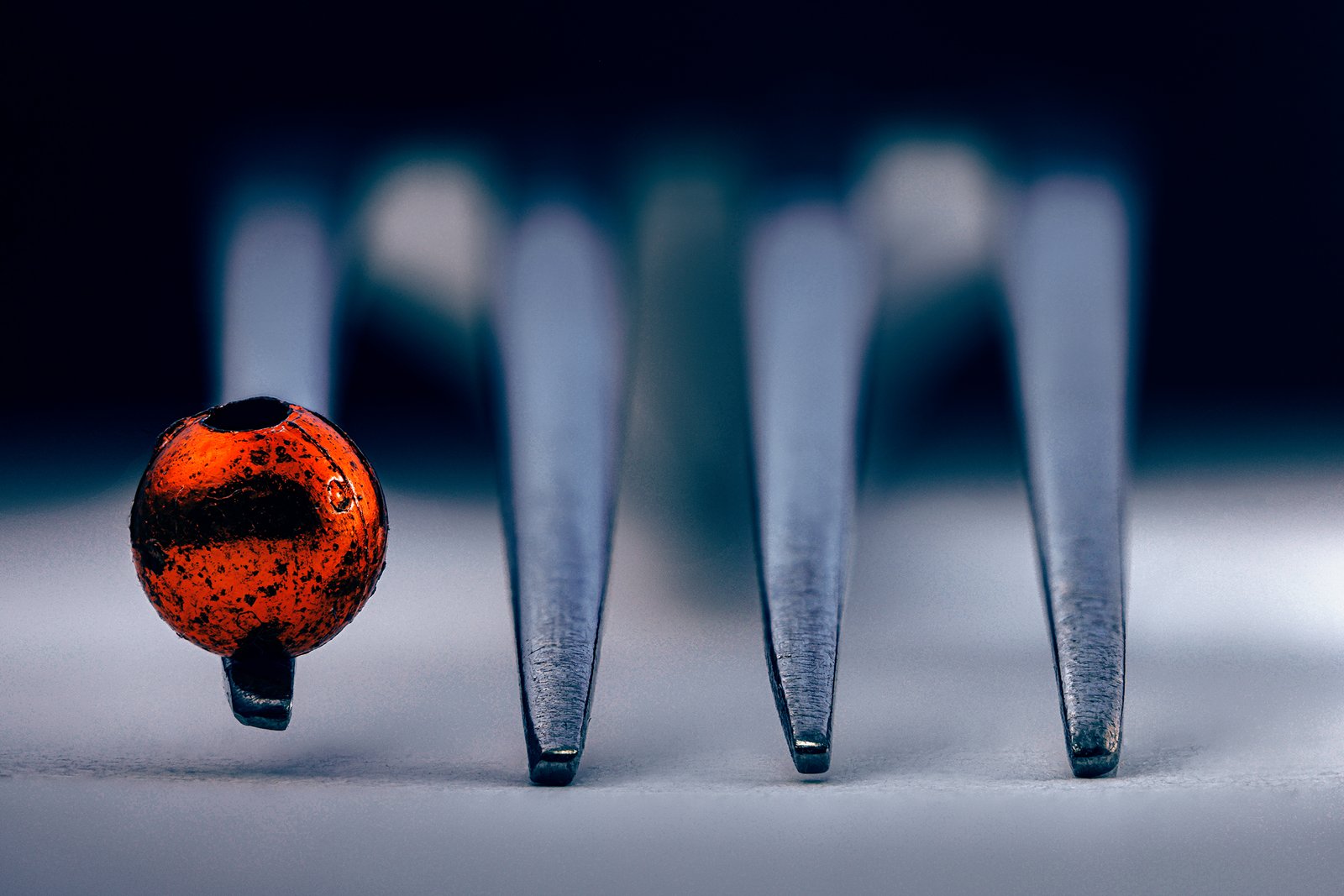
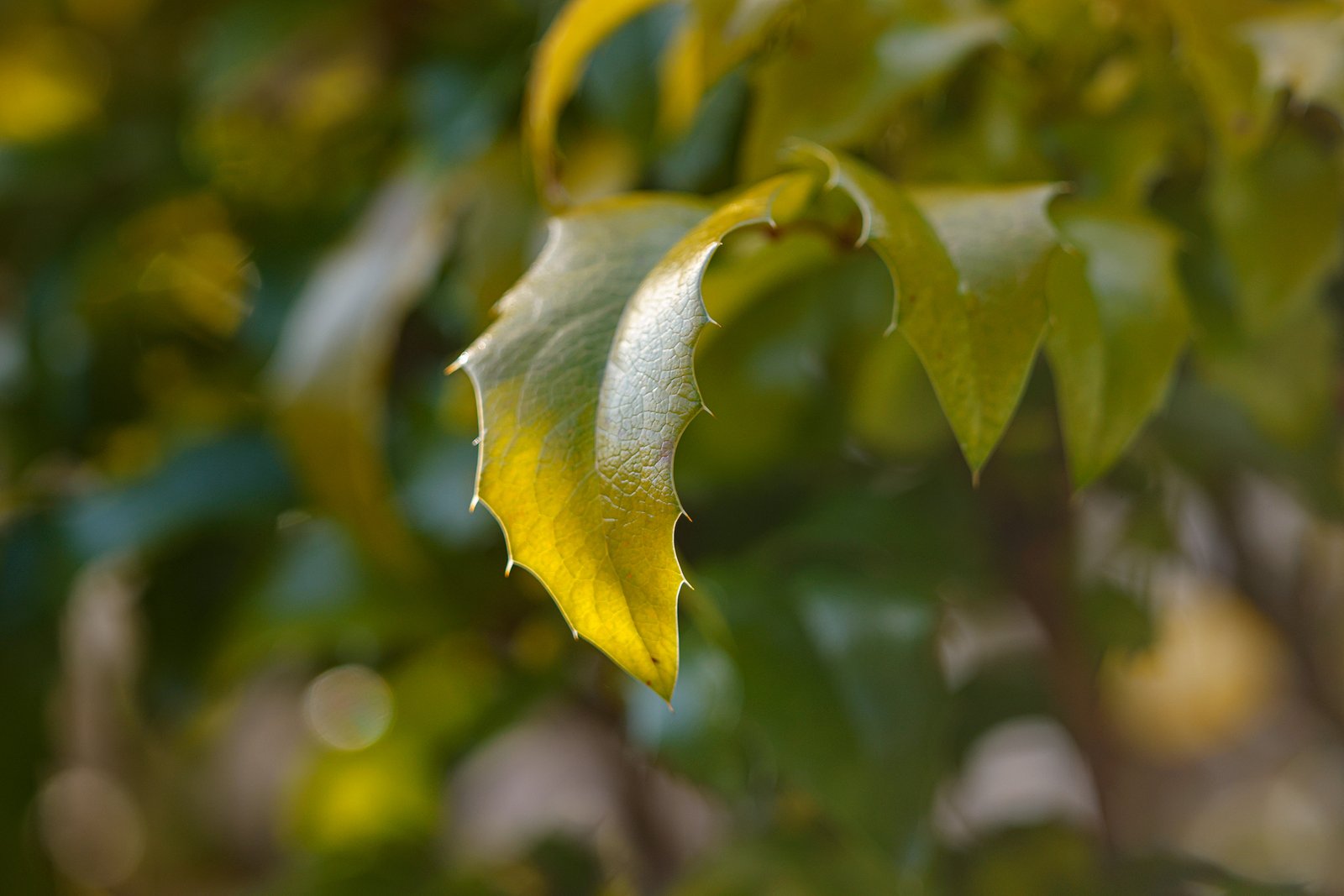

The following shots are cross-view stereo images – here’s a tutorial on how to view them.
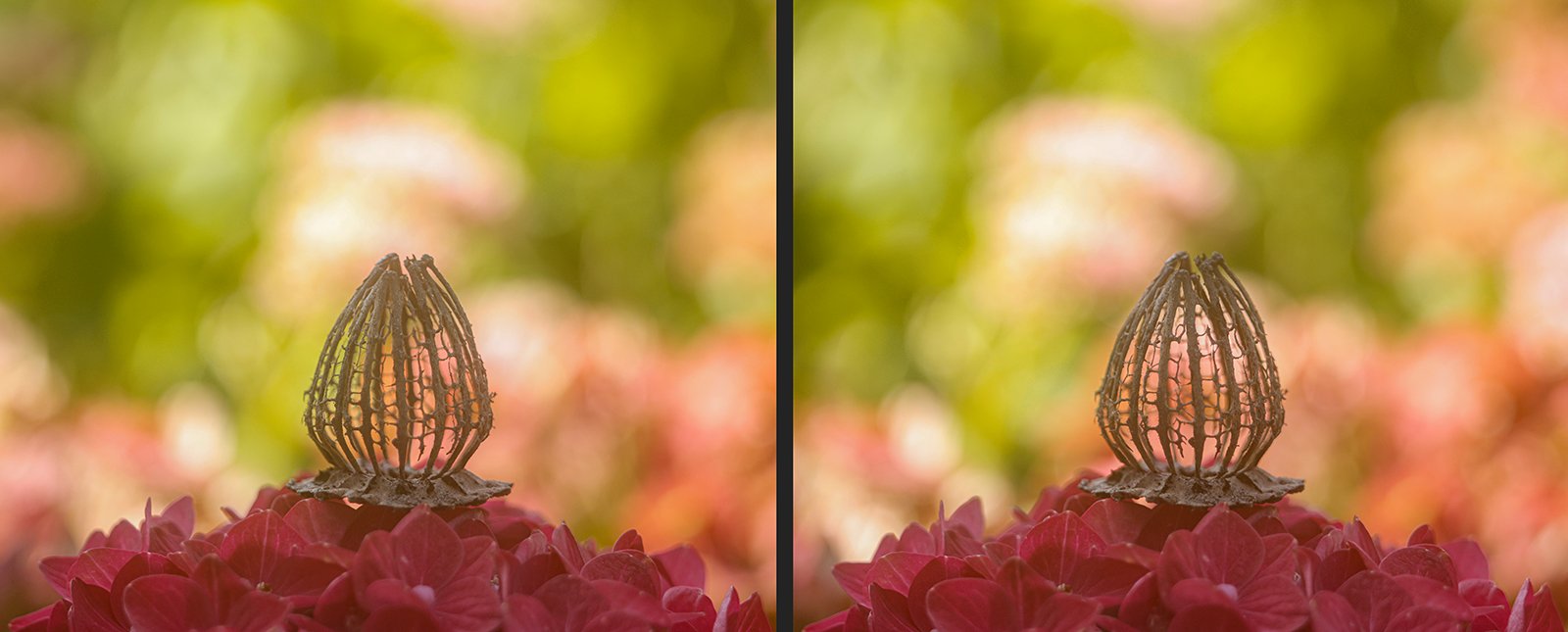
115/4.5 Friedrich Axinon
125/4.5 Friedrich Axinon
135/4.5 Friedrich Axinon
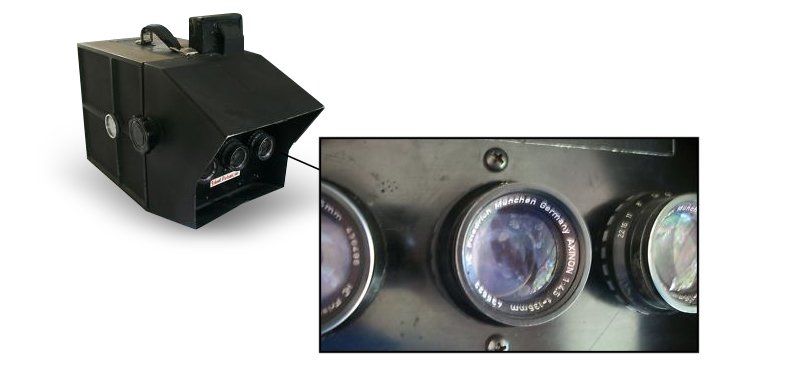
Many of these were also available as Camerz Axinon on the US market, where they were apparently used on special cameras intended for taking school portraits on medium format.
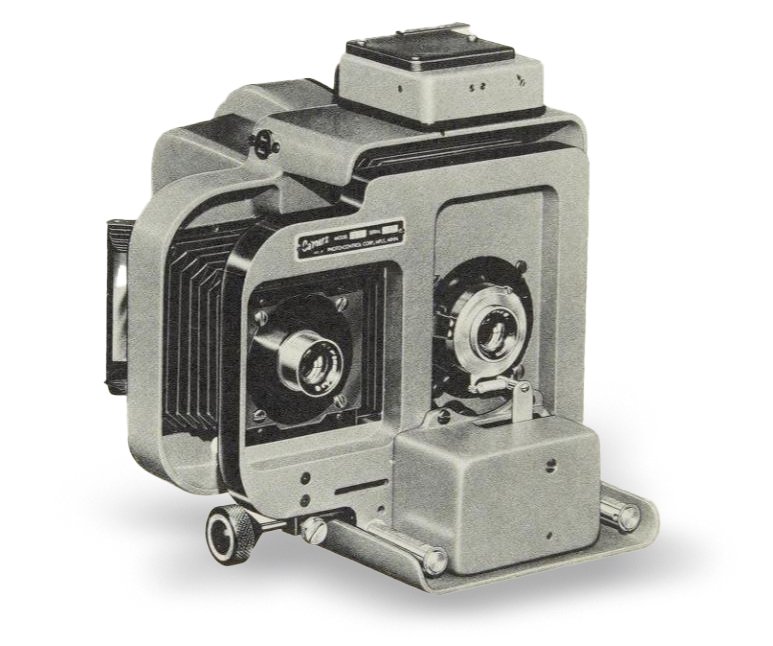
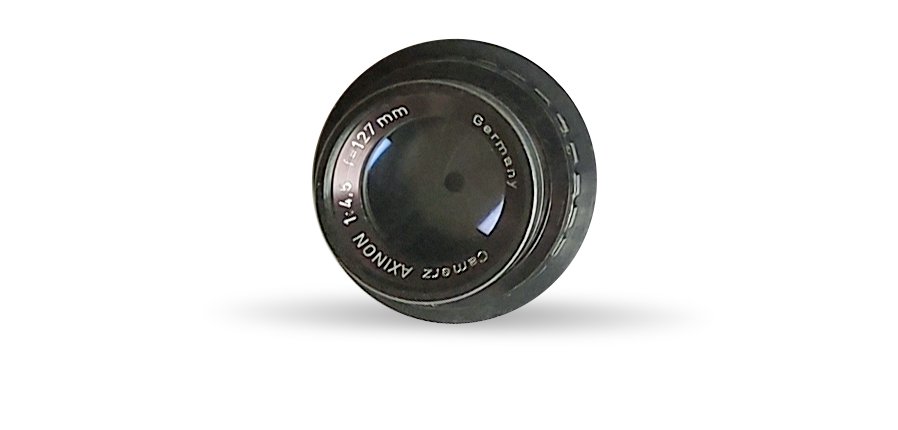
127/4.5 Camerz Axinon
The company selling these cameras called Photo-Control Corporation was also behind a number of other photographic devices and printers (minilabs) similar to the ones from Noritsu, which I’ve also written an article about. It’s not documented but plausible that Friedrich lenses may have been used in a number of them given that the most common ones even got their own labeling. The Spezial-Corygon as well as the Color-Coronar may have been used for enlarging/printing/microfilm devices for example.
LX-Axinon
Supposedly lenses for film cameras. Thiele classifies them as enlarging lenses though.
55/4.5 Friedrich LX-Axinon
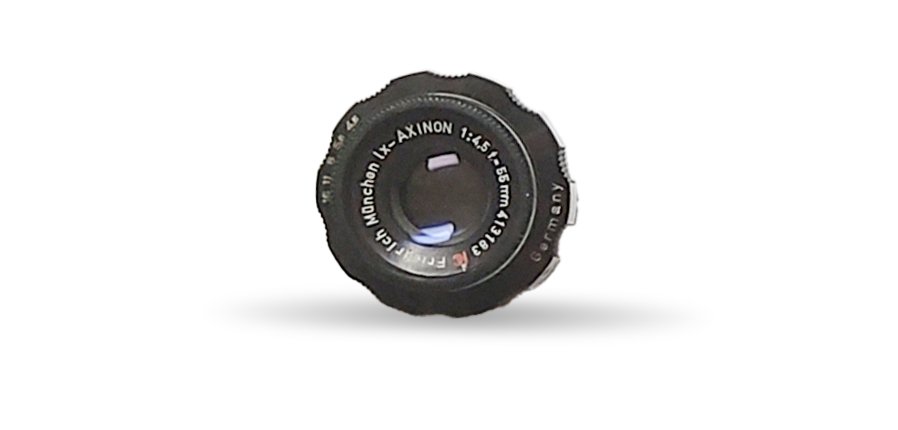
135/4.5 Friedrich LX-Axinon
C-Axinon
Could also be lenses for film cameras. Thiele classifies them as enlarging lenses though.
210/4.5 Friedrich C-Axinon
Coronar
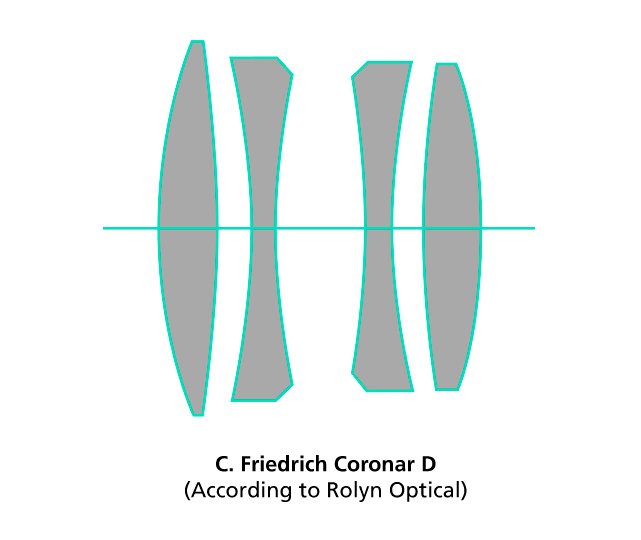
Judging by the regular Coronar lenses I own, it looks like they’re all 4 elements in 4 groups Dialyte designs, just like the description of the Coronar-D in the Rolyn Optical catalog (see further down) suggests.
4/4 Dialyte designs were not uncommon for enlarging and repro lenses for a while, with the Goerz (and later Schneider) Artar series or the Meyer Helioplan and early enlarging Ektar lenses as some of the notable examples.
50/4.5 Friedrich Coronar
55/4.5 Friedrich Coronar
60/4.5 Friedrich Coronar
75/4.5 Friedrich Coronar
90/4.5 Friedrich Coronar
105/4.5 Friedrich Coronar
120/4.5 Friedrich Coronar
135/4.5 Friedrich Coronar
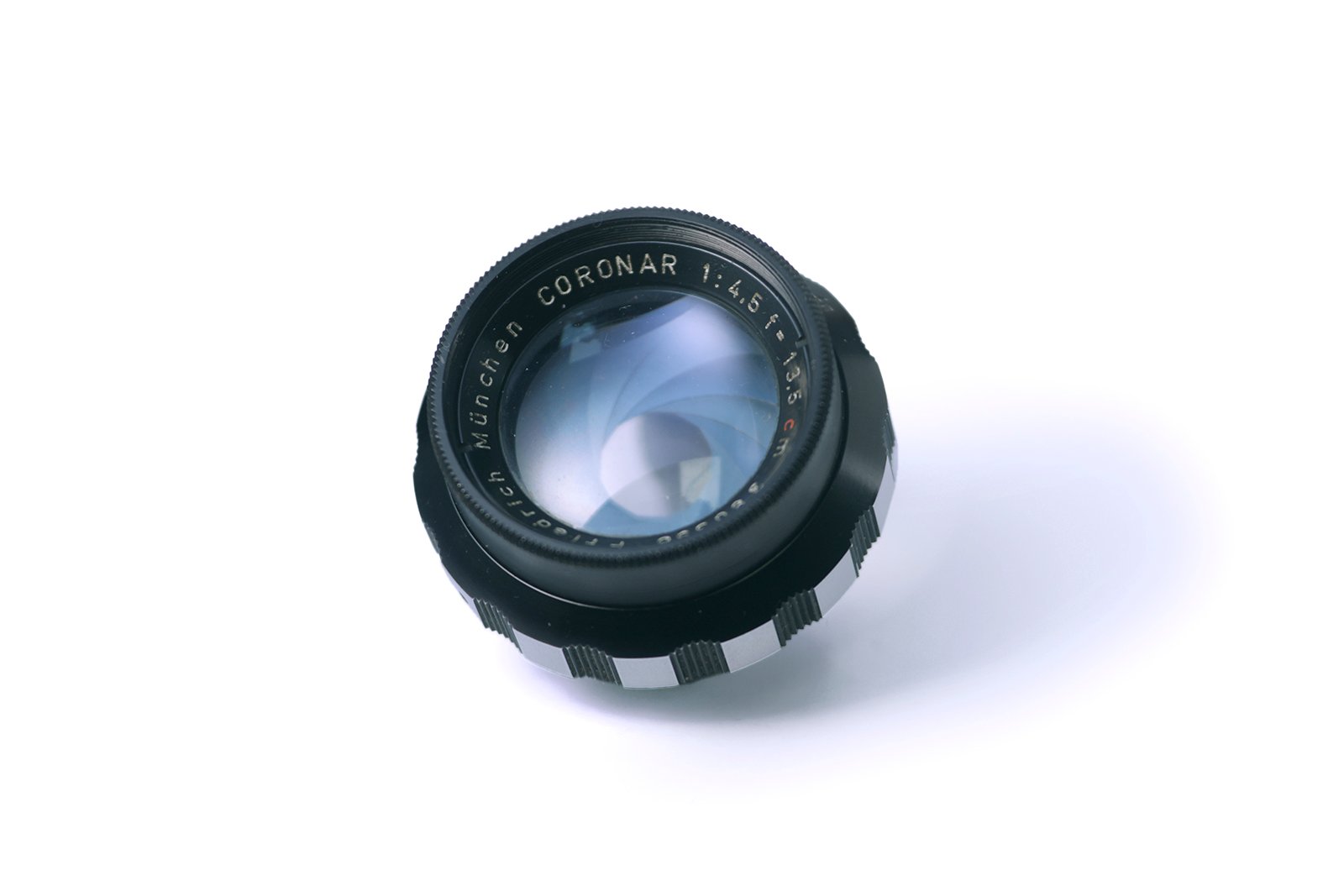
This lens seems to exist in a number of different looking versions. It’s likely that they all share the usual Coronar 4 elements in 4 groups Dialyte optical design though. Judging by serial numbers the ones with the zebra-design and blue aperture blades seem to be the later versions. The version below seems to be uncoated, while the zebra-style lens does have the typical blue/purple coating. The latter also has click-stops while the older variant does not.
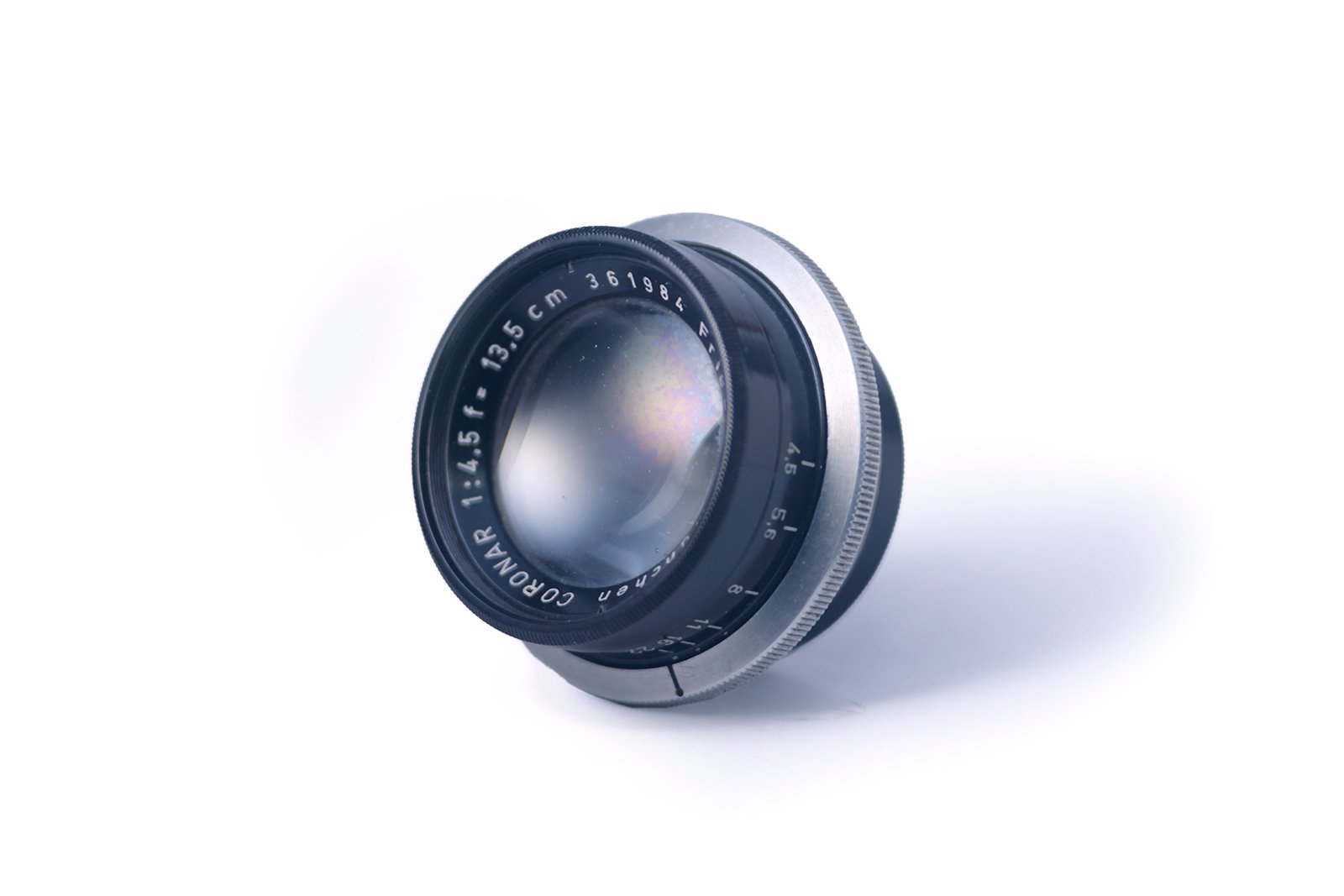


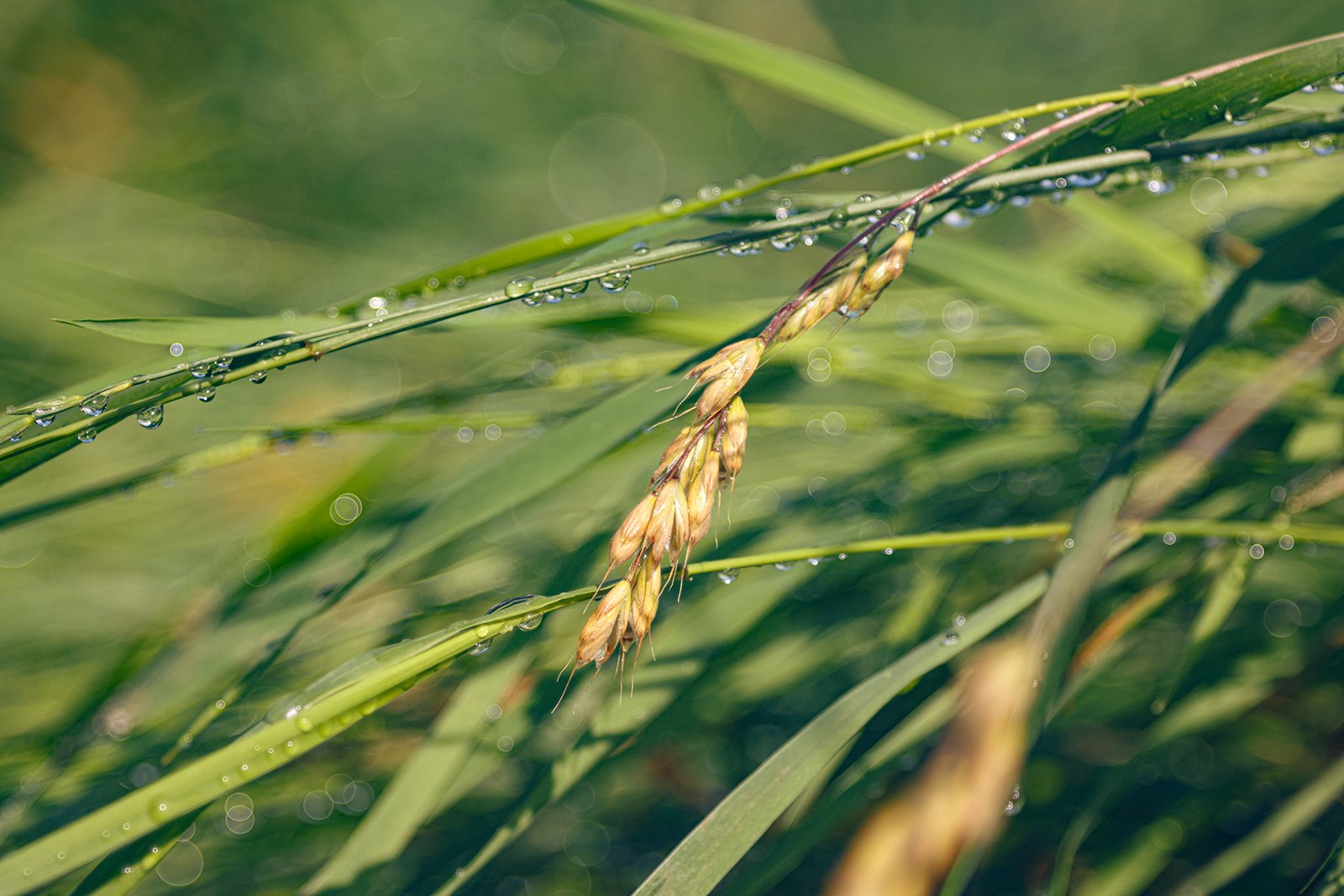
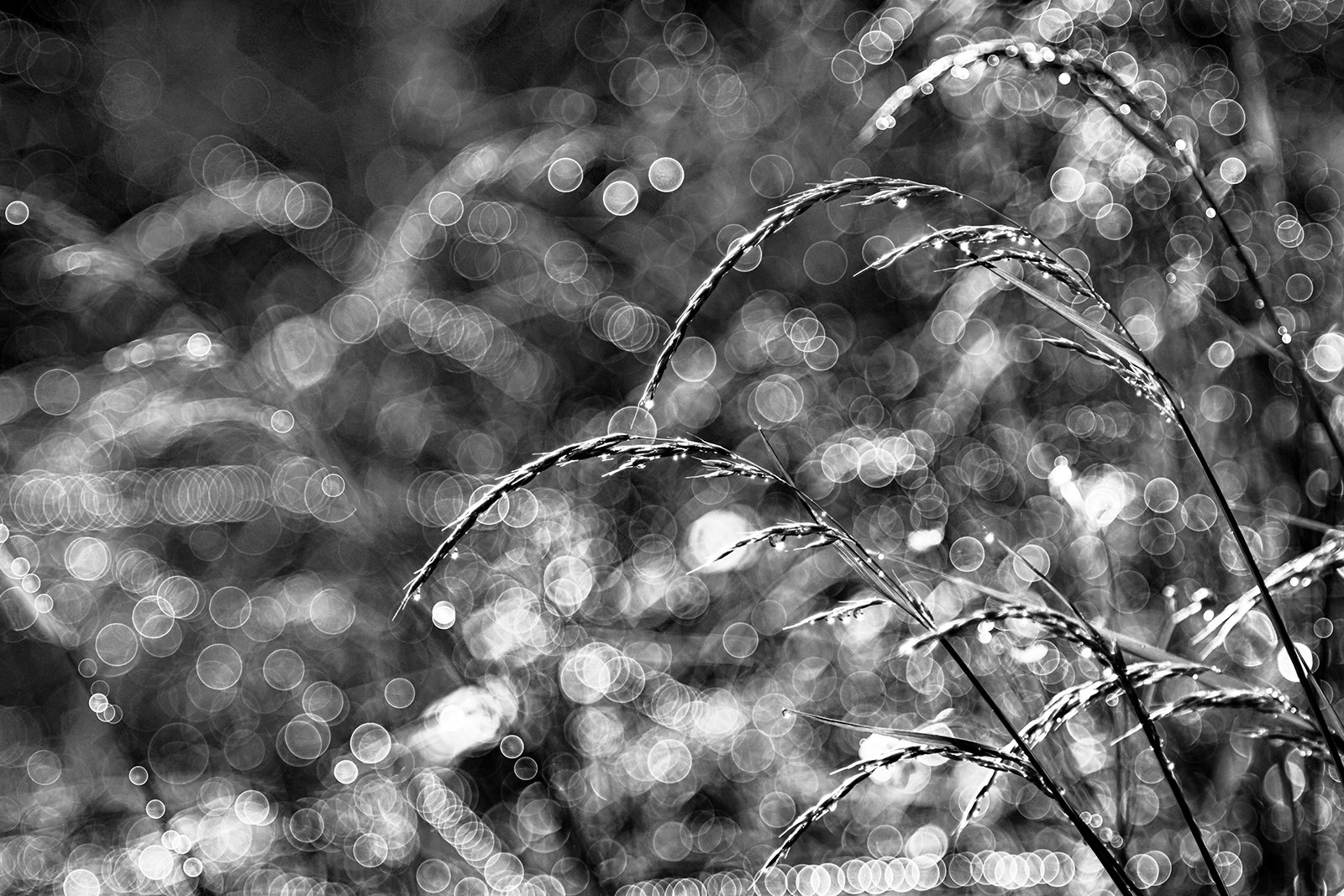
152/4.5 Friedrich Coronar
180/4.5 Friedrich Coronar
210/4.5 Friedrich Coronar
240/6.8 Friedrich Coronar
Coronar-D
4 elements in 4 groups and described as a “symmetrical Cooke type” (which is just another name for a Dialyte) design. Optimized for 1:1 to 1:5 and coated, with blue-ish coating very typical of many Friedrich lenses. According to the Rolyn Optical catalog they made use of lanthanum glass for this series.
135/4.5 Friedrich Coronar-D
152/4.5 Friedrich Coronar-D
163/4.7 Friedrich Coronar-D
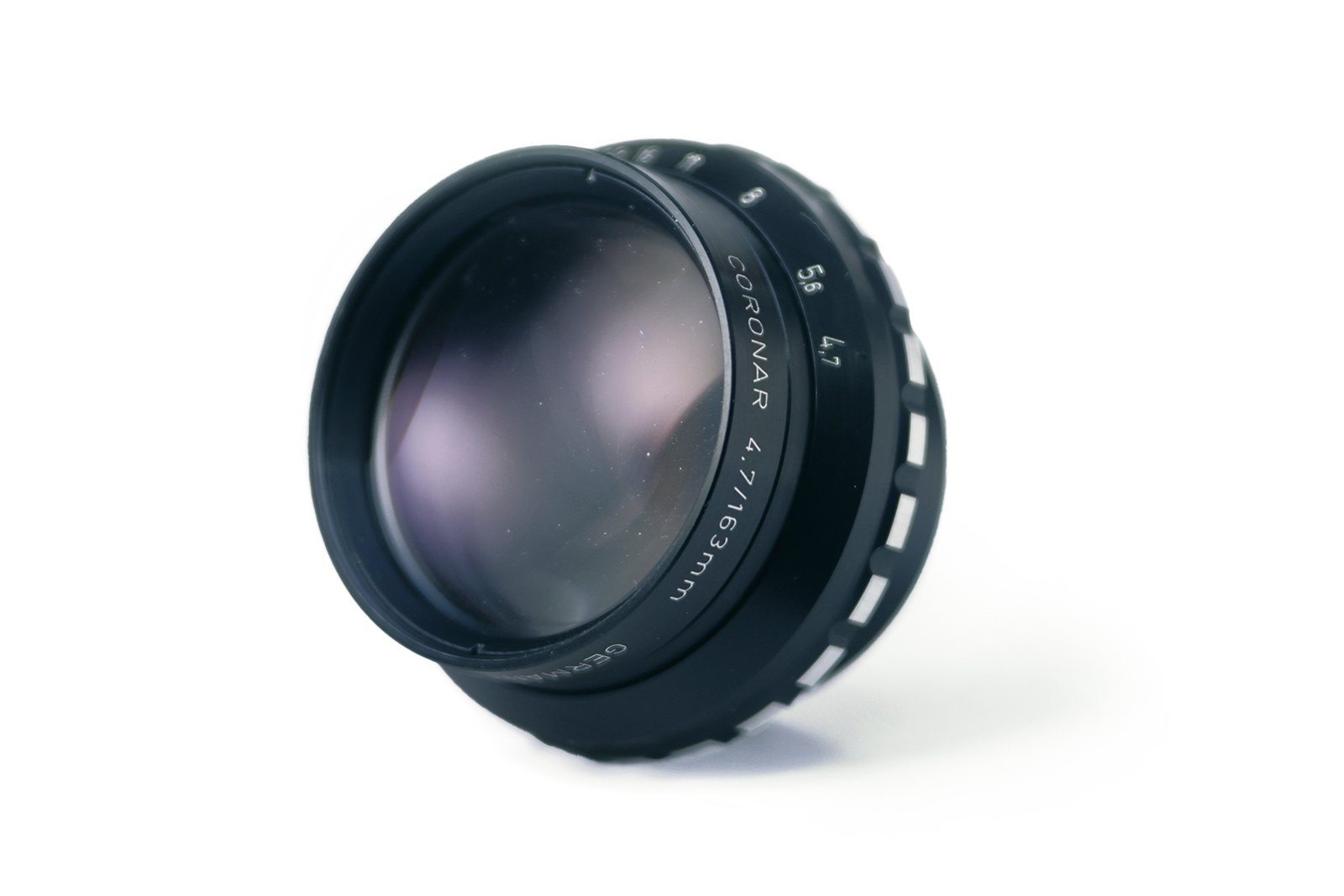
This lens has been a victim of its focal length… with 163 mm and a necessary extension of 100+ mm for infinity focus it just is too cumbersome to handle for most applications. And because of its optimization for the close-up range it usually needs even more. Its performance at the magnification it was made for is quite good but unless you’re working on a setup with a bigger sensor I don’t think any of these lenses are an ideal choice. It could make a nice tube-lens though, so perhaps that’s something to try in the future.
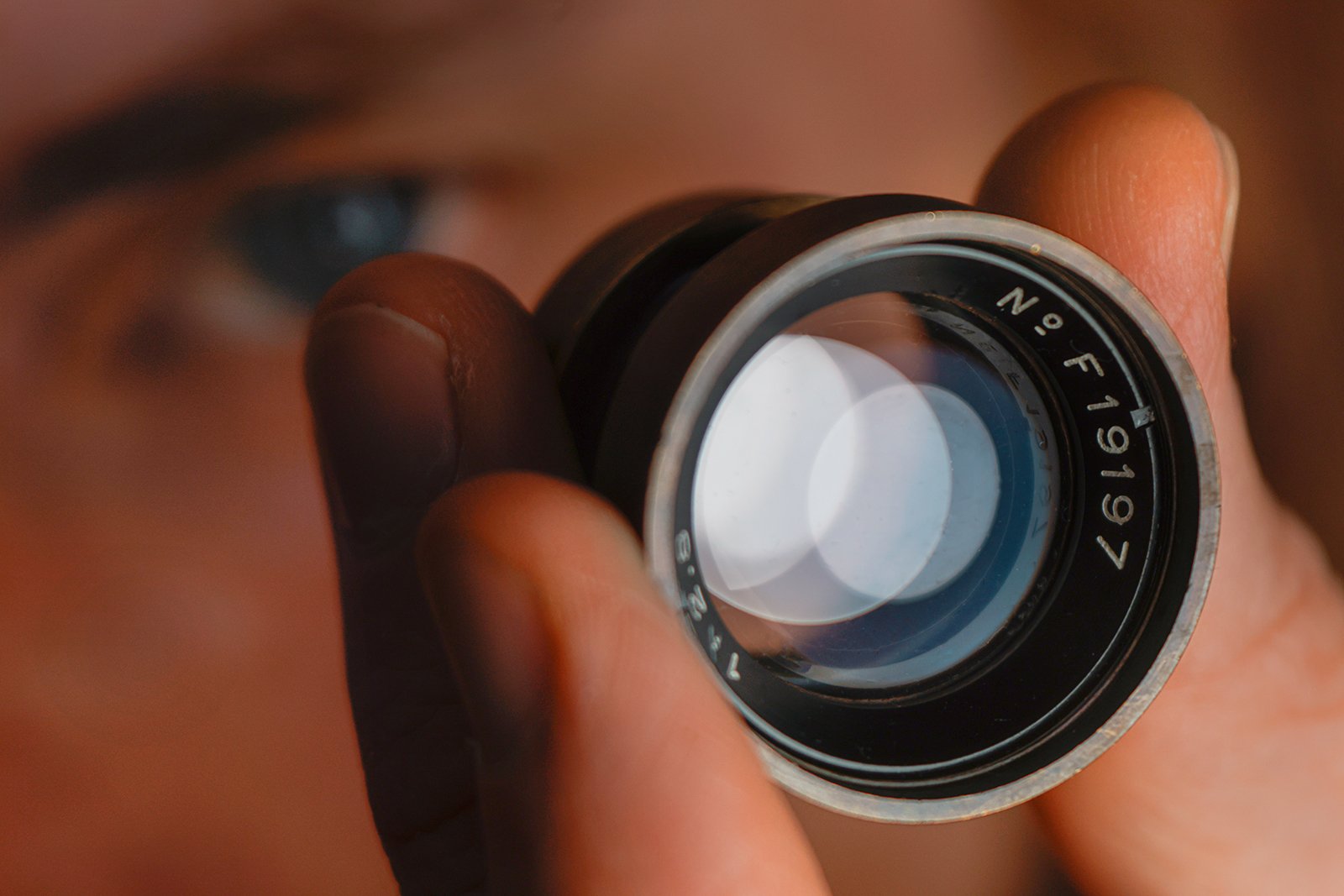
240/4.5 Friedrich Coronar-D
300/4.5 Friedrich Coronar-D
360/4.5 Friedrich Coronar-D
90/4.5 Friedrich (Projektions-)Coronar
The only known Coronar projection lens I’ve seen so far is part of the collection of the Narodni Museum Techniki Warszawa (Warsaw, Poland). According to the information provided there it has a focal length of 9 cm and a variable aperture mechanism.
S-Coronar
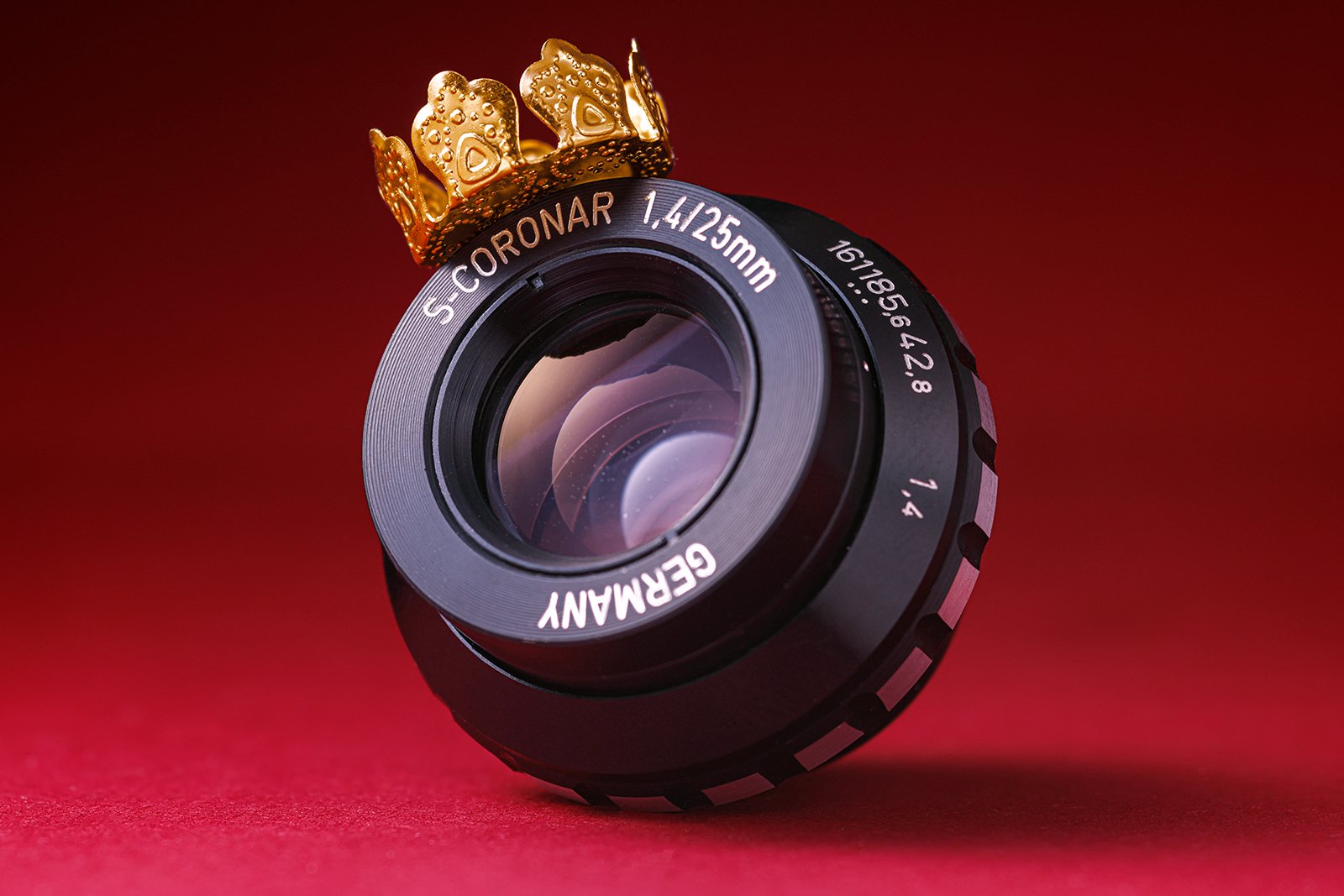
According to the information contained in Rolyn Optical catalogs, the S-Coronar lenses are a 6/4 symmetrical design made for critical projection and optical comparator applications. They are often referred to as enlarging lenses in listings etc. but their original purpose likely doesn’t imply the lenses featured the type of correction this type of lenses is known for.
The S-Coronar series lenses are somewhat rare and seem to be sought-after by people who likely want to use them for filming, perhaps as cheaper alternatives to the extremely expensive Dallmeyer Super-Six, Bausch & Lomb Super-Baltar or Tayor Hobson/Cooke Speed Panchro lines for example. Unfortunately I don’t have any of these rare lenses to compare it directly.
While some similarity in terms of look/rendering is quite possible (after all most of the ones mentioned are 6 element Double Gauss lenses as far as I’m aware) I’m not sure the S-Coronar is up to the famous cine-lens equivalents in terms of sharpness and correction wide open. It does have an interesting OOF look however, so I get why these lenses could appear to be viable alternatives.
Unfortunately by being relatively well known among a number of Leica camera owners with a faible for fast cine lenses (and in some instances also the money to buy several Super-Six, Super-Baltar and Speed Panchro lenses), these lenses might be snatched in an instance, as soon as they appear for a reasonable price. And so it took some time before I finally found one of those faster S-Coronar lenses.
Because a big surplus seller online, who might have bought a significant part of the inventory from Rolyn Optical when it closed its doors in 2012, shared information about prices online, we know the original cost for a couple of them and can do some rough guesswork depending on focal length and speed. And even in a low estimate the high-end series (f/2.8 & f/1.9) might have cost double the price of the excellent Componon-S and Apo-Componon series by Schneider Kreuznach or the Rodenstock Apo-Rodagon lenses.
Were they better enlarging lenses because of that? I certainly don’t think so. But what it comes down to is speed and when compared with enlarging lenses they are indeed almost peerless. There’s only a handful of similar lenses which matches them including the Chugai Computar-DL 55/1.9 or the Schneider-Kreuznach Xenon f/2 industrial lens series.
But if they’re not actually enlarging lenses and due to deficiencies in terms of optical correction not exceptionally suited for that purpose, why even compare them to enlarging lenses or count them among those? Well… long story short, here are some of the reasons:
- They look and feel like enlarging lenses
- C. Friedrich had specialized on producing enlarging lenses after WWII
- Famous darkroom expert Ctein included them in his notable “Enlarger lens buying guide” in Darkroom Photography, January 1989.
- They seem to be 6 elements in 4 groups and were only available in an unusual thread mount and none of the known cine-mounts.
They are however projection lenses, according to the only official source available, so it’s best to keep that in mind!
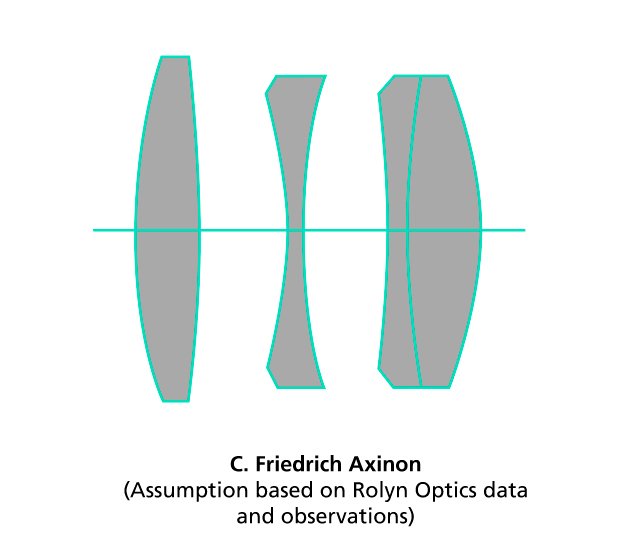
I can only make guesses about the optical design, because there is no lens drawing anywhere as far as I know:
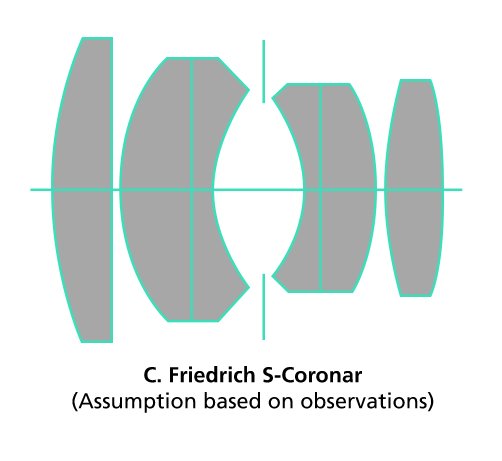
I’ve based this drawing mainly on a patent (US000002734422A) assigned to T. Brendel for Agfa in 1957, which corresponded somewhat with my own observations in terms of lens diameters etc. Because I haven’t fully disassembled the lens it’s still a mere assumption however.
Interestingly enough Rolyn Optical offered several series of superfast Double Gauss lenses in addition to the S-Coronar. The most notable being the Dallmeyer Super-Six
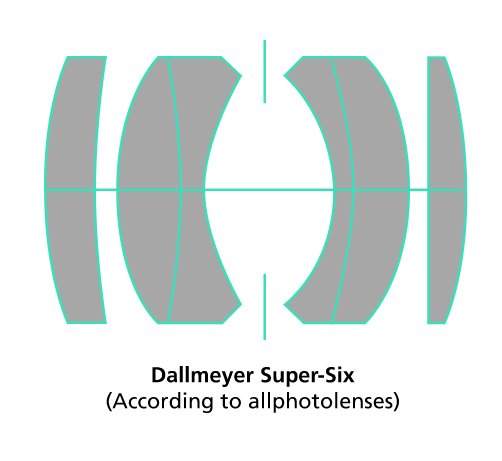
and also the Boyer Saphir (f/1.4 & f/1.9) lenses:
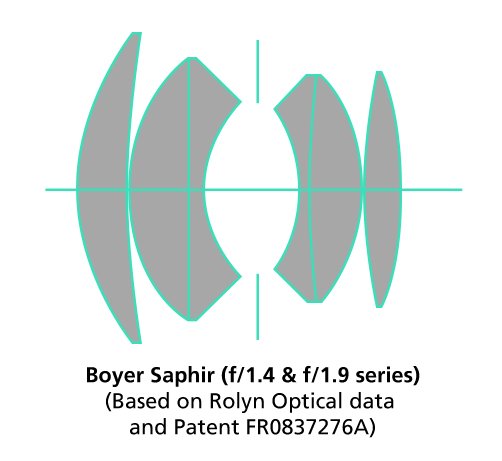
They certainly look similar to the S-Coronar but not identical. That’s to be expected of course, given that all of them share the same heritage – Lee’s Opic (Taylor Series O) from the 1920s. Both, the fast Boyer Saphirs as well as the Dallmeyer Super-Six are very rare on the used market as well and fetch significantly higher prices when they appear.
| f/2.8 series |
35/2.8 Friedrich S-Coronar

50/2.8 Friedrich S-Coronar

Many of the S-Coronar lenses seem to exist in versions with and without a variable aperture and the inscriptions vary as well. Because of this they’re not always easy to spot. If you look out for old lab equipment or surplus stock (though most of the latter might have run out by now) your chances of finding a lens of that family for a reasonable price might increase.
An old listing I found mentioned an original price of 245 $ which roughly equates to around 2000 $ today. While there’s no source to compare exact prices of the same year, the Friedrich lenses might have cost twice as much as comparable (and likely in some aspects) superior Schneider Kreuznach Componon-S or Rodenstock Apo-Rodagon lenses. So the only explanation is an added premium for industrial application and serivce.
58/4 Friedrich S-Coronar

I’m not really sure what this lens is… my suspicion is that it’s an f/2.8 variant, stopped down to f/4 in order to improve image quality. While there is indeed a metal aperture disk inside of it, which can be removed, image quality isn’t very convincing – both as intended at f/4, and particularly not wide-open at f/2.8. So perhaps it is a different (cheaper) design after all or I just happened to get a bad sample. I do wonder why this particular lens got the S-Coronar name though, particularly because it doesn’t seem to be a 6 element lens, but rather a 5 elements in 4 groups one.
65/2.8 Friedrich S-Coronar
75/2.8 Friedrich S-Coronar
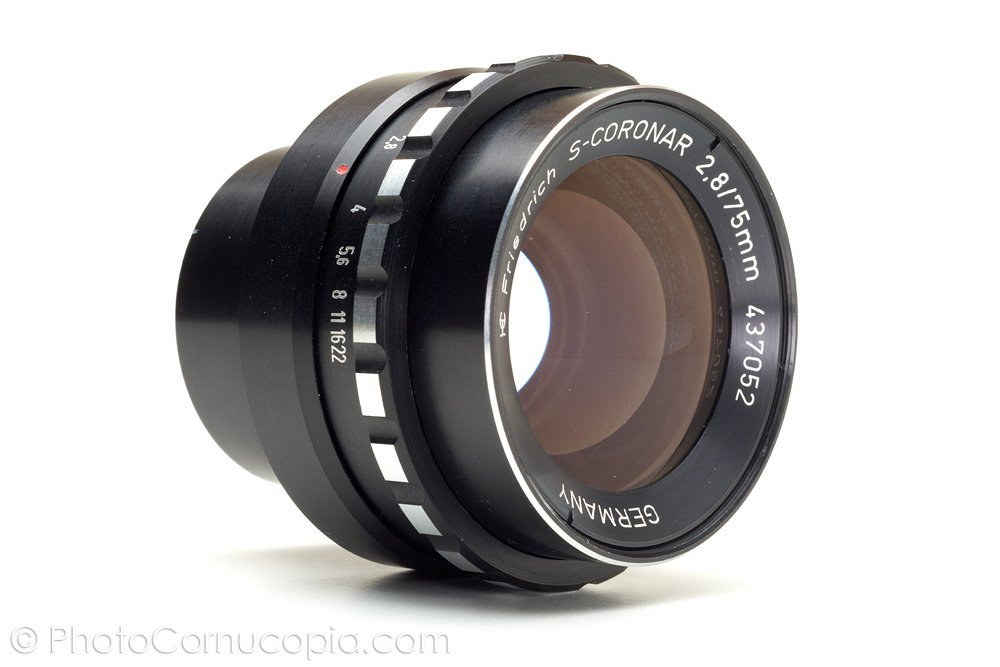
John Jovic, expert on adapted lenses from Australia and creator of the Big List of Enlarging Lenses, has shared some images of this lens as well as sample shots online. It looks similar to the f/1.9 variant and judging by the sample shots it behaves better than its faster sibling when it comes to image quality wide open.



It’s likely that it features the same optical design because – according to John Jovic – it also is a 6 elements in 4 groups Double Gauss design.
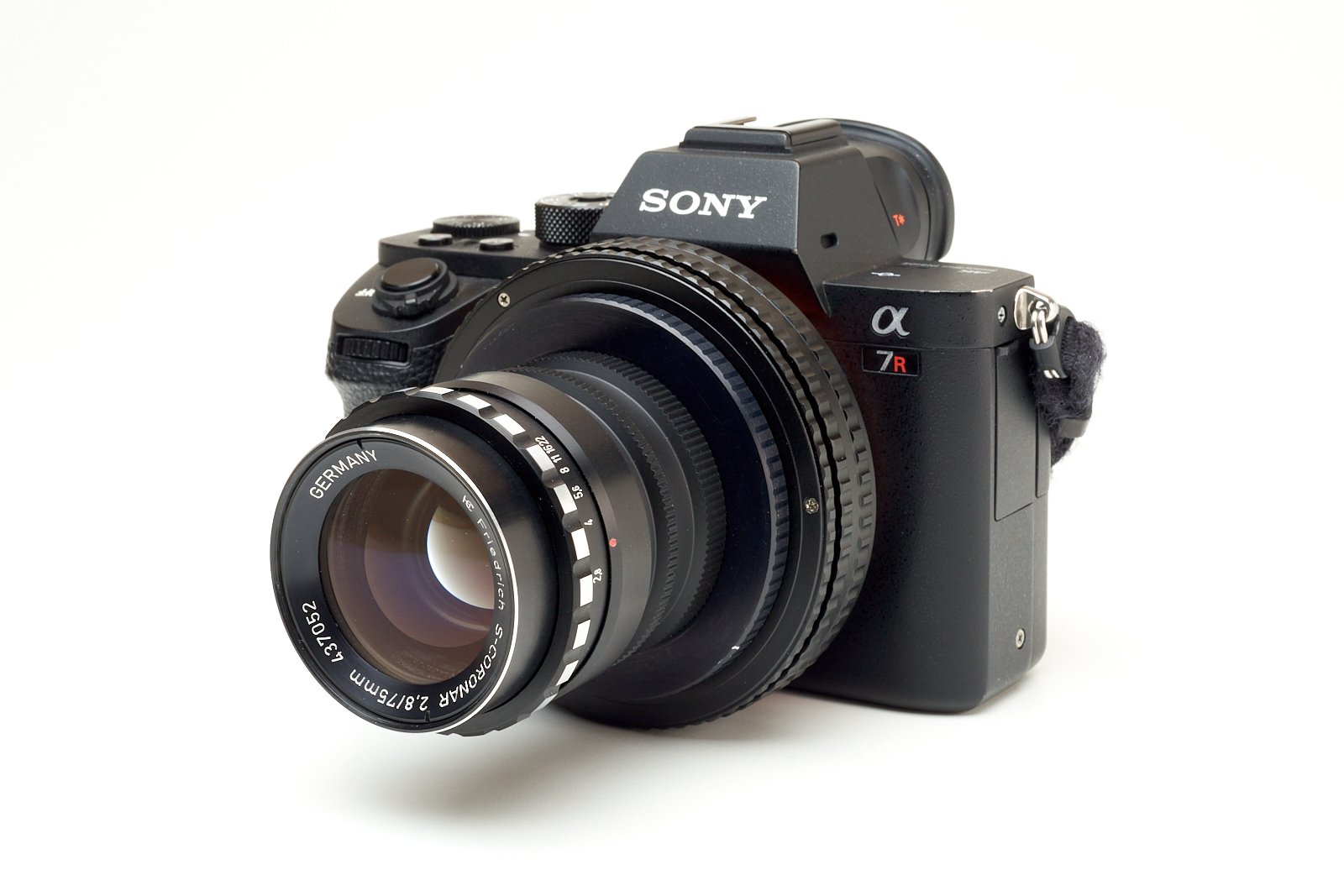
User calvin83 has also shared some shots on the mflenses forum and in addition mentioned an interesting detail about these lenses in his post:
“ There are at least two different variants: one with the name Friedrich with SN on the id tag and the other one with only S-Coronar and Germany.”
(calvin@lensfever)
I had actually never noticed that before, but it could be true for the whole S-Coronar family and might even pose an additional obstacle in finding one, when looking for a Friedrich lens. Why the different inscriptions were made? Who knows. It could have been part of a deal with some distributor or caused by some kind of copyright issue in particular countries. I’ve also seen these lenses with and without the logo shown at the start of the article and have wondered if this was stopped after a certain date.
Theodor Brendel certainly kept the C. Friedrich name around for his optical workshop until it was dissolved, but it’s possible that different clients (like Rolyn Optical) had particular requirements in the types of inscriptions/branding allowed. They certainly never mention Friedrich (or even more notable names like Boyer, Dallmeyer or Rodenstock) by name in their catalogs.
Here are a couple of beautiful shots by calvin@lensfever:
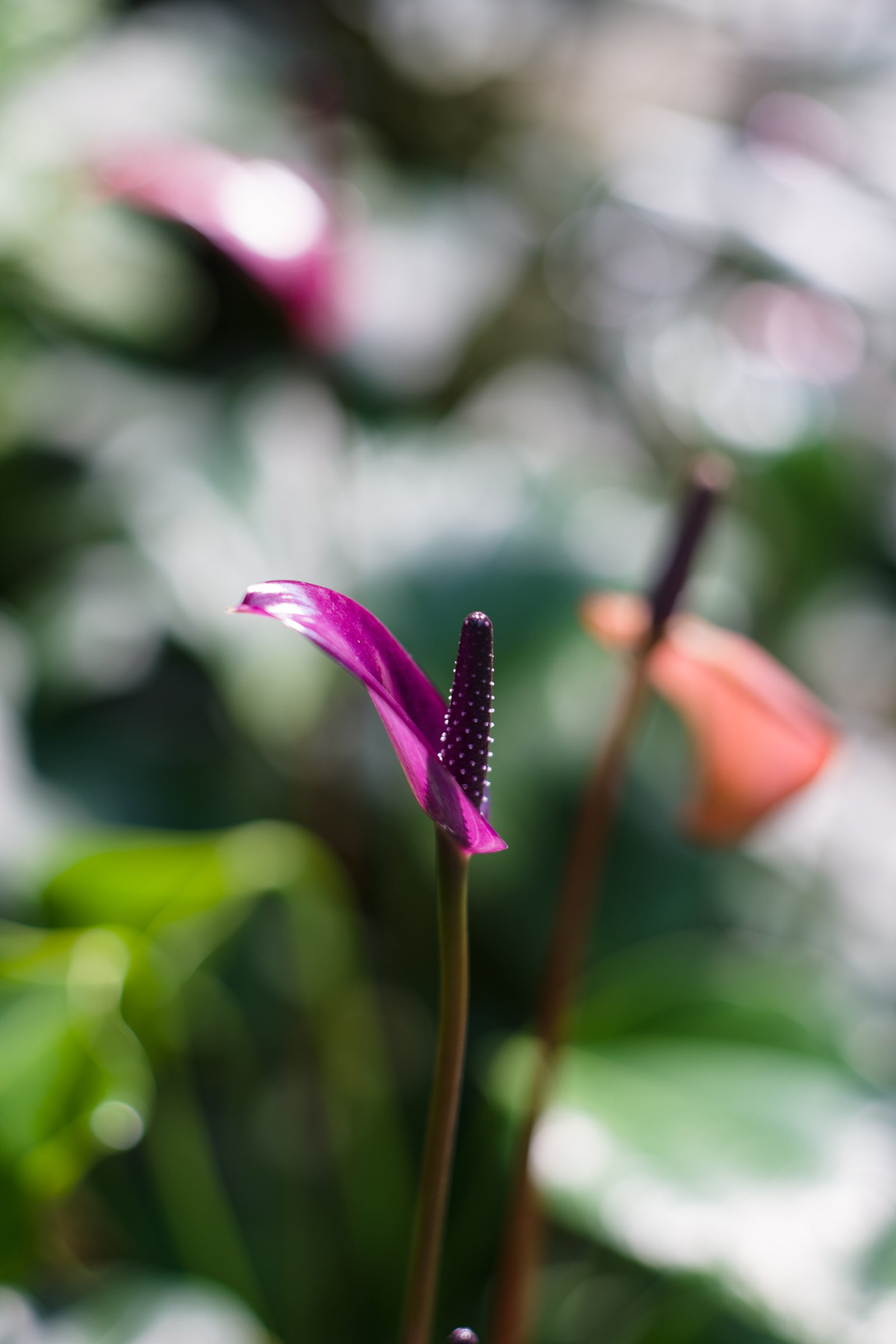
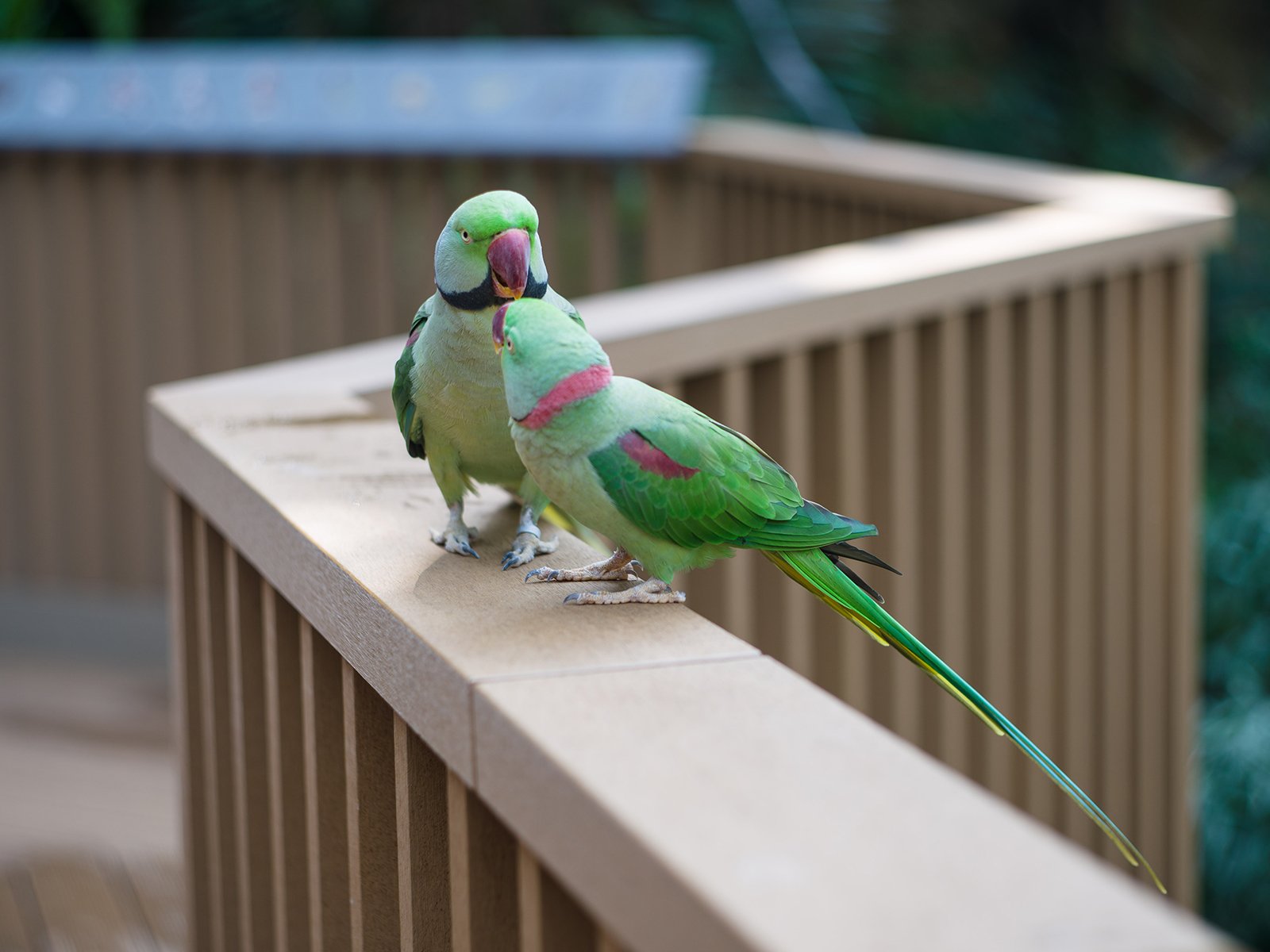
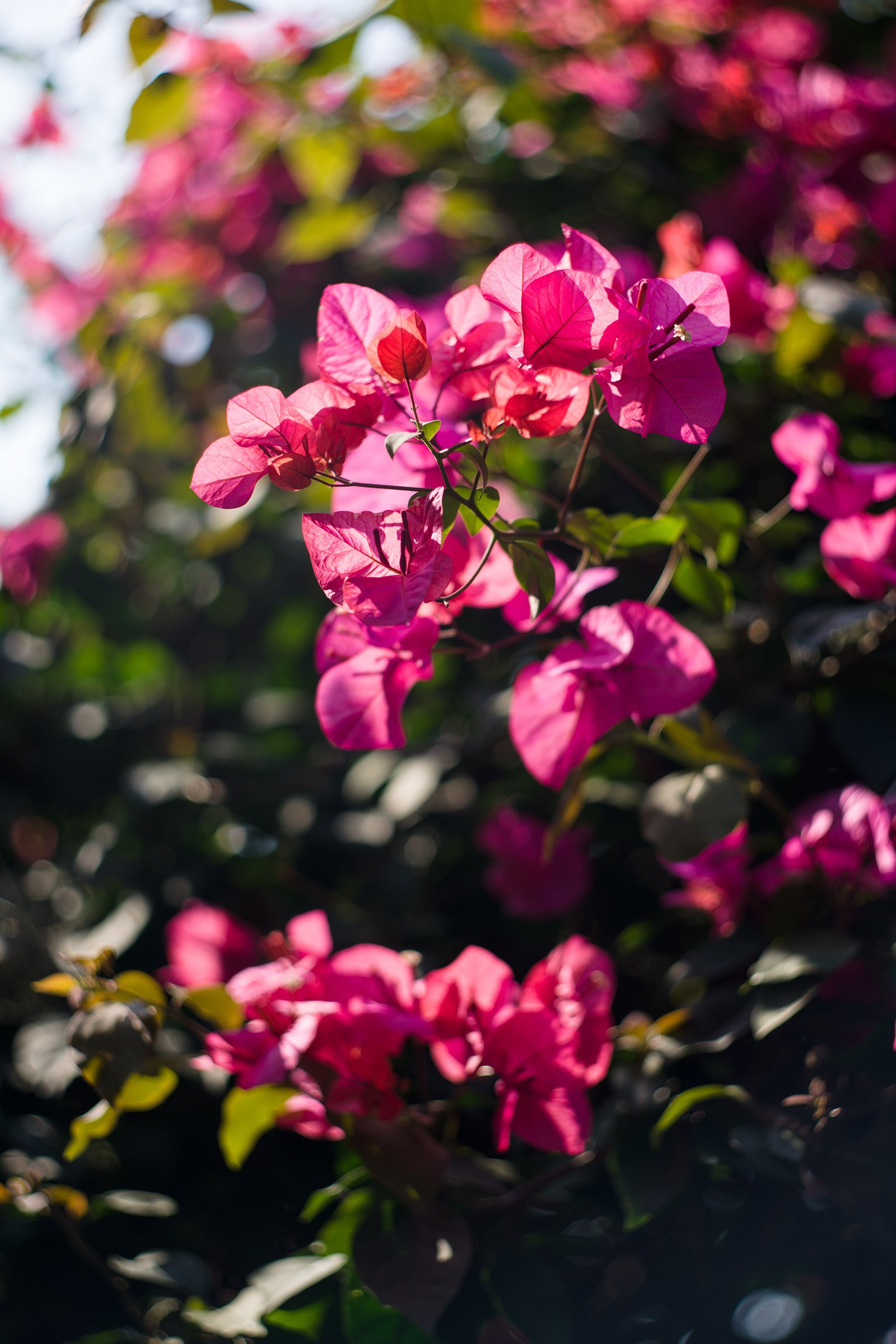
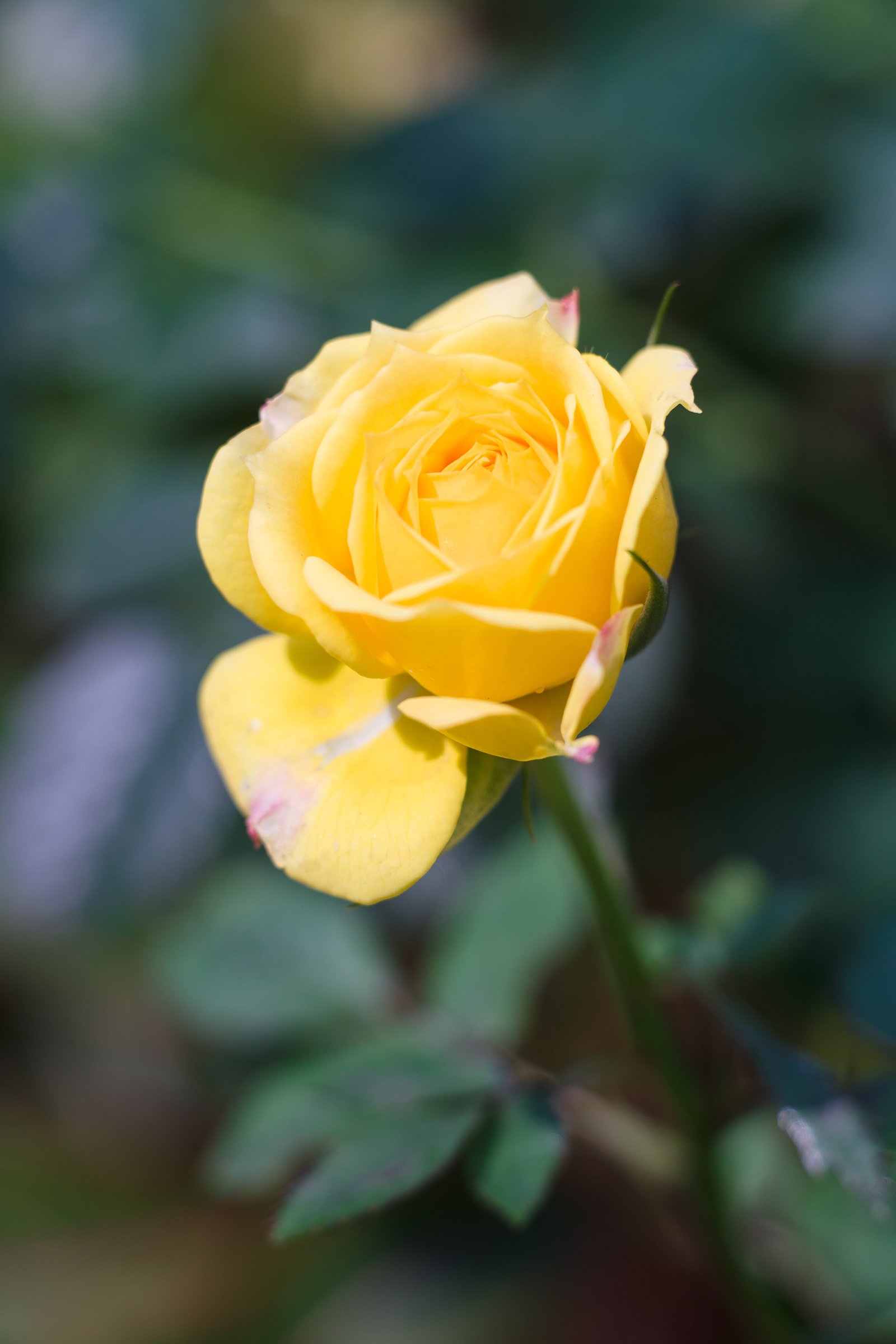

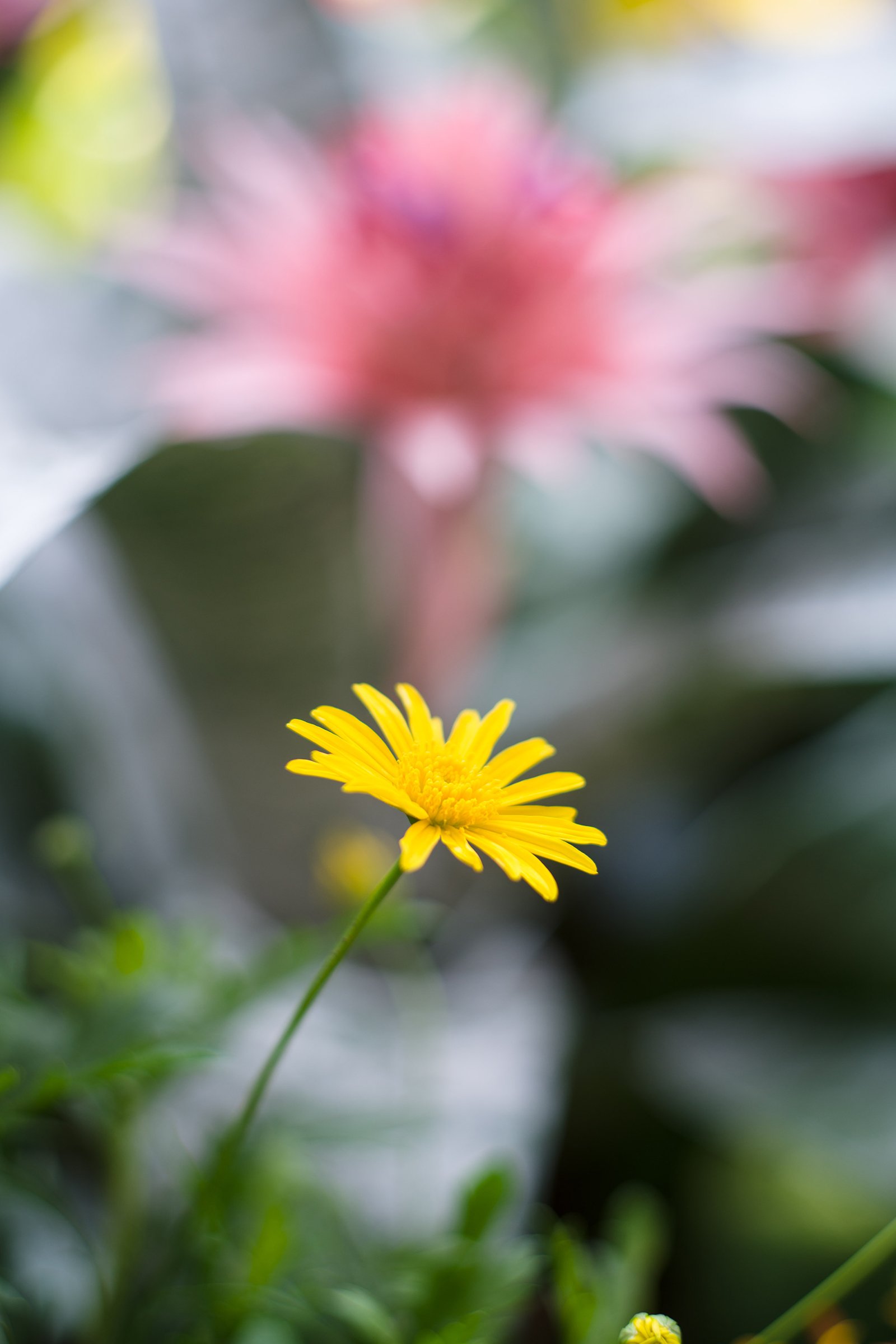
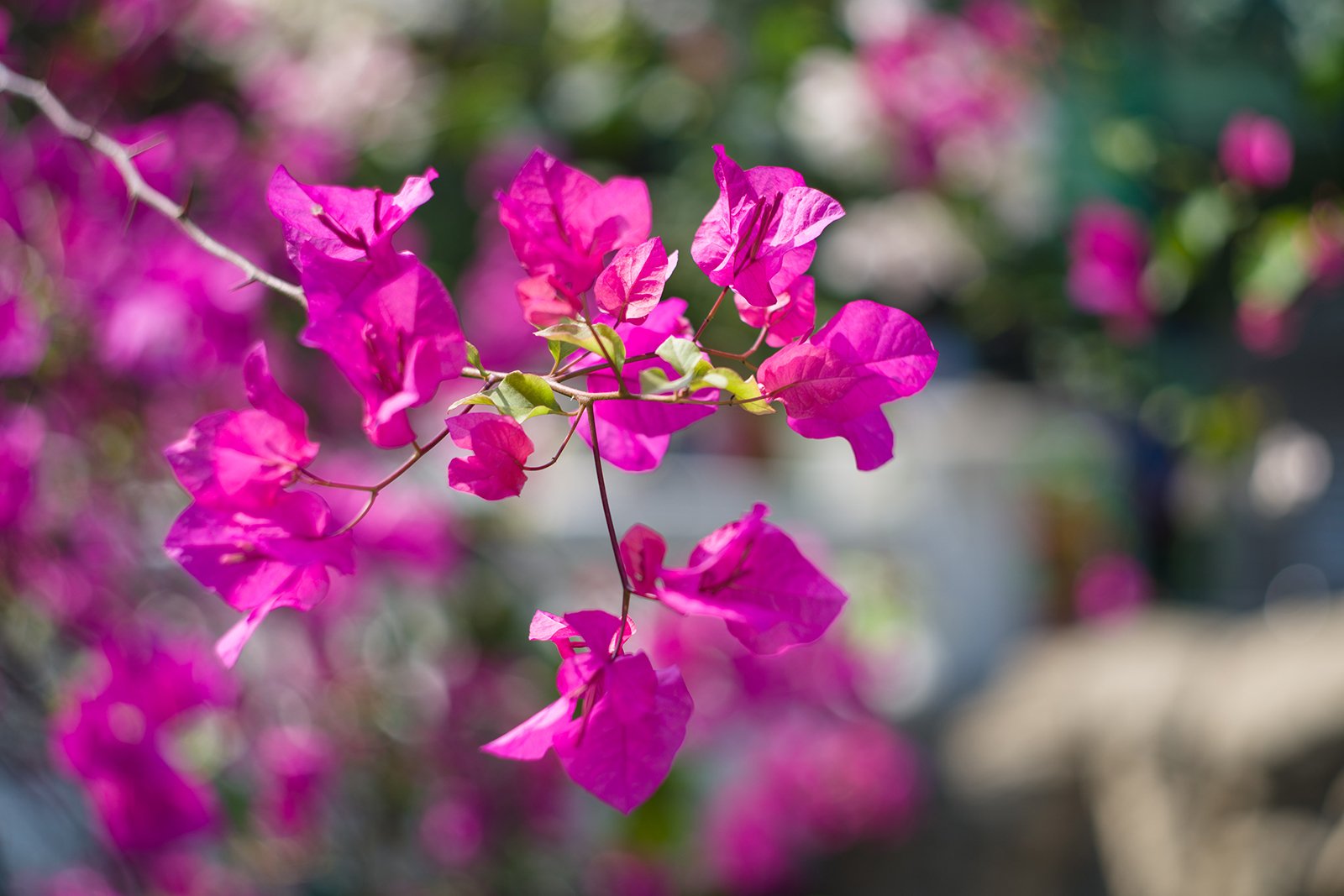
Make sure to check out his post on mflenses and visit his website lensfever where he writes about a lot of interesting adapted lenses. He even developed his own wide angle lens called “Solinon” which you can take a look at here.
85/2.8 Friedrich S-Coronar

100/2.8 Friedrich S-Coronar
| f/1.9 series |
25.5/1.9 Friedrich S-Coronar

Original list price (likely at Rolyn Optical) seems to have been 271 $ (around 2,500 $ today).
User tsaileo53223 on flickr shows a wonderful adaption of this lens onto a Sony Nex camera and also shared some sample shots there. It’s obvious from some of these that this lens does have a very limited image circle.
For macro work it might be interesting, but the lens with variable aperture is certainly preferable for that, because my experience with the fixed aperture version shown below tells me that it needs to be stopped down slightly in order to provide decent image quality, particularly at higher magnifications. I can’t claim that I have got any really convincing results out of it yet, so unless you’re just curious yourself, I think there are a number of significantly better alternatives for small ‘Made in Germany’ macro lenses like this, including the D-Claron line by Schneider Kreuznach, the Dokumar lenses by Zeiss and the Photar family by Leitz.
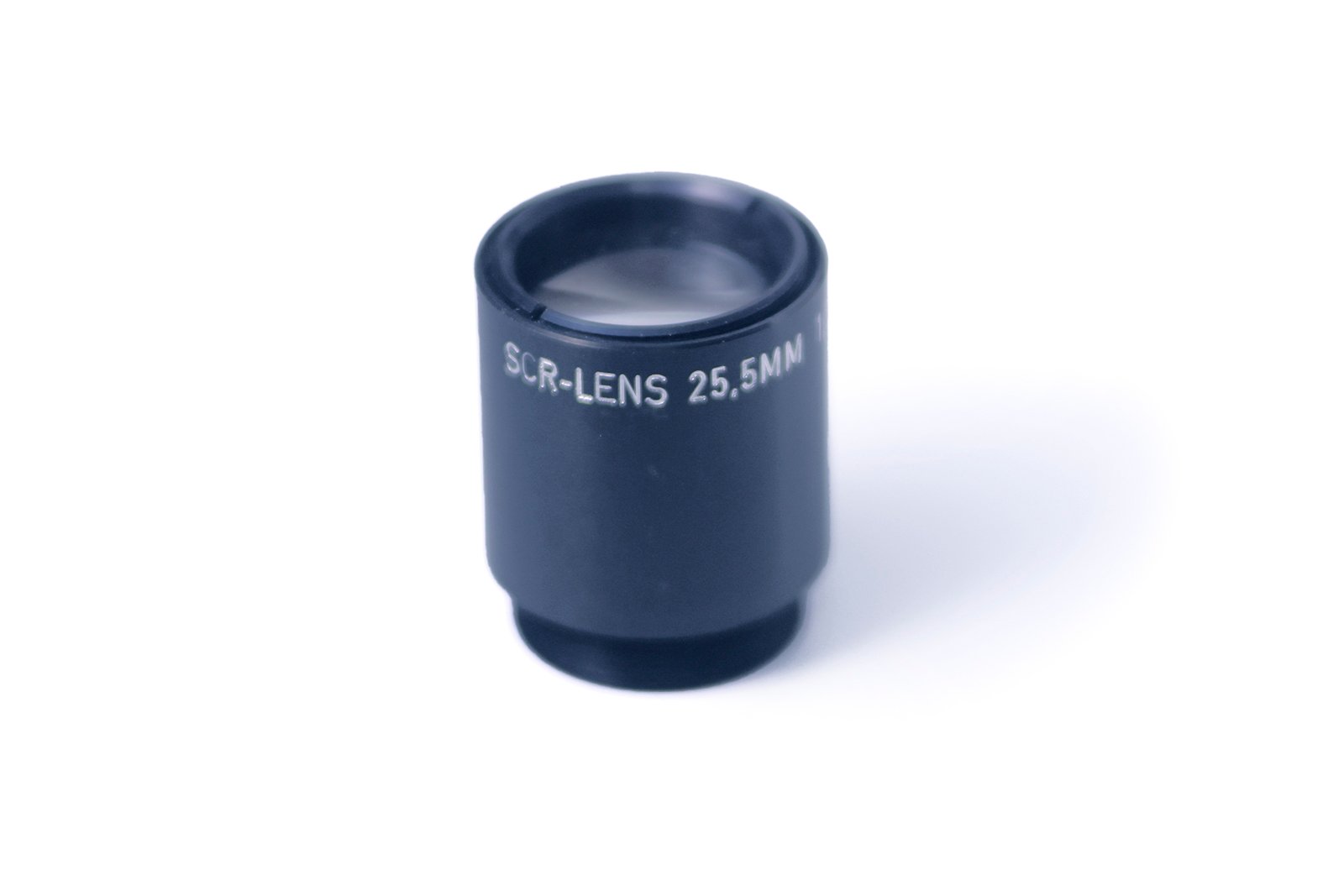
35/1.9 Friedrich S-Coronar
50/1.9 Friedrich S-Coronar
75/1.9 Friedrich S-Coronar
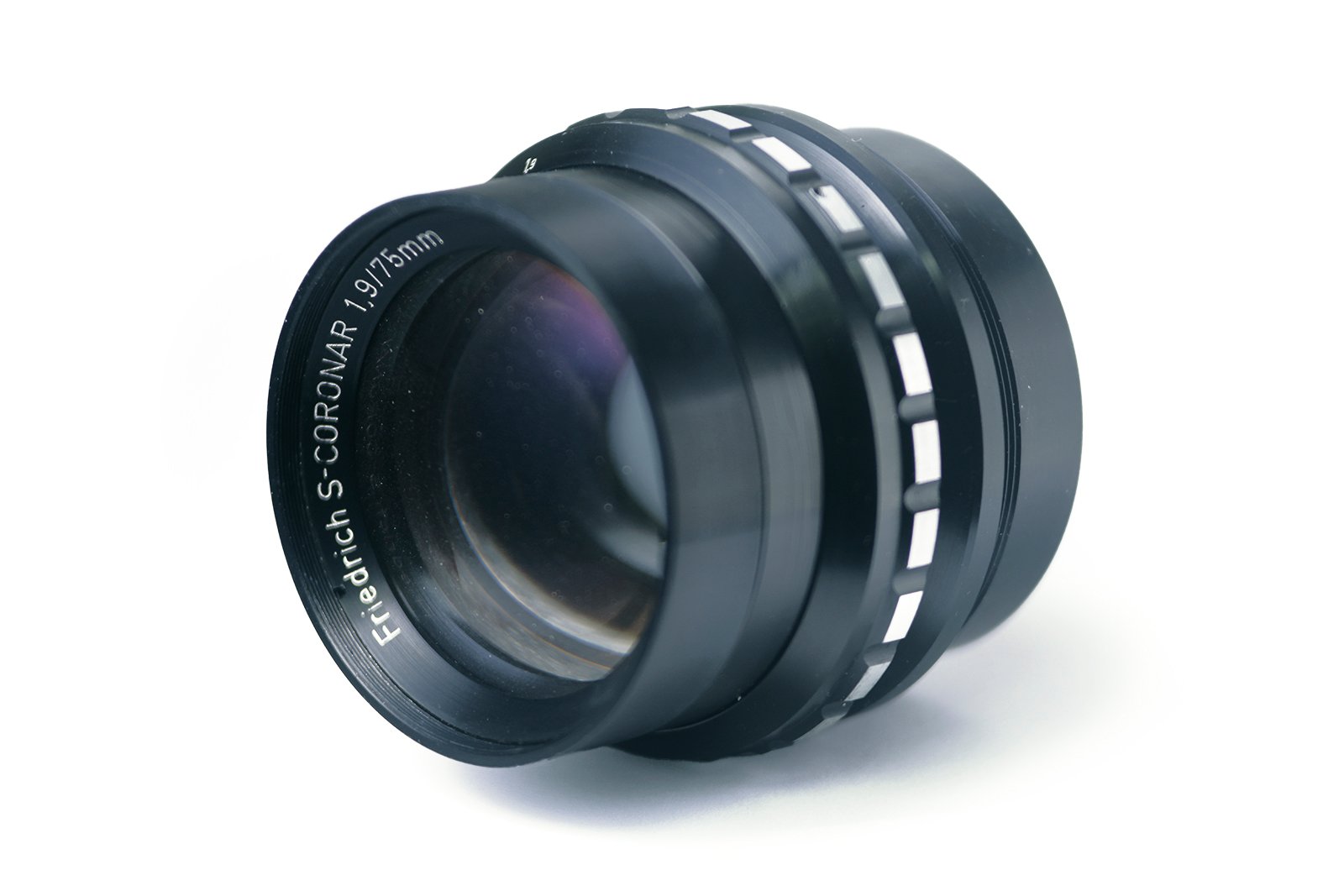
It took quite some time to find one of these (longer focal length) S-Coronar lenses. My sample is not in mint condition, but also not in a totally bad one. It looks like it has been used quite a bit though.
User Xu@EVIL Cameras on flickr also shared a number of beautiful images made with one of these lenses and also mentioned that it should be able to cover the 6×6 (medium) format. This means it should work great on the Fuji GFX as well.
A word of caution: While you would expect a 75 mm enlarging type of lens to have a long focal flange distance allowing for easy adaptation, this one doesn’t have that feature and you might have to find a custom solution for adapting it properly, particularly with its unusual 60×1 mm thread.
Once that’s done however this lens can create wonderful and unique images – far from perfect, mind you – but the rendering still is very nice to look at. Below are a good number of sample shots.
And here it is compared with one of my personal favorite lenses, the Schneider Kreuznach Xenon 75/2. First, wide open:


As expected (it’s f/2 vs. f/1.9 after all) the Xenon is slightly sharper and does show less glow. But if you prefer a more unique and slightly softer look – which can indeed be beneficial for portraits – the S-Coronar is a more interesting lens. Stopped down to f/2.8 both lenses show significantly more sharpness and detail already, with the Xenon still slightly better in terms of detail and resolution and the S-Coronar when it comes to contrast.

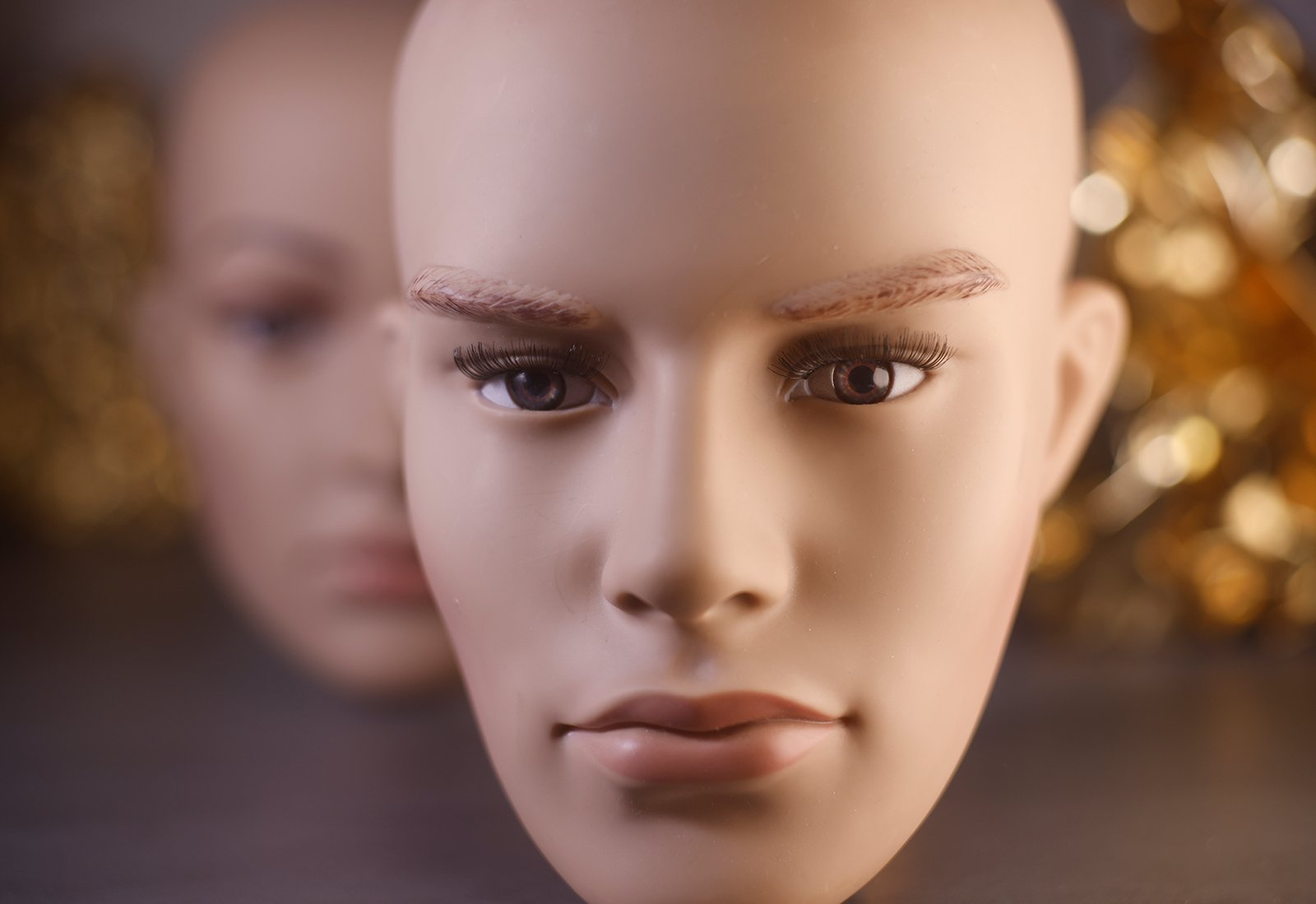
The bigger image circle of the S-Coronar can be a plus for adaption on medium format, in terms of size and weight, but of course the Xenon is nicer to handle (depending on the variant you’ve got), easier to adapt and also more common, at least in the Arriflex mount. If you want to know more about the abundance of different Xenon-lenses by Schneider Kreuznach, you can read up (hopefully soon) on The Xenon Family here.
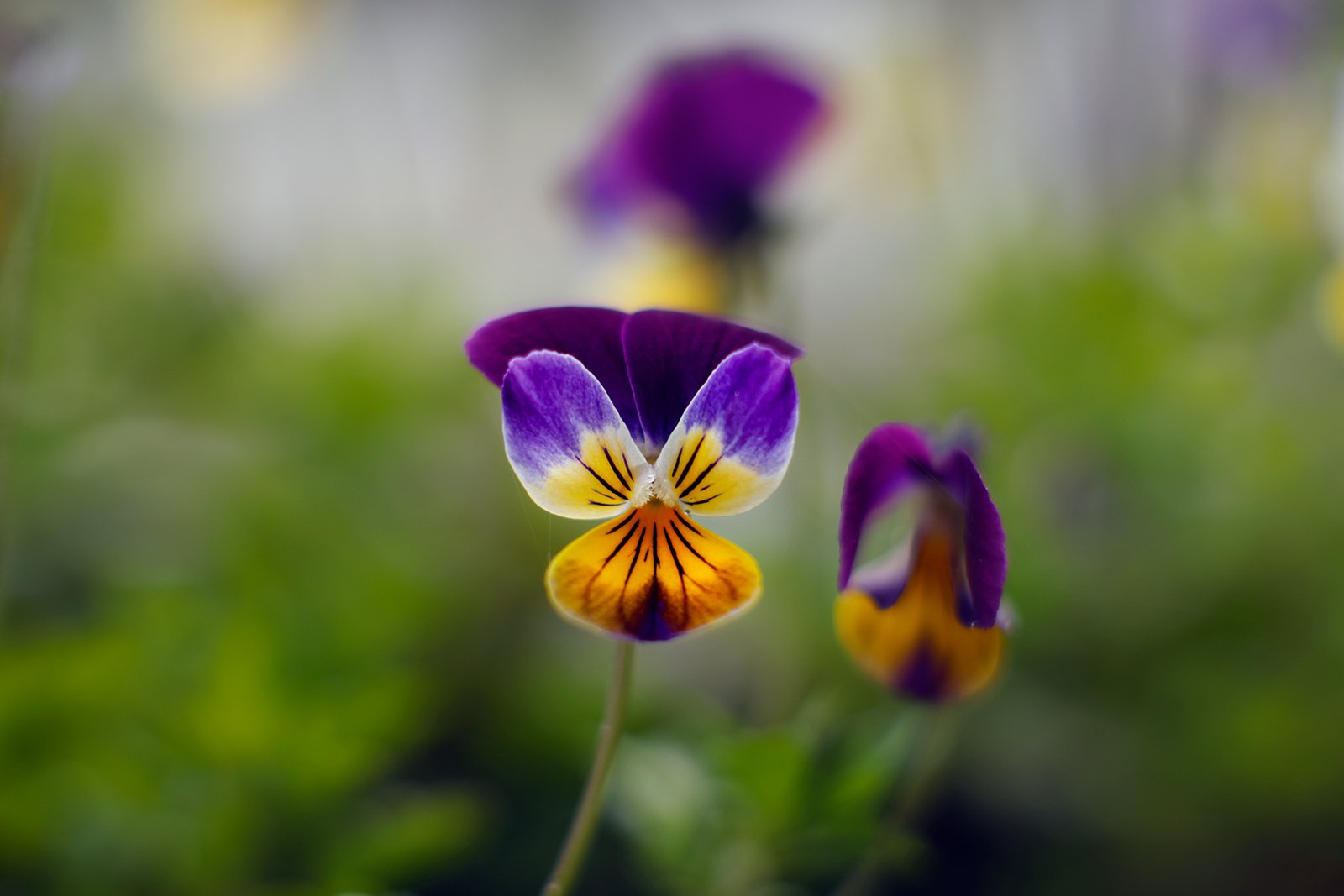
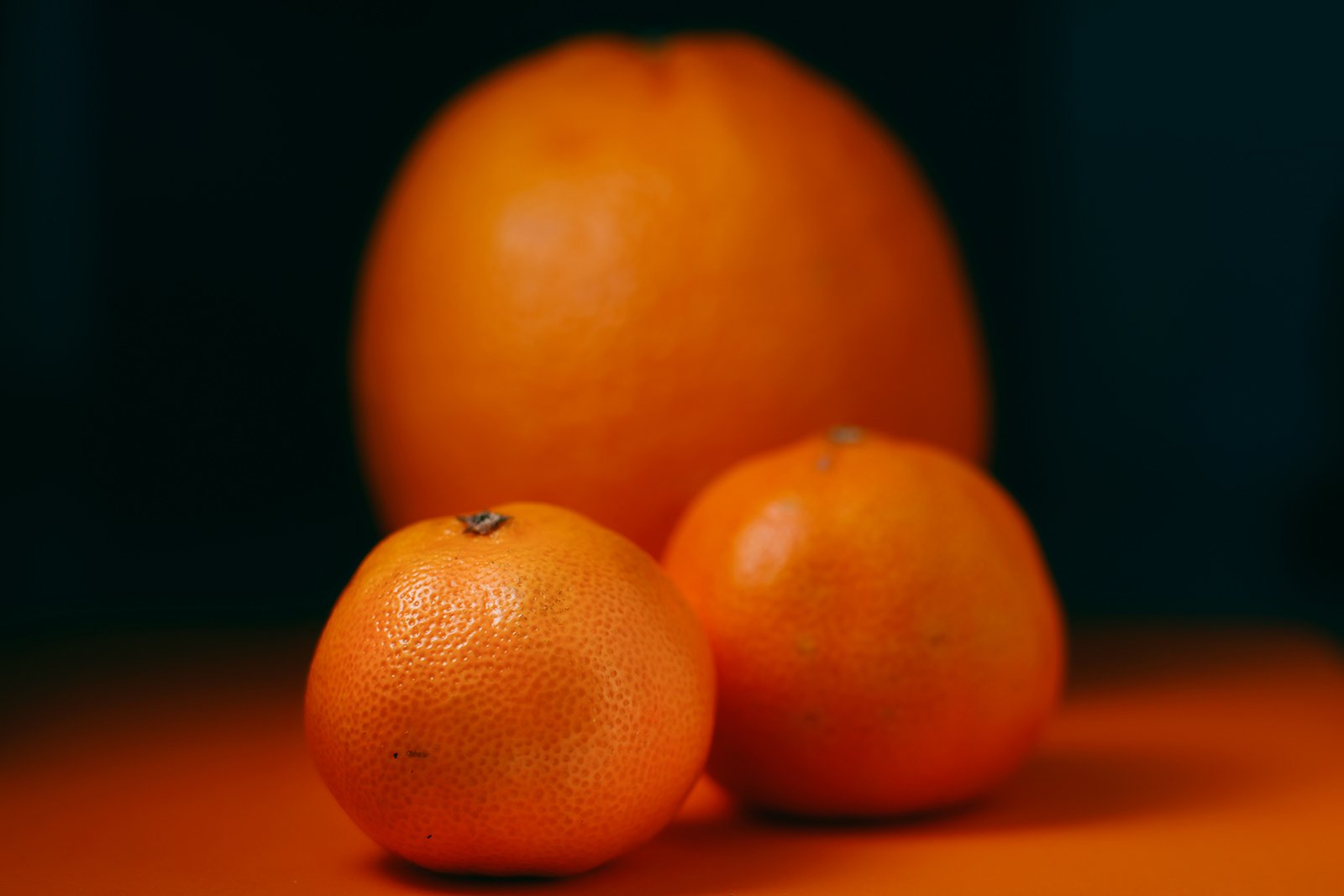










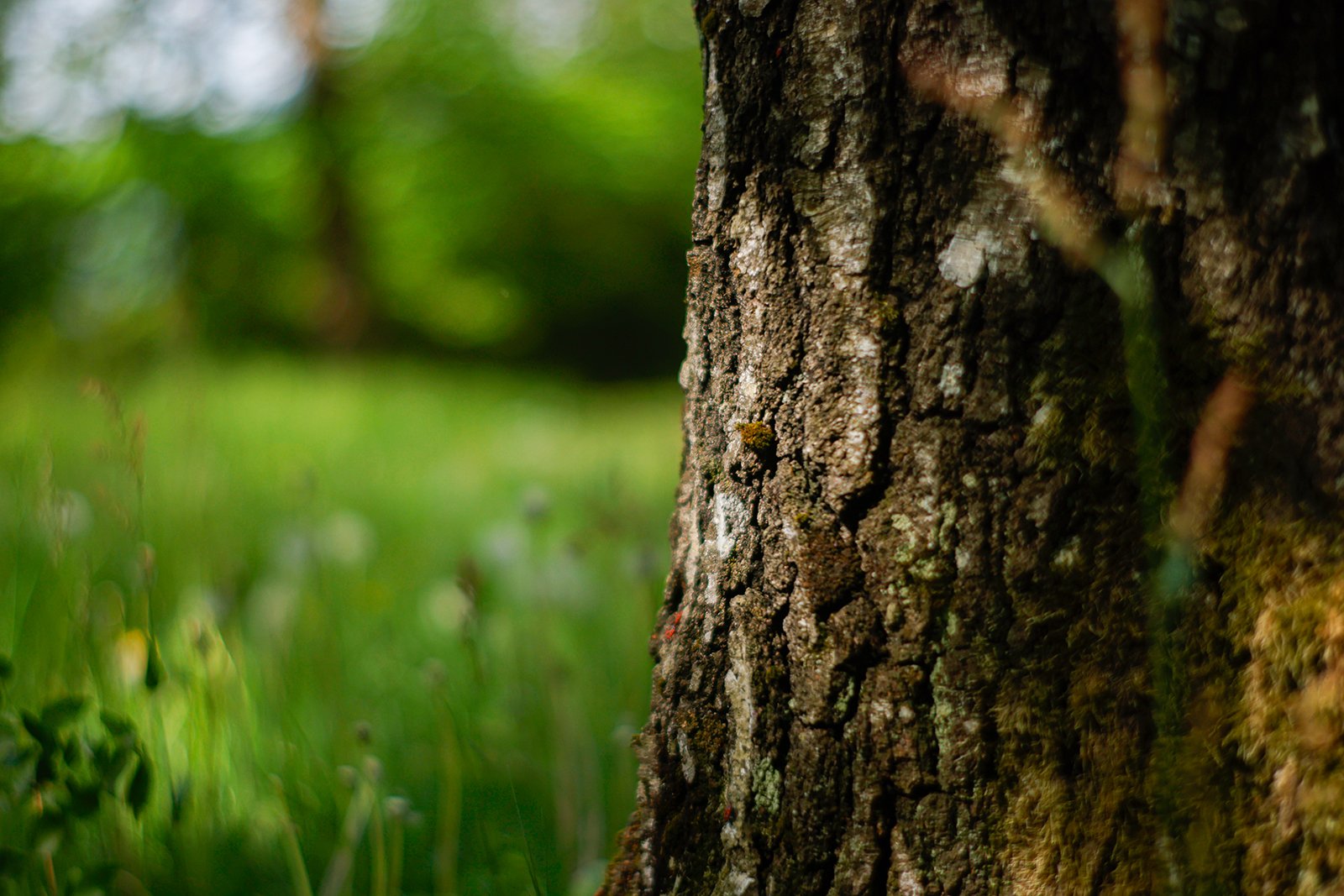
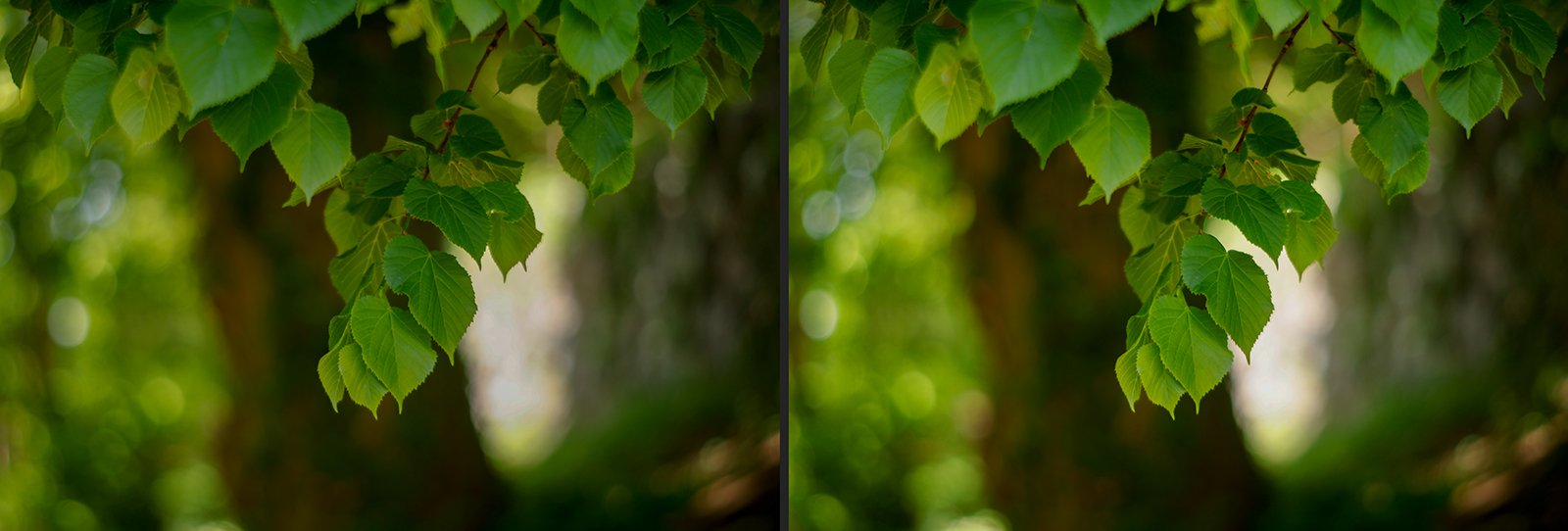
In my opinion this lens is great for creating stereo 3D images, here are a couple I’ve taken:



Unfortunately we don’t know the real cost of these lenses when they were made. By extrapolating some concrete information about the shorter focal length lenses of this series as well as comparisons with similar lens series, I would assume something in the vicinity of 500 $ in 1972, which would be around 3,800 $ in 2025.
100/1.9 Friedrich S-Coronar
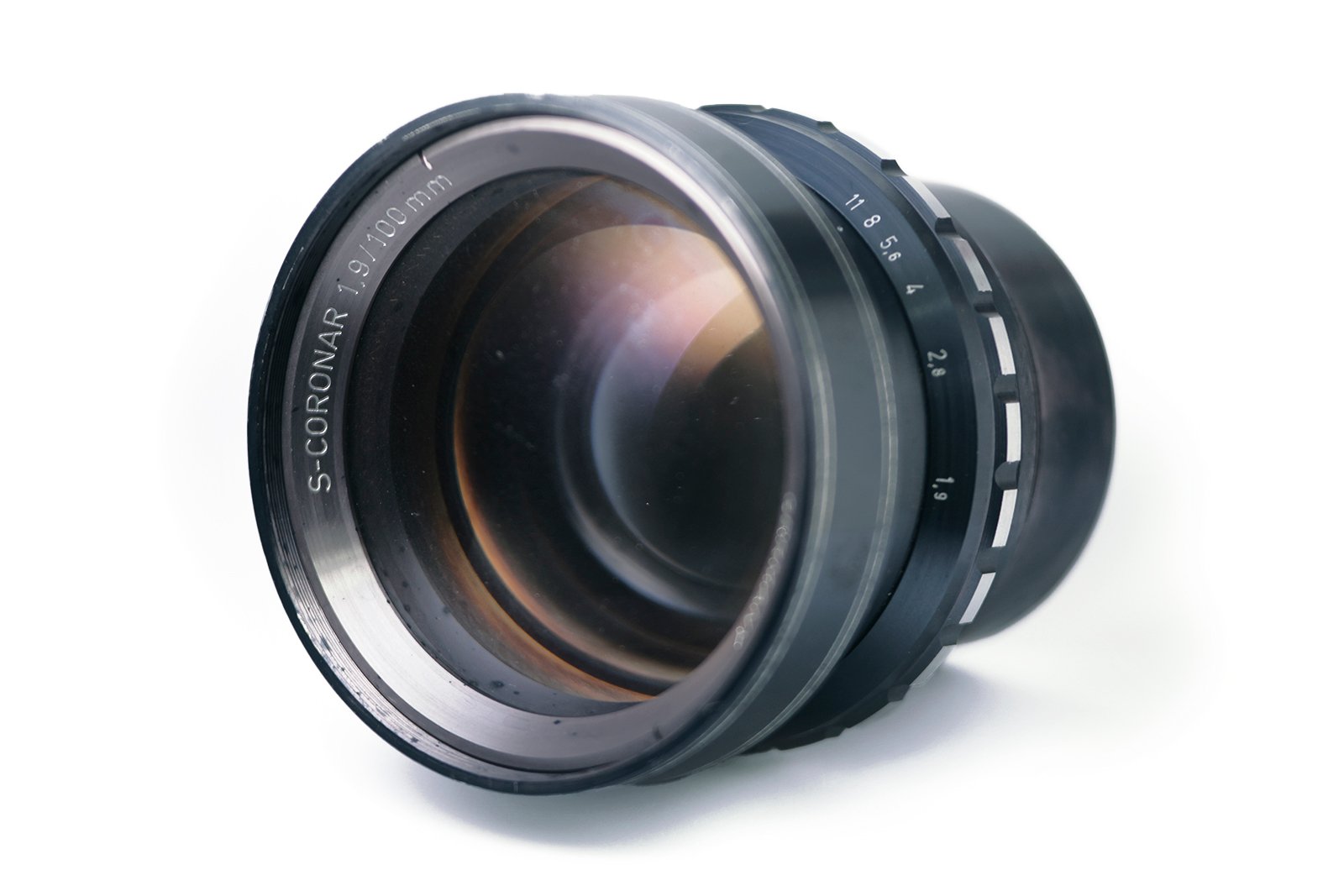
Turns out I’m not the first one to write extensively about this lens. Jimmy P.C. Wang (Orange Cat Studio) from Japan has written a lot about this lens and also shot a number of image, which you can see here:

You can find Jimmy Wang’s interesting article if you search for friedrich s-coronar 100mm f1-9 & pcking on the internet. The write-up can be translated of course, but from what I’ve seen so far, the translation likely doesn’t do it justice. It certainly seems more like a free-from artistic interpretation of the lens – which is great – but should probably be enjoyed best in its original language to get the full meaning of stuff. Safe to say, that Jimmy Wang was very impressed by this lens, making comparisons to Leica lenses and praising it for its look.
The way he adapted the lens is very clean and impressive and because he seems to have gotten a completely pristine sample without flaws, I can imagine him being impressed even more than I was when seeing, holding and viewing this lens. So don’t be surprised if my impressions differ in some ways… it might of course have to do with flaws in my adaption and also the shape the lens is in.
Don’t get me wrong: The lens I have is not in terrible shape. It seems to be more than fine in terms of optics and the small flaws on the glass and coating shouldn’t impact performance to any significant degree. But similar to what I’ve mentioned about the 75 mm variant of this series, this lens neither seems to be particularly sharp wide open, nor is it very well corrected and thus likely not optimized for any type of enlarging.
Does that impact my enjoyment of it, though? Not in the slightest. This is a spectacular lens for portraits, featuring a flattering, very warm, slightly soft and glowy look with incredibly smooth background rendering wide open and stopped down (from f/2.8 on) it becomes a capable close-up and macro lens, already better in terms of image quality and correction and still faster than almost any enlarging lens in that focal length.
Its image circle should be quite generous as well (the table in Cteins article mentions 6×9), allowing for use on medium format and offering some movements on full frame or smaller formats.
The round aperture with 15 blades is a big benefit as well and does make the lens significantly more versatile than your typical projection lens. What I like most about it, is certainly its rendering. Slightly glowy wide open and fast enough to provide sufficient separation at some distance, this lens seems perfect for soft and flattering portraits. Unlike many projection or cine lenses in its focal length range, results are not affected by strong field curvature, harsh bokeh effects or swirl.
As you would expect for a 100 mm f/1.9 lens, this one is pretty heavy and with its 60×1 mm thread also not easy to adapt, I’m afraid. But where’s a will there’s a way and with some improvisation (in my case more of this and less of the following…) and proper technical knowledge and skill the lens is going to fit on any modern mirrorless camera. Focal flange distance is quite short for a 100 mm lens, so I wouldn’t expect it to work on DSLR cameras, which is good to keep in mind. If you can find one in decent condition and for what you consider a reasonable price, it surely seems worth it in my opinion.
Here are some sample shots, taken with this big lens from one of the smallest lens manufacturers which ever came out of the city of Munich:
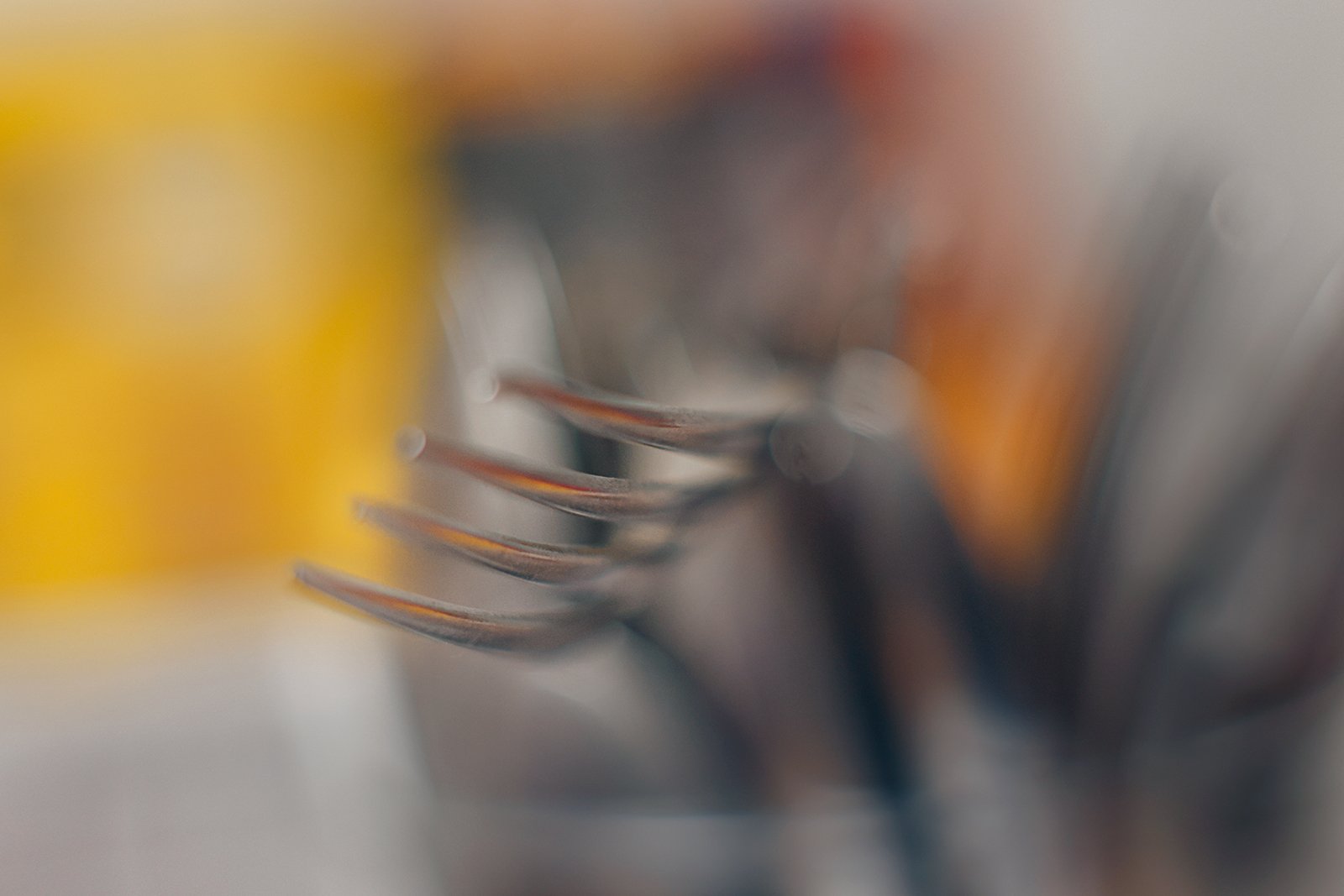





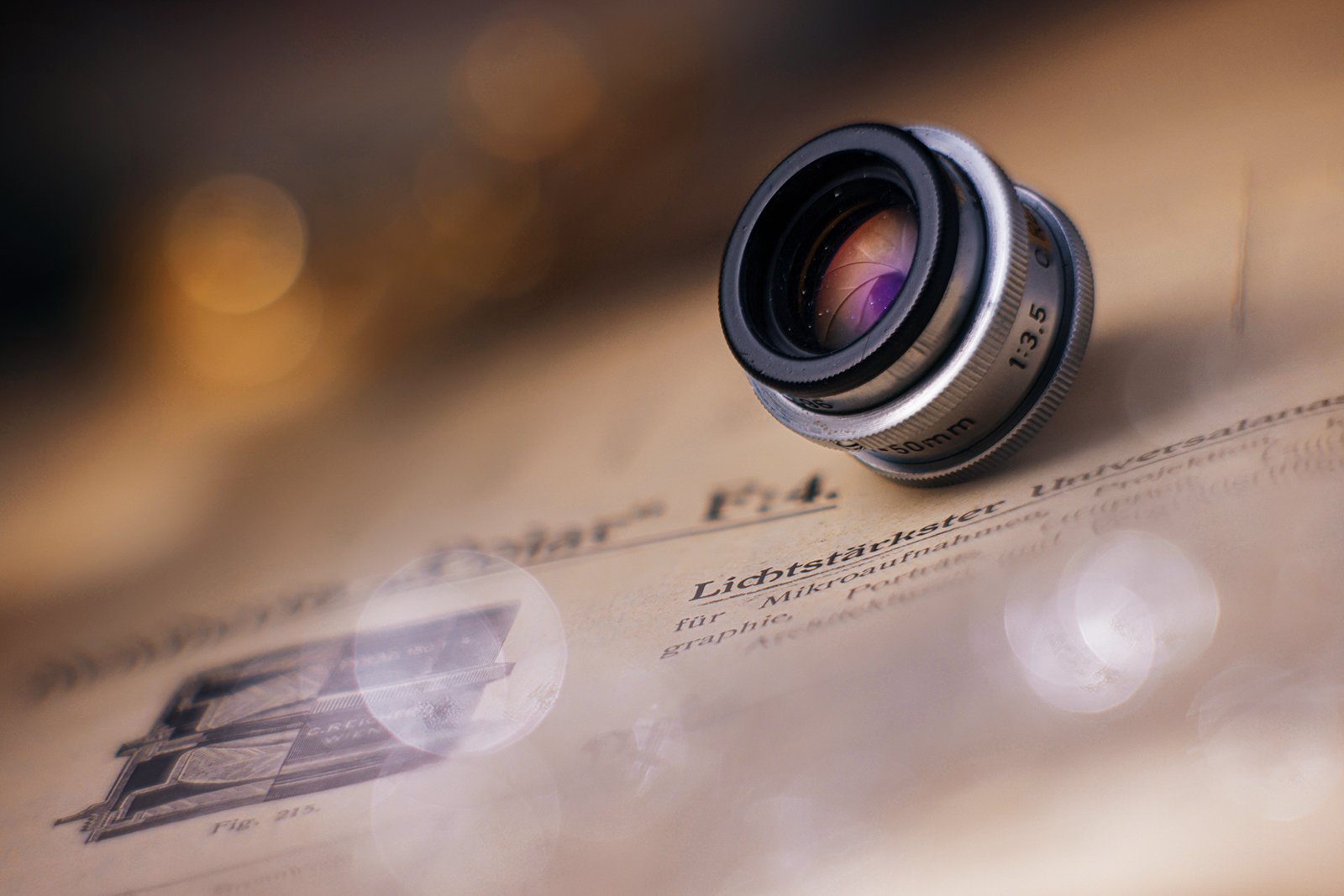
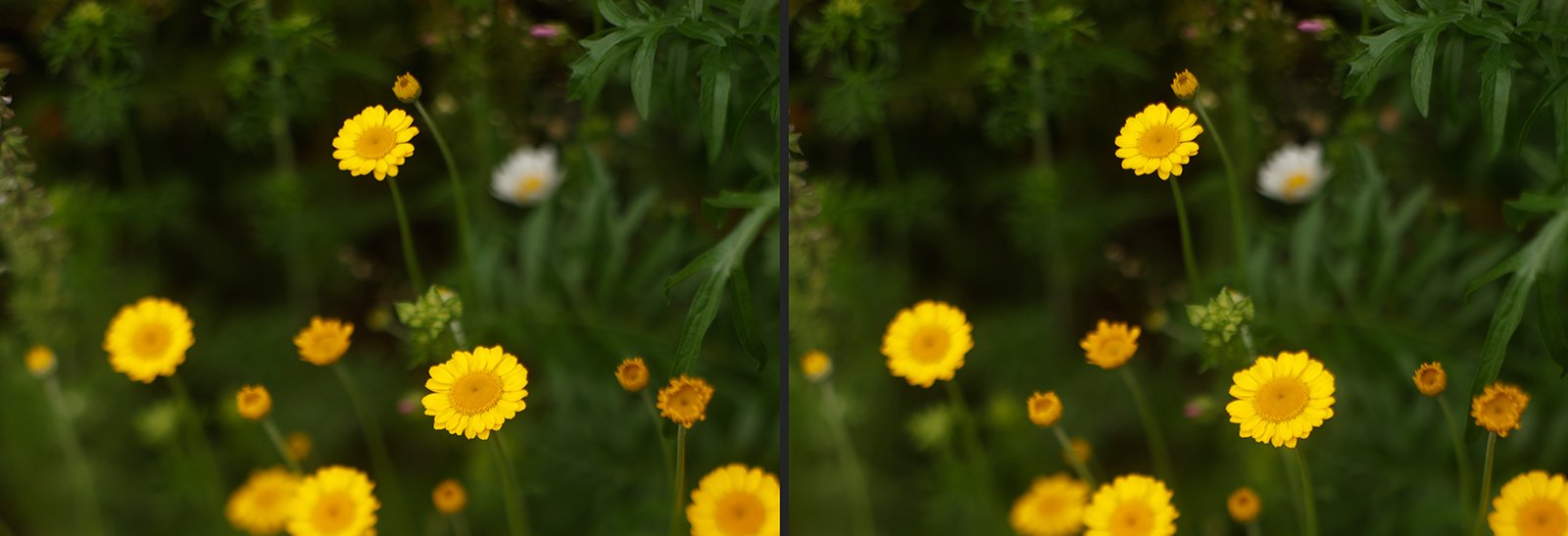
I feel like some of these images speak for themselves, if you’re interested in a particular look. I don’t think it works in every instance and I certainly can’t claim that its optical performance is top-notch throughout… but when it works it does deliver something unique and interesting in my eyes. Just like the 75 mm variant, it also shines when used for taking stereo-images. Here’s a couple of stereo (cross-view) captures:


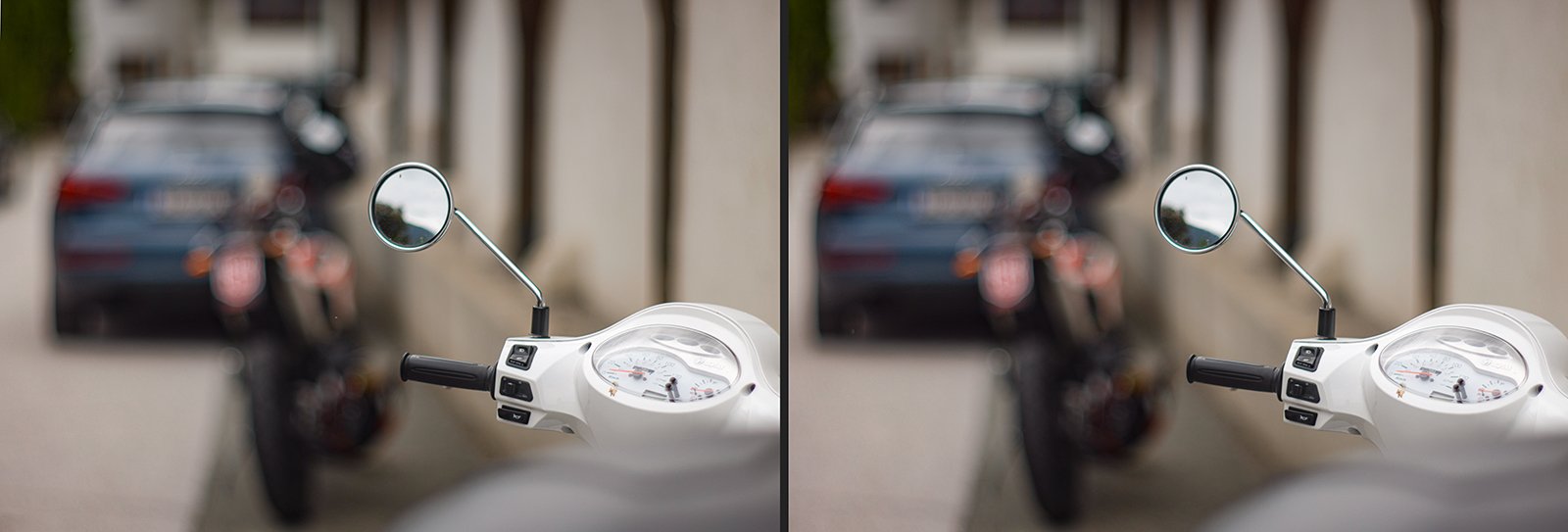
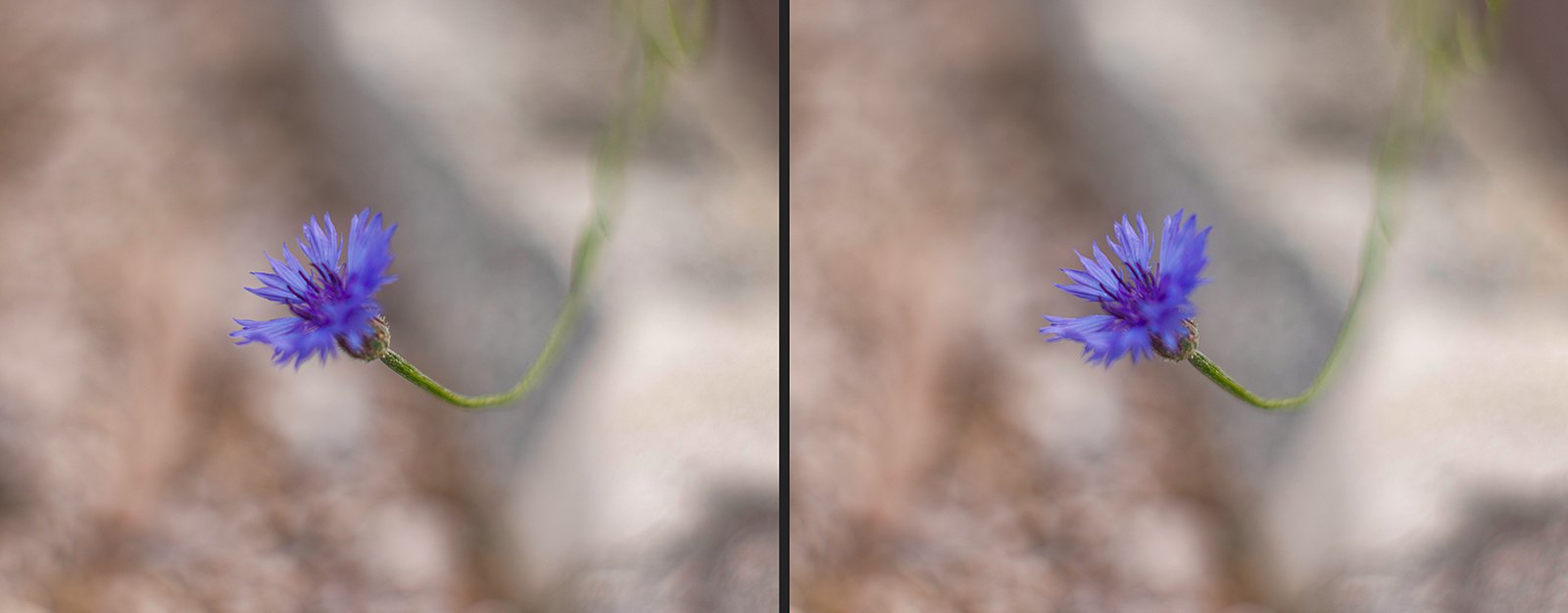
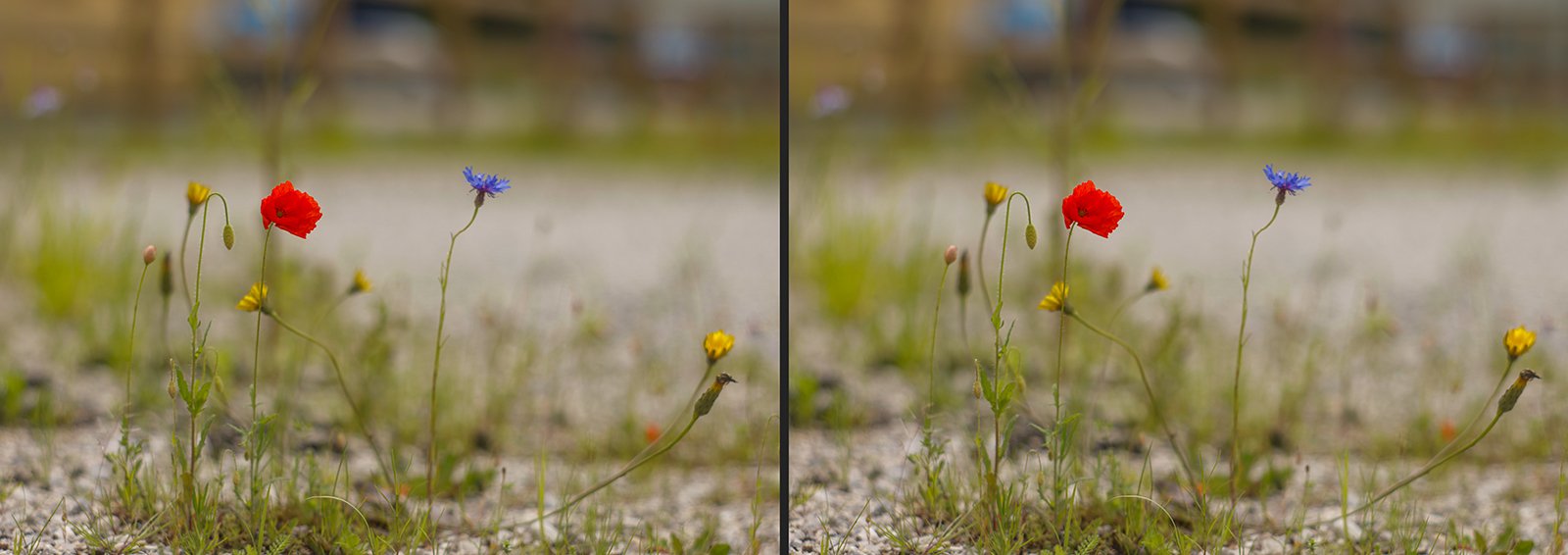

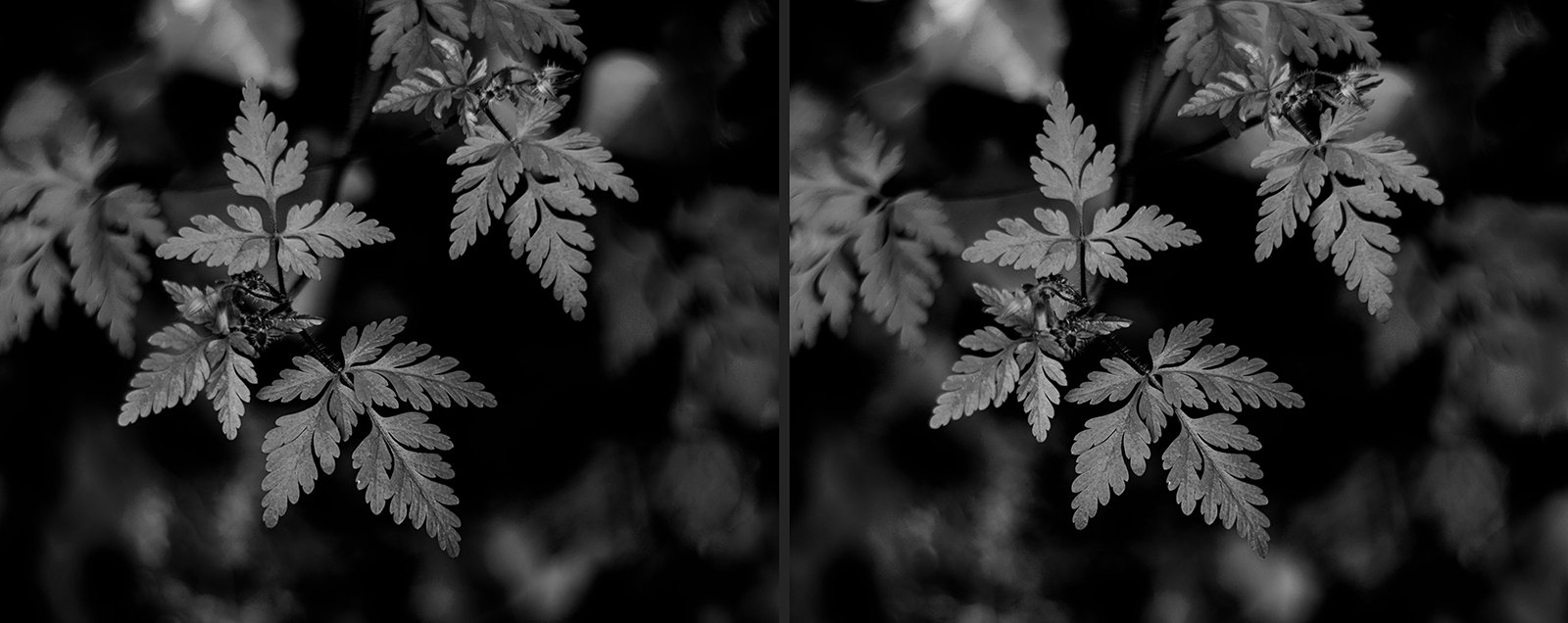
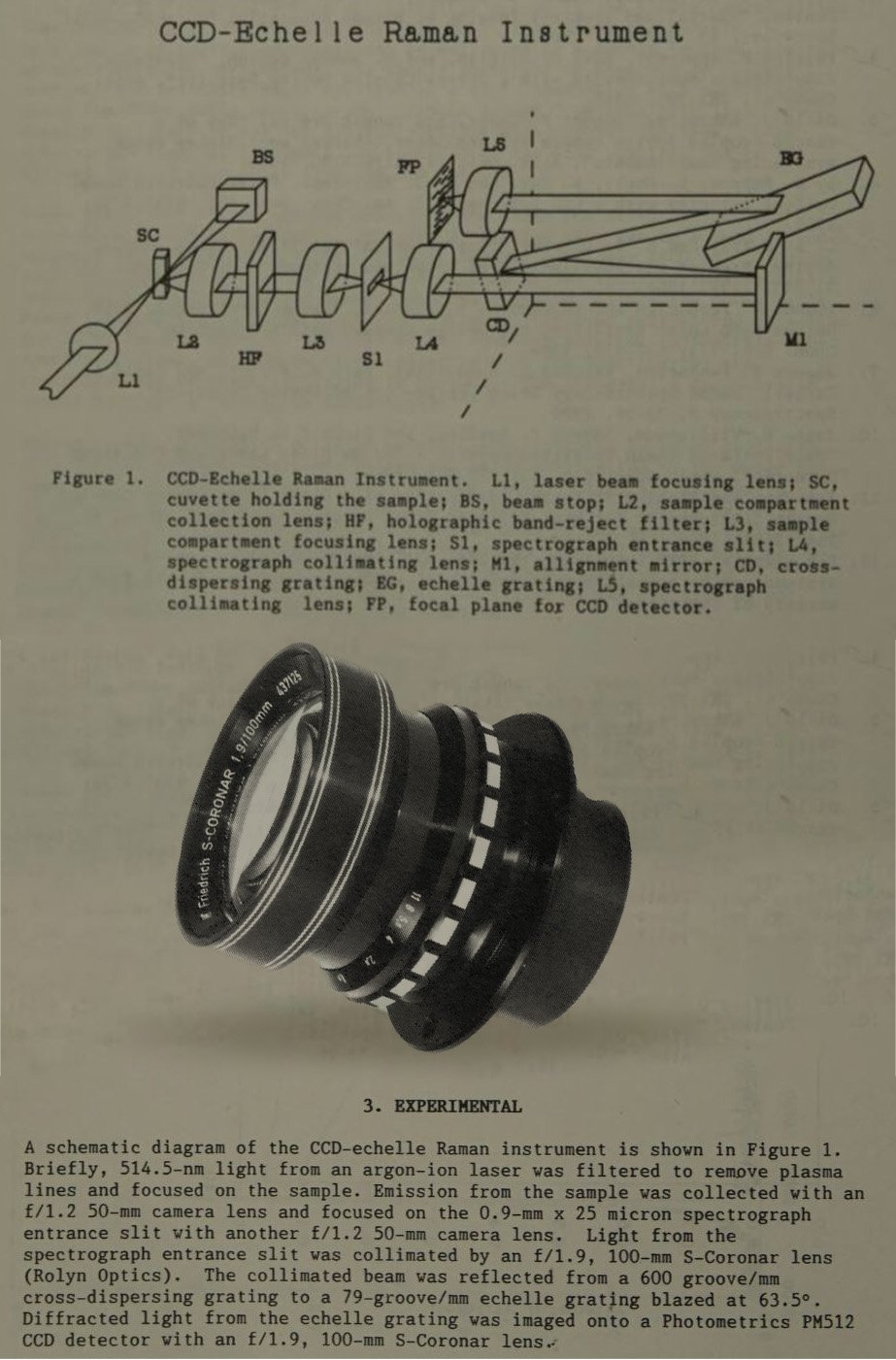
Here’s something else I found interesting – a description and drawing of an application in which this specific lens was used, apparently for collimating light:
| f/1.4 series |
Every Rolyn catalog I’ve managed to find only mentions the f/1.9 and f/2.8 series. And so I suspect the f/1.4 series was only offered on special request. It seems to have been limited to number of focal lengths as well.
20/1.4 Friedrich S-Coronar
25/1.4 Friedrich S-Coronar
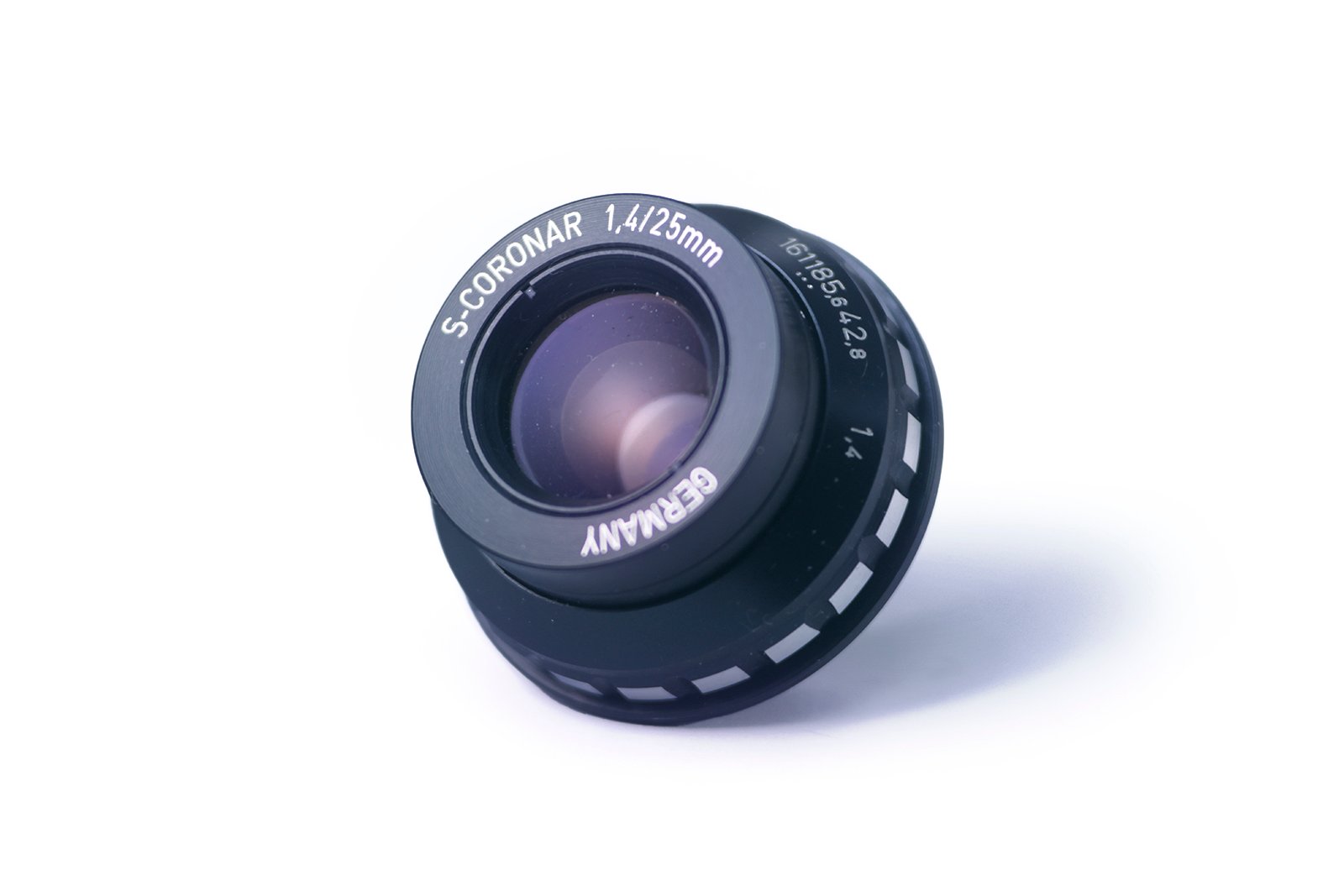
This lens does have a small image circle and short focal flange distance and might be hard to adapt in any meaningful way, but reversed it makes for a wonderful high magnification macro lens. Its original list price in 1972 supposedly was 374.50 $ (which amounts to around 2,800 $ today). While I’ve never been fully convinced by the results of the 25.5/1.9 version mentioned above, which I had gotten some time earlier, I’m glad that I gave this one a chance regardless.
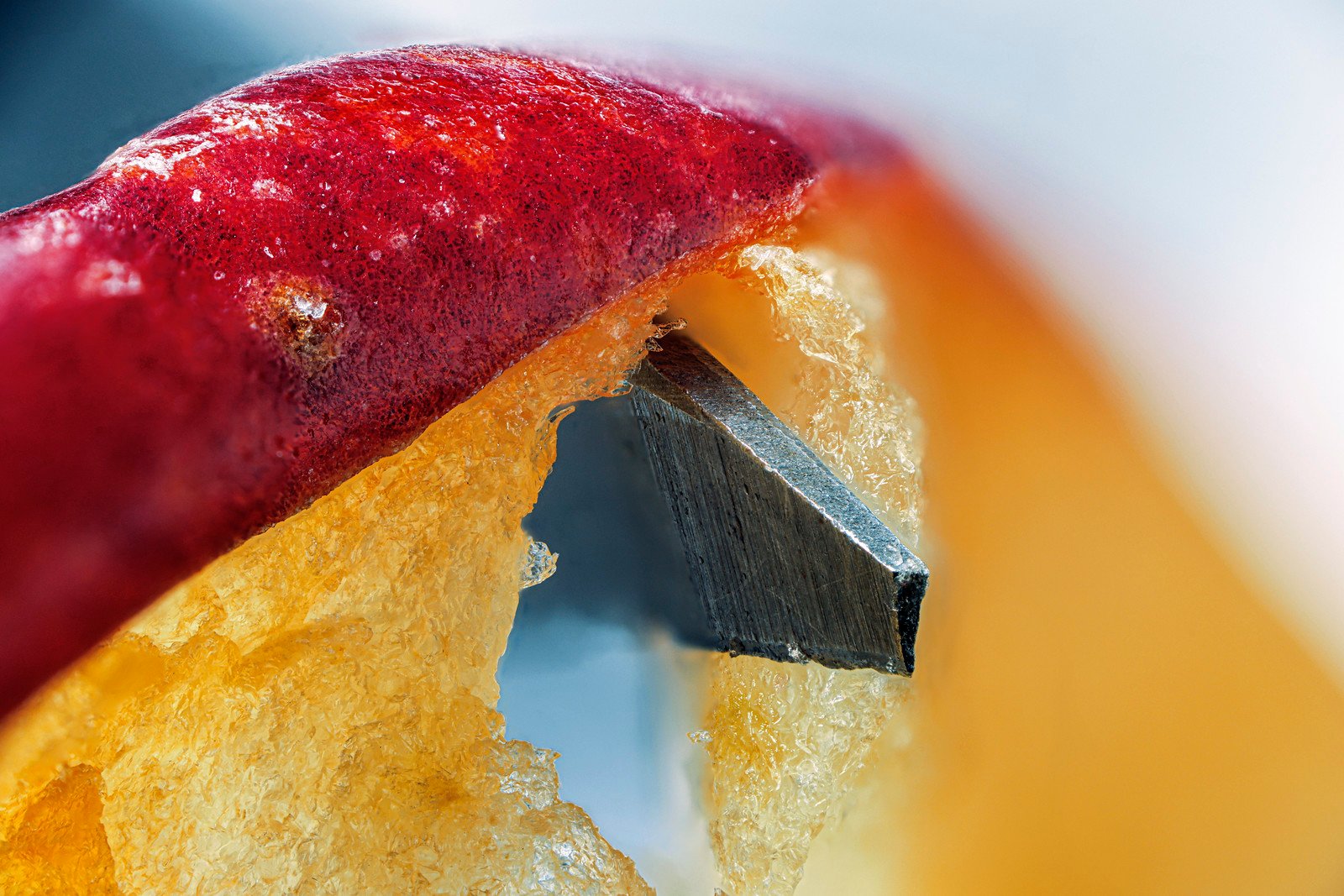
It’s quite a capable lens for high-magnification macro experiments and I’m pretty sure that I’ve only scratched the surface in terms of quality which could be extracted from that lens by putting in some more time and consideration. I’ve tried it with various tube-lenses, but I’m not sure that has made any positive impact. Reversing the lens is beneficial from my experience and stopping it down (after all f/1.4 is crazy shallow at high-magnifications) is as well.



35/1.4 Friedrich S-Coronar
Once again fellow lens experimenter tsaileo53223 has shared a good number of shots on flickr. If you look at the image name you can even spot at which f-stop it was taken. Seems like quite a capable lens and hopefully also somewhat better in terms of coverage. I still wouldn’t expect this one to cover APS-C though from my experience with its shorter sibling.
50/1.4 Friedrich S-Coronar
So far this is the longest focal length in the f/1.4 series. There are no images of the lens itself out there, but user leidot has taken some portraits with this lens and shared them on flickr.
Coronar/Corygon-Kath
It’s mere speculation, but “Kath” could stand for “Kathode” (german for ‘Cathode’), which I’ve seen mentioned in a number of lenses used for CRT projection or similar applications. Spec-wise these lenses sound impressive, but these are often a gamble in terms of image quality and sometimes limited to a specific spectrum of light etc.
67.5/2.25 Friedrich Coronar-Kath
80/2.8 Friedrich Corygon-Kath-Relay
92/1.4 Friedrich Corygon-Kath-Special
Spezial-Anastigmat
75/2 Friedrich Special-Anastigmat
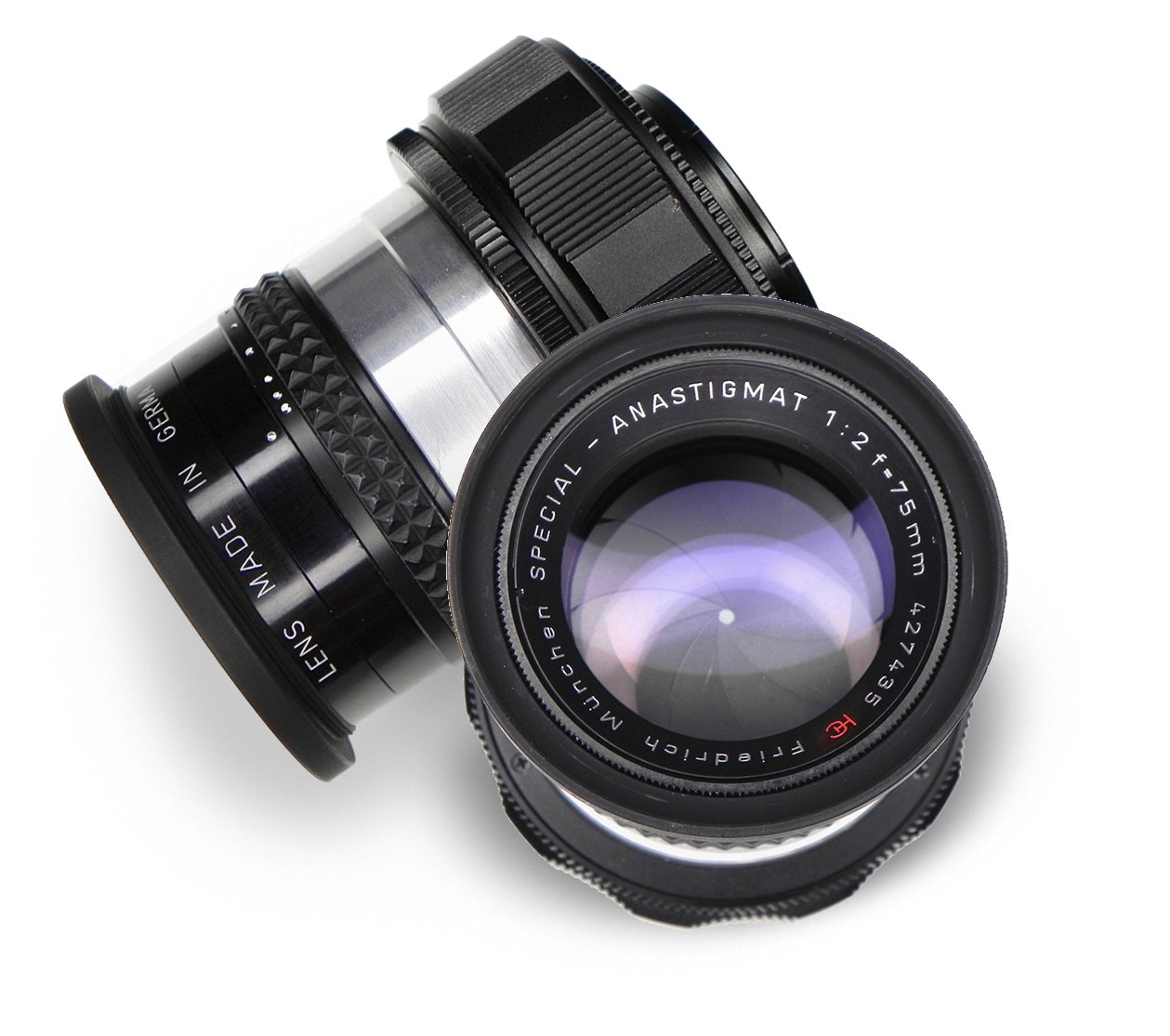
I’ve only seen this single fast one of these. It’s likely that this was a projection lens without variable aperture originally and was modified later, hence the unusual aperture ring and markings. The aperture blades themselves also look completely different to any of the common Friedrich variants.
100/5 Friedrich Special-Anastigmat
While this one certainly sounds less impressive in terms of specs, the ‘Special’ in its name suggests, that it likely was highly optimized for a specific task or customer.
Vario-Coronar
135/4.5 Friedrich Vario-Coronar
The single mention of this lens seems to be Hartmut Thiele’s summary about C. Friedrich and the name doesn’t really make any sense. While the “Vario-“ suggests that it is a lens with variable focal length, there’s only one focal length mentioned. I can’t really imagine that anyone would just make up such a specific lens name and so I thought of two possible explanations:
- There is indeed a Friedrich lens with variable focal length (see CF-R series above) or even several, though they were rarely labeled as such (perhaps internally though) and thus not really associated with C. Friedrich. As far as I know Rolyn only sourced lenses from two manufacturers from Germany: Rodenstock and C. Friedrich. From their looks it’s hard to tell, but the CF on the lenses shown below might even stand for C. Friedrich… (Update: This suspicion turned out to be true, because soon after I found some evidence, thanks to a kind person on reddit)
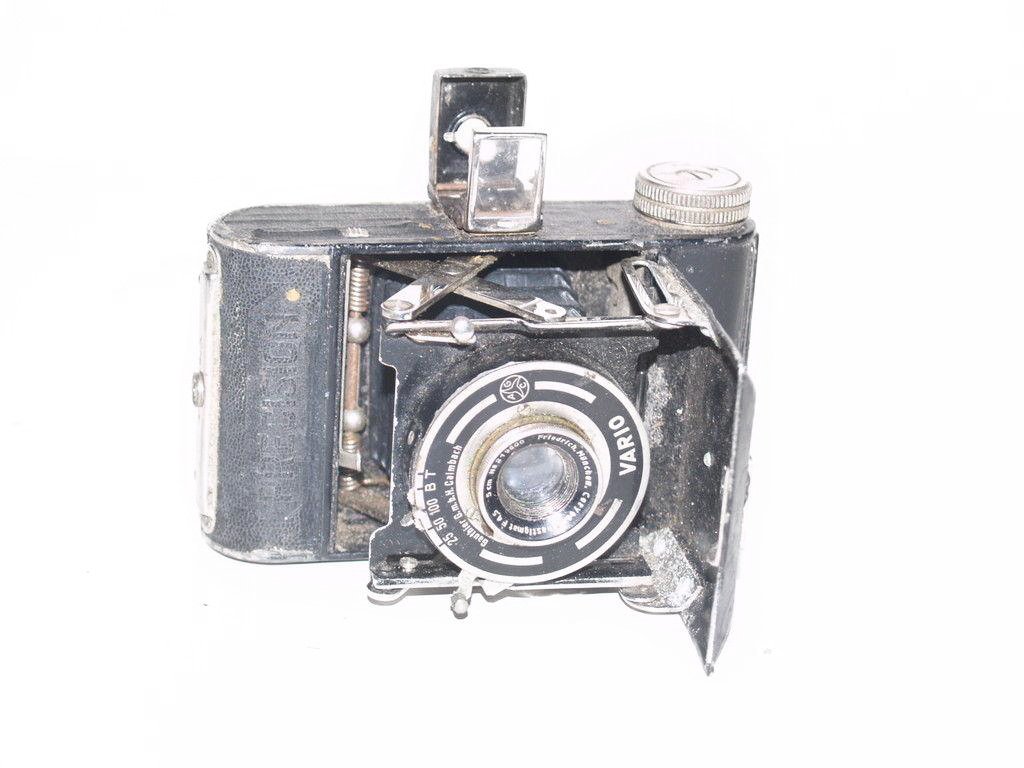
- The “Vario” was featured in the name of the lens because of a particular shutter (Gaulthier Vario shutter) and so it’s essentially just a basic Coronar 135 mm f/4.5 lens.
To be honest, both theories are far-fetched and it’s ultimately not really important. I’d still love to know if C. Friedrich really made those variable focal length lenses, because I’ve experimented with similar optics from other manufacturers extensively and documented them in my write-ups The Noritsu Story as well as Agfa-Gevaert Industrial lenses. Some of those are significantly better than you’d expect.
Color-Coronar
Like the similar looking Spezial-Corygon lenses mentioned above, the Color-Coronar series might have been used in some type of repro- or photo-processing devices or related industrial applications.
70/4.5 Friedrich Color-Coronar

85/4.5 Friedrich Color-Coronar

While it is relatively slow this lens does produce nice looking images. Because of the similar look I suspected that it might be a 5/3 Heliar design like the Kodak Printing-Ektar lenses initially. A japanese blog entry found calls it a Tessar, but my own observation leads me to belive that it’s more likely a 4 elements in 4 groups Dialyte design. This would also fit into the usual Coronar designation, while the Friedrich pendant to the Tessar would be called Axinon.
Image quality is pretty good and the lens reasonably well corrected. It’s possible that these lenses exist in several more focal lengths, but so far I’ve only seen this one. Many of the similar lenses were stopped down further with internal metal disks, so it’s likely that image quality might be improved by putting the lens cells into a variable aperture.
In addition to that a lens hood seems very important as contrast can be very low in these lenses clearly not designed as taking lenses and thus without any efficient protection against stray light.


Here’s a comparison with a Pako-labeled lens in a comparable focal length, which also is a 4 elements in 4 groups Dialyte design lens, though made in Japan (rumored by Olympus):
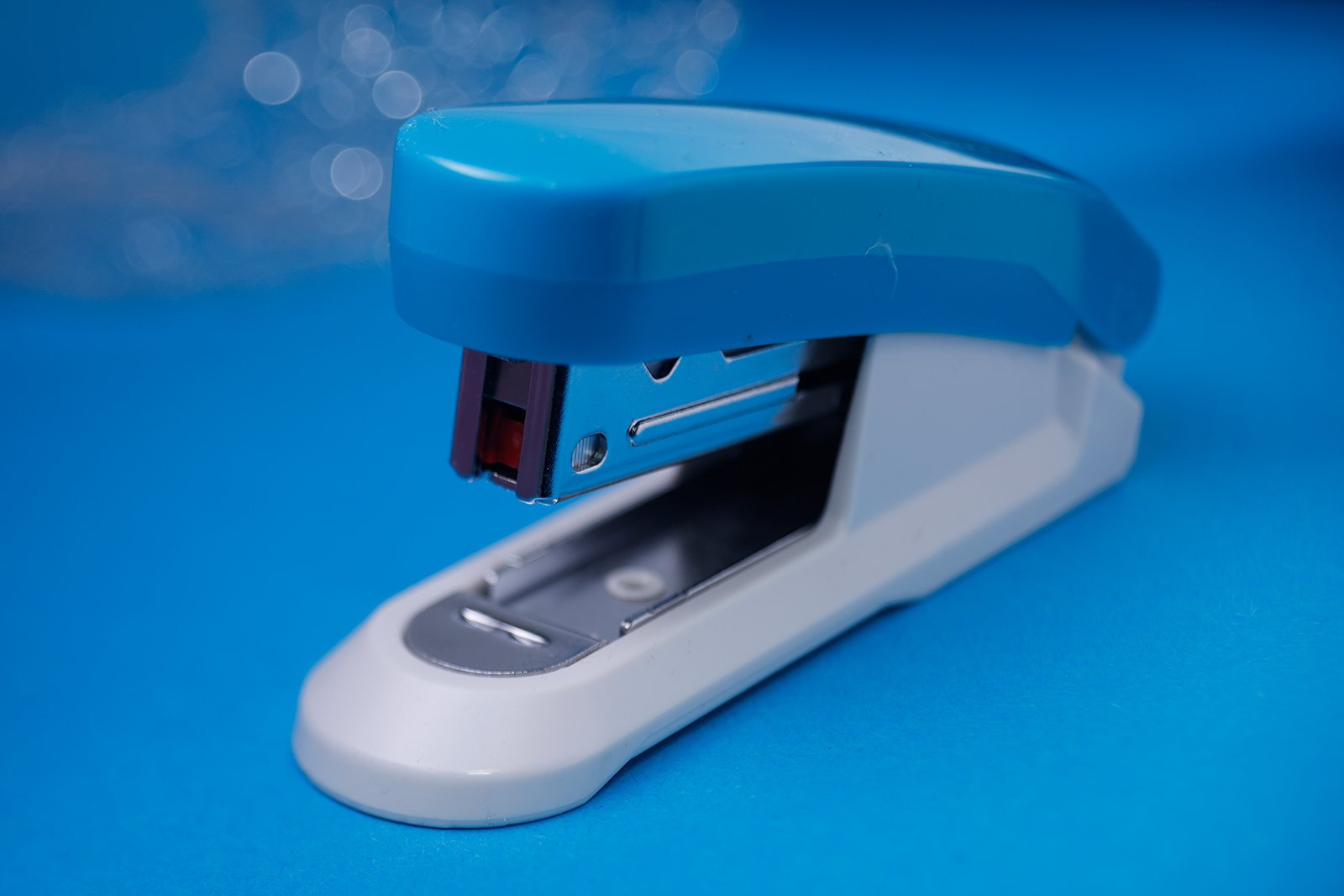
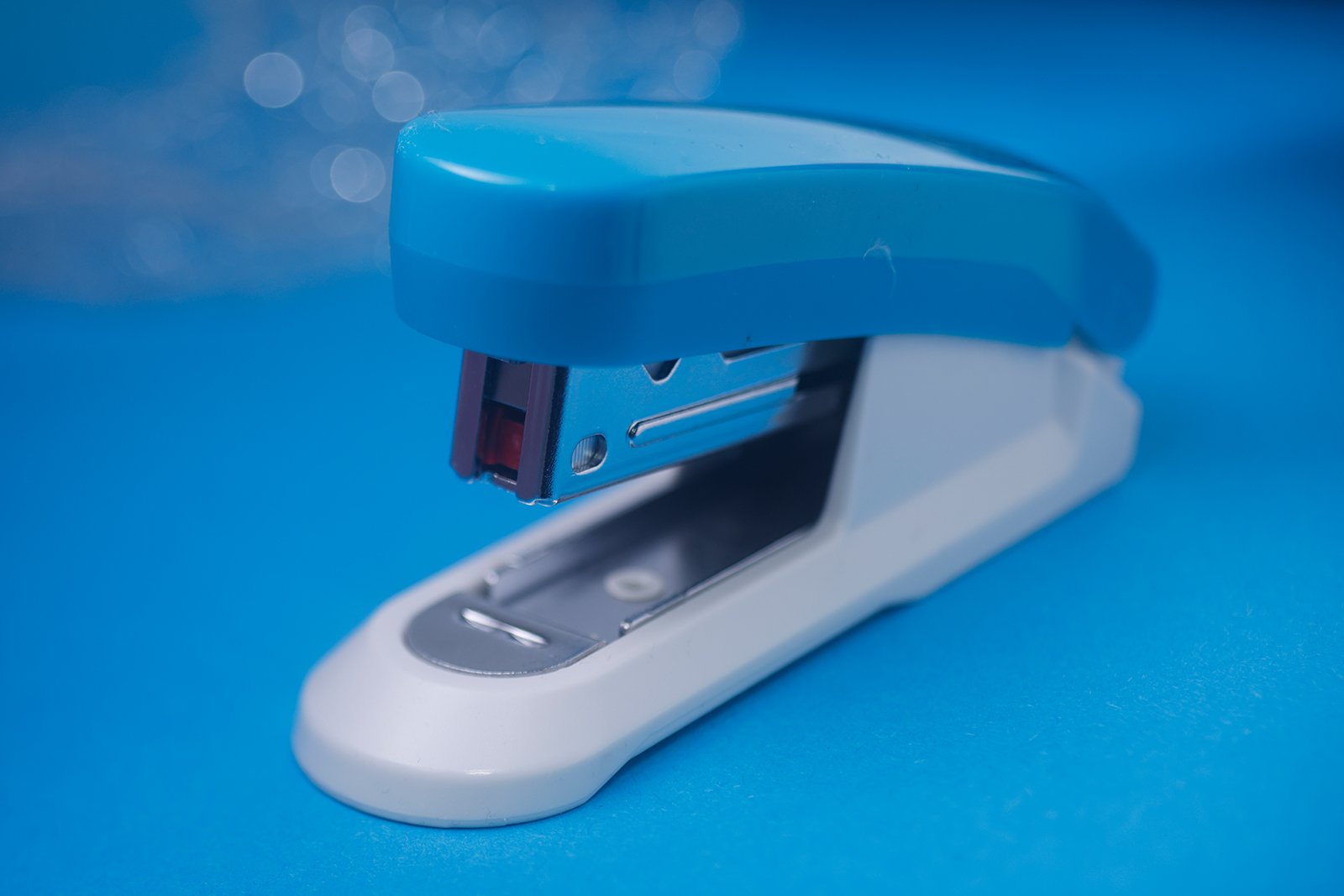
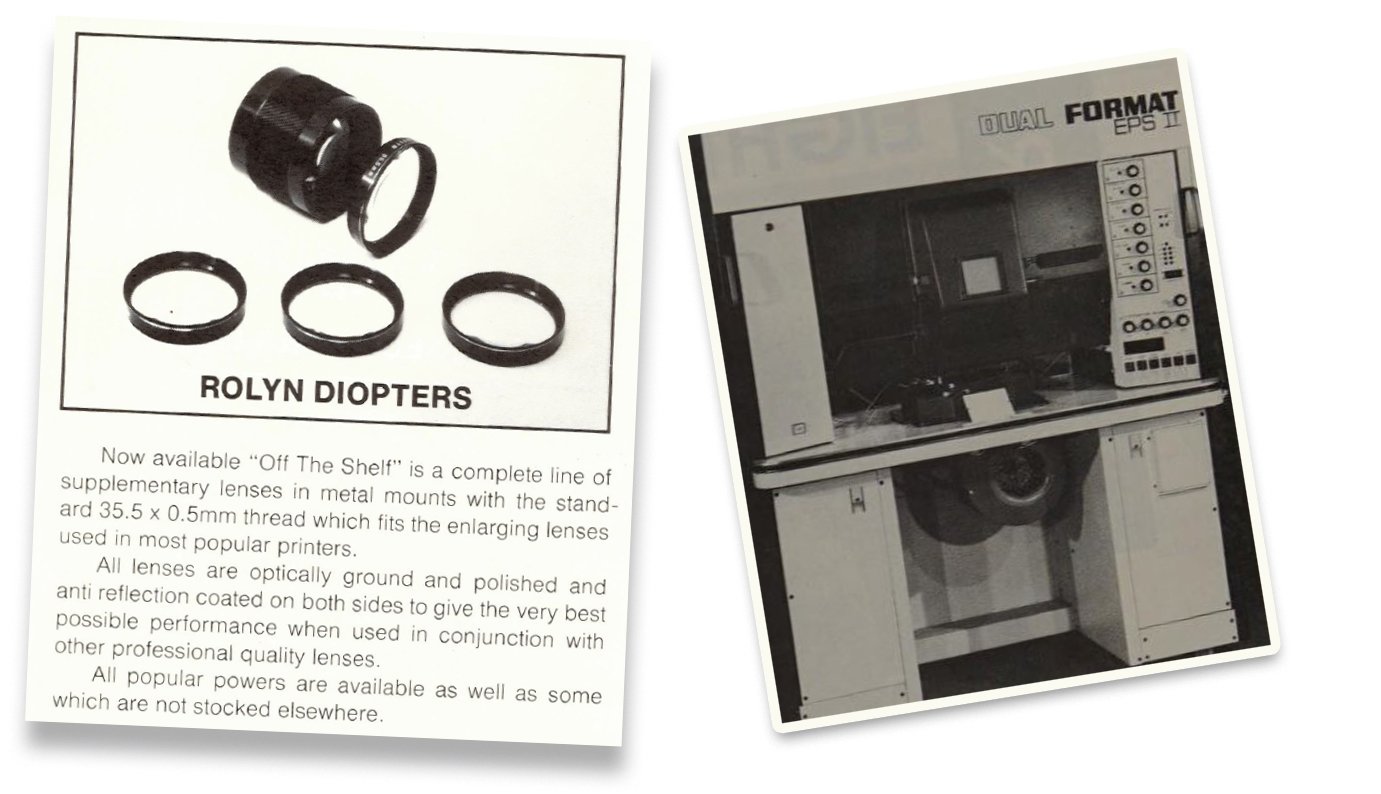
The Rolyn Optical catalog also contains some diopters for a lens which looks very similar to the Color-Coronar. The diopters are described as “…supplementary lenses (…) with the standard 35.5 x 0.5 mm thread, which fits the enlarging lenses used in most popular printers.”
So that pretty much confirms my suspicion. And indeed – the thread on both the Color-Coronar as well as the Pako and Printing-Ektar lenses is 35.5 x 0.5 mm.
Anastigmat Repro-Akmar
One single mention in a surplus-sellers list. There’s no focal length mentioned and the speed of f/1.9 sounds unrealistic, given that Akmar was likely used to describe a 6 elements in 2 groups (Dagor) design, which are not known to be that fast. It could be a typo and mean f/9 which is quite common among Repro-lenses.
Other products
Coronar-Ergänzungslinsen (screw-on lenses)
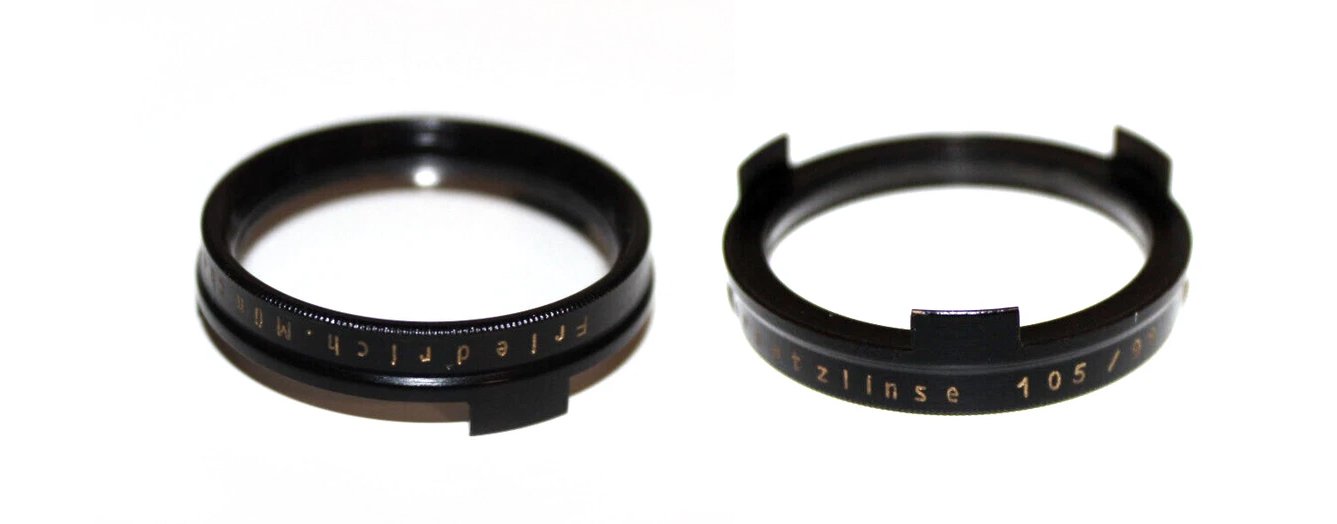
In the book “Kompendium der praktischen Photographie” by Fritz Schmidt these are mentioned as good examples of such screw-on lenses, altering the optical specs of optics though it’s not specified whether they were only available in order to reduce the minimum focusing distance for macro work or altering the focal length as well.
Arri viewfinder
C. Friedrich was apparently also working on for Arri (Arnold Richter), an important maker of cine cameras, also based in Munich:
“The second viewfinder-optic came from Christof Friedrich, who was running a workshop for precision optics and mechanics. (…) At the start of 1960 Friedrich got in contact with Theodor Brendel, an optics constructor, who had worked for Enna and Agfa earlier and at ARRI later on.”
(Translated from this website)
While the work of C. Friedrich on an Arri viewfinder is not particularly relevant for the topic at hand, it seems like this opportunity brought the company in contact with T. Brendel, who later became its owner.
Collimators
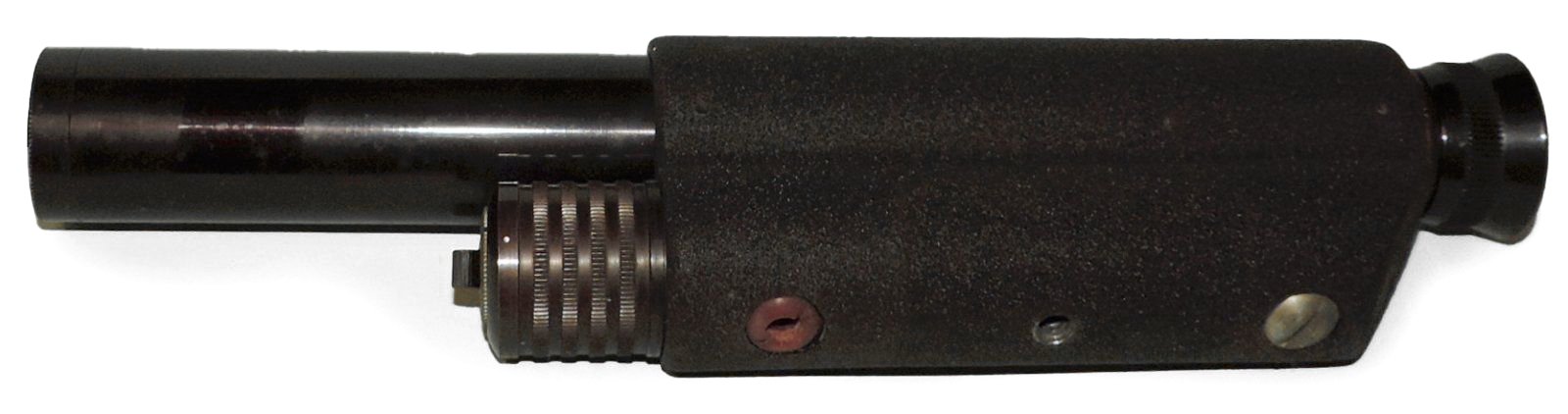
Though not much is known about the specifics and the extent, C. Friedrich also built collimators at some point in time.
Why the big gestures?
Even though a lot of information is still missing, I’m fairly sure this is the most comprehensive writeup on C. Friedrich, the barely known and to most people perhaps not very relevant maker from Munich, Germany. And believe me: If I had found all the stuff I had hoped for in terms of sources and specs, this would be even larger in scale. I’d also prefer to let you know about more applications of these lenses. It would be great to get a glimpse at the additional series I don’t own a single sample of. And it would be awesome to present some more definitive facts from spec sheets, catalogs or magazines… But information has been very scarce on C. Friedrich so far.
Perhaps one day, I’ll find more of what Ive been looking for and can give you a complete overview and share a more thorough experience with these lenses. Until then I hope there’s at least something of interest for you to read through, view and if you feel inspired to investigate yourself, please reach out if you find anything new or interesting!
Because I was so impressed by a couple of the Friedrich lenses and fascinated by its history and connections, I wanted to create this as statement and reminder, that even the work of many of the smaller companies in the vast photographic industry is worthy of being documented and acknowledged.
Big Thanks to…
Nikolaus Brendel, son of Theodor Brendel, who was kind enough to reply to all my questions and gave me some great insights on the company’s later years in Gößweinstein.
Dan Fromm, whose excellent articles gave me the idea to look into Rolyn Optics and who helped me finding a digital copy of their catalog.
John Jovic, creator of the excellent photocornucopia site and Big List of Enlarging Lenses, which sent me on the path of the C. Friedrich lens offerings.
Calvin83 (calvin@lensfever) for all the information he shared as well as the wonderful S-Coronar shots.
Franz Will & Sendlinger Kulturschmiede for sharing information about their local history in Munich
Jamaeolus on mflenses for sharing information and images of the Axinon series.
digifret on the digicamclub forum for the helpful links.
Xu@EVIL Cameras for sharing some wonderful shots on flickr.
aenorton on reddit for the excellent help in regards to Rolyn Optics.
Stupendous research, as always! A real gold mine of information.
Thank you so much! It can be challenging with small manufacturers like that, but it‘s even more fun as well.
The Coronar-D lenses being a symmetrical Dialyte formula (air spaced Dagor) works excellent from 1:1 to infinity focus due to its symmetrical design. Coronar-D in longer focal lengths work very good as sheet film view camera lenses. Very reasonable image quality and performance at their full aperture of f4.5, optimum at about f8, small than f16 lens becomes diffraction limited. The Coronar-D is essentially a classic Dialyte formula APO process lens (Goerz APO atrtar, Rodenstock APO ronar and many others) made using Lanthanum low dispersion glass with a large f4.5 full aperture compared to the traditional f9 and smaller full aperture.
Having used a 360mm f4.5 Coronar-D on a 5×7 Sinar Norma with Sinar shutter, this lens has proven to be surprising good for images that are best with apertures from f4.5 to f11. The full aperture of f4.5 complements the f9 and smaller full aperture Dialyte APO process lenses very nicely.
Can send image of the 360mm f4.5 Coronar-D and sample of B&W images made with this lens.
Thank you very much for that information and your assessment! Would indeed love to see an image of the lens and sample shots if you‘re able to share them – thanks a lot for the offer! I‘ll reach out to via email.
Super article!
Get in touch re Taylor Hobson lenses 👍
Thank you very much – highly appreciated!